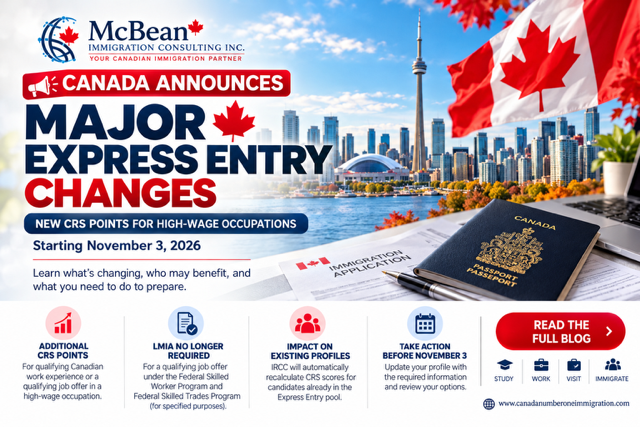
Canada Announces Major Express Entry Changes: New CRS Points for High-Wage Occupations Starting November 3, 2026
Canada Announces Major Express Entry Changes: New CRS Points for High-Wage Occupations Starting November 3, 2026
Published: October 16, 2026
By Minerva McBean, RCIC | McBean Immigration Consulting Inc.
Canada has announced important changes to its Express Entry immigration system that could affect skilled workers hoping to become permanent residents.
On October 16, 2026, Immigration, Refugees and Citizenship Canada (IRCC) announced changes to the Comprehensive Ranking System (CRS), the points-based system used to rank candidates in the Express Entry pool.
Starting November 3, 2026, eligible candidates may receive additional CRS points for qualifying Canadian work experience or a qualifying job offer in a high-wage occupation. IRCC is also changing how certain job offers are assessed, removing the LMIA requirement for specified Express Entry purposes.
For skilled workers already in Canada, foreign workers planning their permanent residence journey, and employers supporting skilled employees, these changes are worth understanding.
Here is what you need to know and what you can do to prepare.
1. What Is Changing Under Express Entry?
Express Entry is Canada’s online application management system for several economic immigration programs, including:
* Federal Skilled Worker Program (FSWP)
* Canadian Experience Class (CEC)
* Federal Skilled Trades Program (FSTP)
* A portion of the Provincial Nominee Program (PNP)
Candidates receive a CRS score based on factors such as age, education, language proficiency, work experience and other qualifying factors. Candidates with competitive scores may receive an Invitation to Apply (ITA) for permanent residence when IRCC conducts an invitation round.
Under the announced changes, IRCC will introduce additional points for candidates with eligible Canadian work experience or a qualifying job offer in a high-wage occupation.
This means that a candidate’s Canadian work experience and qualifying employment circumstances may become even more important when assessing their potential CRS score.
However, the changes do not guarantee an invitation to apply, and candidates must continue to meet the eligibility requirements of the immigration program under which they seek permanent residence.
2. What Is Considered a High-Wage Occupation?
One of the most important details is how IRCC defines a high-wage occupation.
According to the announcement, a high-wage occupation is one in which the occupation’s median wage is at least 1.3 times the median wage of the overall Canadian workforce.
This assessment is based on typical earnings for the occupation, rather than simply the salary an individual candidate currently earns.
Examples of sectors that may include eligible high-wage occupations are:
* Health care
* Skilled trades
* Engineering
* Technology
* Education
Not every occupation within these sectors will necessarily qualify. IRCC will maintain a list of eligible high-wage occupations using Canadian labour market data.
If you work in one of these sectors, do not assume your occupation qualifies without checking the official list and applicable requirements.
3. Will Canadian Work Experience Help You Earn More CRS Points?
Canadian work experience is already an important factor in Express Entry. The announced changes will introduce additional points linked to eligible Canadian work experience in high-wage occupations.
This may be relevant to foreign workers who have established themselves in Canada and are working toward permanent residence.
For example, imagine a foreign worker employed in Canada in an engineering occupation. Depending on the worker’s occupation, qualifying experience, Express Entry program eligibility and the applicable rules, the new system may provide additional CRS points.
The actual effect will depend on the candidate’s circumstances and the final scoring requirements.
If you are already working in Canada, this is an opportunity to review your Express Entry profile and determine whether your work experience could qualify under the new rules.
4. Will You Still Need an LMIA for a Qualifying Job Offer?
This is another significant part of the announcement.
Starting November 3, 2026, an LMIA will no longer be required for a qualifying job offer to receive the new Express Entry points or to meet job-offer requirements under the Federal Skilled Worker Program and Federal Skilled Trades Program.
An LMIA, or Labour Market Impact Assessment, is a document that an employer may need before hiring a foreign worker. It generally assesses the potential impact of hiring a foreign national on the Canadian labour market.
The announced change simplifies specific Express Entry requirements relating to qualifying job offers.
However, there is an important distinction:
This is not a blanket exemption from LMIA requirements for all foreign workers or all Canadian work permits.
Employers and foreign nationals must still comply with the requirements that apply to the relevant work permit and immigration program. IRCC will also continue to assess whether job offers are genuine and meet applicable requirements.
Before an employer changes its hiring arrangements or a foreign worker relies on a job offer for immigration purposes, the specific circumstances should be reviewed.
5. What If You Are Already in the Express Entry Pool?
If you already have an active Express Entry profile, you should pay close attention to the November 3 implementation date.
IRCC has indicated that candidates already in the pool will have their CRS scores automatically recalculated under the new points system.
However, candidates who wish to receive points for a qualifying job offer must update their profiles with the required information before November 3, 2026.
IRCC has also indicated that the recalculation process may take up to two weeks, during which invitation rounds will be paused.
Here are practical steps you can take:
1. Review your existing profile. Confirm that your work history, education, language results and other information remain accurate.
2. Check your job offer details. If you have a job offer that may qualify, review the information and requirements that must be entered in your profile.
3. Assess your occupation. Check the official high-wage occupation list when available and confirm how the new rules apply to your circumstances.
4. Review your immigration program eligibility. A higher CRS score does not replace the need to qualify for an eligible Express Entry program.
5. Monitor official IRCC updates. Confirm the applicable rules before making decisions based on the new system.
Do not enter inaccurate information or claim points for which you do not qualify.
6. What If Your CRS Score Is Currently Too Low?
If your CRS score is not competitive, it may be tempting to wait for the new changes and hope that your score increases.
However, waiting without reviewing your options may not be the best approach.
Your immigration strategy should consider your complete profile, including your age, education, language proficiency, work experience, qualifying job offers and eligibility for relevant immigration programs.
Depending on your circumstances, you may need to explore options such as improving your language test results, obtaining additional qualifying work experience, assessing eligibility for category-based selection or investigating a suitable Provincial Nominee Program.
A provincial nomination through an Express Entry-aligned stream can be particularly significant because it can provide additional CRS points under the applicable rules.
The right strategy will depend on your individual circumstances. No single pathway is suitable for everyone.
7. Does This Mean Permanent Residence Will Become Easier?
Not necessarily.
The announced changes may benefit some candidates, particularly those who qualify under the new high-wage occupation rules. Other candidates may see little or no change to their scores.
Express Entry remains competitive. Meeting the minimum eligibility requirements does not guarantee an invitation, and having a qualifying job offer does not automatically result in permanent residence.
The number of invitations issued, the type of invitation round, the CRS cut-off and the candidate’s eligibility will continue to matter.
The key is to understand how the new rules interact with your individual profile rather than relying on general predictions or social media claims.
8. How McBean Immigration Consulting Inc. Can Help
At McBean Immigration Consulting Inc., we understand that immigration policy changes can create both opportunities and uncertainty.
Our goal is to help individuals and families understand their options, assess their eligibility and make informed decisions about their Canadian immigration journey.
We can assist with reviewing your Express Entry profile, assessing your immigration options, identifying potential areas for improvement and determining whether a provincial nomination or another immigration pathway may be worth exploring.
If you are already in the Express Entry pool, working in Canada or considering applying for permanent residence, now is a good time to review your circumstances.
Do not rely on assumptions about your CRS score. Understand your options and plan accordingly.
Ready to Review Your Express Entry Profile?
Book a consultation with McBean Immigration Consulting Inc. to discuss your circumstances and receive guidance on the immigration options that may be available to you.
Visit: https://canadanumberoneimmigration.com
Follow McBean Immigration Consulting Inc. for immigration updates, practical guidance and important Canadian immigration news.
Immigration information is subject to change. Eligibility and outcomes depend on the applicant’s individual circumstances and the applicable legislation, regulations and program instructions. This article is for general information purposes and does not constitute legal advice or guarantee an immigration outcome.
Official Source
Immigration, Refugees and Citizenship Canada (IRCC): Canada refocusing Express Entry on top talent that drives economic growth, October 16, 2026.
https://www.canada.ca/en/immigration-refugees-citizenship/news/2026/10/canada-refocusing-express-entry-on-top-talent-that-drives-economic-growth.html
Stay Updated
Subscribe to our newsletter for the latest immigration news and tips.