Is BC PNP Tech the Right Immigration Path for You?

If you’re a skilled tech worker with a job offer from a British Columbia employer in an eligible occupation, BC PNP Tech is very likely your fastest route to Canadian permanent residency; learn more about the Skilled Migration Visa process for international professionals. It runs on weekly draws, accepts lower selection scores than most other Canadian pathways, and can add 600 CRS points to your Express Entry profile once you’re nominated.
Your immediate next step is simple: pull up Appendix 1: BC PNP Tech, confirm your job title matches one of the roughly 29 listed occupations at the 5-digit NOC/TEER code level, and verify your employer actually operates in BC. Do that before you touch the BCPNP Online portal.
Three things will disqualify you fast, so rule them out first:
- Your occupation isn’t on Appendix 1, or your employer classified it under the wrong NOC code.
- Your employer has no physical BC presence, no WorkSafeBC account, or doesn’t pay at least the median wage for your occupation.
- Your job offer doesn’t meet the minimum duration rules for your occupation category.
Pro Tip: Don’t rely on your job title alone. Two “software developers” can sit under different NOC codes depending on their actual duties. Ask your employer’s HR team to confirm the exact 5-digit code they intend to declare before you register, because a mismatch here is the single most common cause of wasted weeks.
Key Takeaways
BC PNP Tech works best for skilled tech workers with a genuine BC employer, an Appendix 1 occupation match, and a wage that clears the provincial median.
| Point | Details |
|---|---|
| Verify your NOC code first | Confirm your job matches an Appendix 1 occupation at the exact 5-digit code before registering. |
| Confirm employer BC presence | Check your employer has active WorkSafeBC coverage, provincial tax filings, and a wage meeting the median. |
| Register in BCPNP Online early | Weekly tech draws mean a clean registration can clear in weeks, not months. |
| Decide on EEBC before submitting | Resolve language tests and ECA first, since the EEBC choice can’t be changed later. |
| Get a licensed RCIC review for complex cases | Canada Number One Immigration’s licensed RCIC can catch NOC mismatches and employer documentation gaps before they cause a refusal. |
Table of Contents
- How BC PNP Tech Works Inside the Provincial Nominee Program
- Core Eligibility Checklist for BC PNP Tech
- Which Tech Occupations Qualify Under Appendix 1
- What a Qualifying BC Job Offer Needs to Include
- How to Register and Apply Through BCPNP Online
- Should You Choose Express Entry BC?
- Documents and Fees You’ll Need to Prepare
- How Long Does BC PNP Tech Actually Take?
- What Happens After Your Provincial Nomination
- Common Mistakes That Slow Down or Sink a BC PNP Tech Application
- When a Licensed RCIC Makes a Real Difference
- What the Pattern Behind Most Applications Tells Us
- Get Expert Help With Your BC PNP Tech Application
- Sources
How BC PNP Tech Works Inside the Provincial Nominee Program
BC PNP Tech is a priority processing lane built into the province’s Skills Immigration stream, not a separate program with its own rulebook. It exists because British Columbia’s tech sector kept losing skilled hires to slower federal timelines, so the province carved out weekly, occupation-specific draws instead of making tech workers compete in general draws against every other skilled worker in the province.
The mechanics matter here. BC runs dedicated tech draws on a regular weekly cadence, typically issuing around 300 invitations per draw in 2025 and 2026, with SIRS score cutoffs commonly landing in the lower 90s to low 110s range. Compare that to general Skilled Worker draws, where cutoffs often run from 115 to 130, and you can see why tech workers with modest scores still get invited regularly through this lane.
Once BC nominates you, the payoff compounds. A provincial nomination adds 600 points to your Express Entry Comprehensive Ranking System score, which all but guarantees an Invitation to Apply in the next federal draw, since no other Express Entry candidate can realistically outscore a nomination bump that large.
Who is this actually built for? Employer-sponsored tech workers whose job matches one of the priority occupations in Appendix 1. That includes a meaningful share of hybrid roles, since BC doesn’t require you to sit in an office five days a week. It does require your employer to have a genuine, verifiable BC business presence, which rules out fully remote arrangements with employers based entirely outside the province.

Core Eligibility Checklist for BC PNP Tech
Before you spend hours on a BCPNP Online profile, run through the gatekeeper requirements. Miss any one of these and your registration won’t clear:
- Eligible occupation. Your job must match a 5-digit NOC/TEER code listed on Appendix 1.
- BC-based employer. The company must have an active, established business operation physically located in British Columbia.
- Qualifying job offer. The wage must meet or exceed the provincial median for your occupation, and the offer duration must satisfy BC’s minimum term requirements.
- Work experience. Most applicants need at least two years of full-time, paid, skilled work experience directly related to the job offer, gained within roughly the last five years.
- Language and education. You need proof of language ability appropriate to your occupation’s skill level, plus education credentials (or an Educational Credential Assessment if your degree is foreign).
The two-year work experience rule trips up more applicants than any other line item. BC wants documented, verifiable evidence: reference letters on company letterhead stating your job title, duties, dates of employment, and hours worked per week, not just a résumé claim. Pay stubs, T4 slips, or foreign equivalents help corroborate the letters.
Here’s where Appendix 1 diverges from the rest of Skills Immigration: several priority tech occupations don’t require an indeterminate (permanent) job offer. A fixed-term offer of at least one year can qualify, provided it meets the duration and time-remaining criteria BC sets for those roles. That exception alone makes the Tech stream meaningfully more accessible to contract-heavy tech employers than general Skills Immigration streams.
Which Tech Occupations Qualify Under Appendix 1
Appendix 1 lists roughly 29 priority technology occupations, and the only reliable way to confirm your eligibility is to check the province’s own PDF against your job’s exact 5-digit NOC or TEER code, not the job title on your business card.
BC assesses eligibility at that 5-digit level specifically because two jobs with similar titles can fall under completely different codes depending on actual day-to-day duties. Your employer is the one who declares the NOC code during registration, so the accuracy of that declaration rests almost entirely on how well they understand your role against the official code descriptions.
Here’s how common tech roles typically sort under Appendix 1:
| Job Type | Typically Eligible? | Notes |
|---|---|---|
| Software developers and programmers | Yes | Core priority occupation, high volume of nominations |
| Data scientists and data analysts | Yes | Included where the role meets the specific TEER threshold |
| Systems administrators | Yes | Must match network/systems TEER code precisely |
| UX/UI designers | Yes | Eligible when duties center on user experience design, not general graphic design |
| Computer and network hardware engineers | Often no | Hardware-focused roles frequently fall outside the priority list |
| General IT help desk or support technicians | Often no | Many entry-level support roles sit below the eligible TEER threshold |
Borderline cases are common in tech because job titles evolve faster than official occupation classifications. A “product engineer” who spends most of their time writing code might qualify under a software development code, while the same title at a different company might lean hardware and fall outside Appendix 1 entirely.
Pro Tip: If your role blends duties across two possible NOC codes, ask your employer which set of responsibilities consumes the majority of your working hours. BC PNP officers weigh the primary duties described in your job offer letter and reference letters, so the wording your employer uses matters as much as the actual work you do.
What a Qualifying BC Job Offer Needs to Include
Your employer needs to be established in British Columbia, and BC wants proof: an active WorkSafeBC account, provincial tax filings, and a wage offer that meets or exceeds the provincial median for your specific occupation. This isn’t a formality. BC actively verifies these details, and employers with no payroll history or a shell-like presence get flagged during review.
For most Skills Immigration streams, the job offer needs to be indeterminate, meaning ongoing with no fixed end date. Priority tech occupations get an exception: a fixed-term offer meeting BC’s minimum duration and remaining time criteria can qualify. That single rule change is why so many tech workers on contract or project-based arrangements can still use this stream when they’d be shut out of general Skills Immigration.
Employers carry real obligations here too. They typically need to:
- Register as an employer within BCPNP Online and complete an employer profile.
- Provide a signed offer of employment letter detailing wage, hours, duties, and duration.
- Submit supporting documentation proving BC business operations, including WorkSafeBC coverage and provincial payroll records.
- Respond to any BC PNP requests for clarification or additional verification during processing.
Pro Tip: If your role is remote or hybrid, make sure your offer letter explicitly states your reporting location and confirms the employer’s BC office as your base of employment. Vague language about “remote work” without a clear BC anchor is one of the fastest ways to trigger a request for more information.
How to Register and Apply Through BCPNP Online
The process runs in a fixed sequence, and skipping steps doesn’t speed anything up. Here’s the order:
- Create a profile in BCPNP Online, the only portal BC accepts registrations and applications through.
- Submit your registration under the Tech stream, entering your job offer details, wage, occupation code, and personal information so the system calculates your SIRS score.
- Wait for a tech-specific draw. BC issues invitations weekly, and your registration stays active while you wait, though you can update it if your circumstances change.
- Receive an Invitation to Apply (ITA) if your SIRS score clears that week’s cutoff.
- Submit a full application within the deadline stated in your invitation, including all required documents and the application fee.
Your SIRS score depends heavily on the wage offered, BC-specific work experience, education level, and language ability. Tech draws have historically accepted SIRS scores between roughly 90 and 110, noticeably lower than general Skilled Worker draw cutoffs of 115 to 130. That gap is the whole reason so many tech applicants specifically target this stream instead of registering under general Skills Immigration.
A word of caution: registrations don’t sit passively forever. If your job offer, wage, or work experience changes, update your registration immediately, because an outdated registration that generates an ITA based on stale information can lead to a refused application later. And if you receive an invitation and let the deadline pass without submitting, you lose that invitation and have to wait for your registration to clear a future draw.
Should You Choose Express Entry BC?
Express Entry BC (EEBC) is worth selecting if you already meet the minimum entry criteria for a federal Express Entry program (Federal Skilled Worker, Federal Skilled Trades, or Canadian Experience Class) and you want the fastest possible route to permanent residency after nomination.
Here’s why it matters so much: a BC nomination adds 600 CRS points regardless of which option you choose, but EEBC routes your application through the Express Entry system from the start, which generally means faster federal processing once you’re nominated, since your profile is already sitting in the federal pool. Non-EEBC nominees still apply for PR through a paper-based process that typically takes longer.
The tradeoff is stricter eligibility at the front end. EEBC requires:
- An active Express Entry profile that already meets a federal program’s minimum requirements.
- Language test results that satisfy the federal program’s minimum benchmark, not just BC’s provincial minimum.
- An Educational Credential Assessment for any foreign degree, since federal programs require it even when BC’s base stream doesn’t.
Once you select Express Entry BC on your registration, that choice is locked in. You cannot convert a non-EEBC registration to EEBC later, and you cannot switch back. If your language test results or ECA aren’t finalized yet, decide carefully before you submit, because a rushed choice here can cost you months.
Resolve your language testing and ECA before you register if you’re leaning toward EEBC. Applicants who register without EEBC because their documents weren’t ready, then later qualify federally, often find themselves stuck completing the slower non-EEBC process anyway.
Documents and Fees You’ll Need to Prepare
Start gathering these long before you expect an invitation, because scrambling after an ITA arrives eats into your response window. Core documents include:
- Signed job offer letter meeting BC’s wage and duration requirements.
- Employer support documentation, including proof of BC business operations.
- Reference letters and pay evidence covering your qualifying work experience.
- Education credentials, or an ECA if your degree was earned outside Canada.
- Language test results from an approved testing body.
- Valid passport and other identity documents.
- Police certificates covering every country you’ve lived in for six months or more since age 18.
- Medical exam results, though these typically come later, often at the federal PR stage rather than the provincial nomination stage.
On the employer side, BC frequently requests payroll records, active WorkSafeBC account confirmation, and provincial business tax filings to verify the company genuinely operates in British Columbia and isn’t simply issuing paper offers.
Fees get paid directly through BCPNP Online once you submit your full application after receiving an ITA. Never send payment or documents by email. BC’s Technical Guide is explicit that the portal is the only accepted channel, and communications outside it are a common source of fraud attempts targeting applicants.
Beyond the provincial fee, budget for federal costs at the PR stage, including the Right of Permanent Residence Fee and biometrics, which apply regardless of which provincial stream nominated you.
How Long Does BC PNP Tech Actually Take?
Realistic timelines run in stages, and each stage has its own bottleneck. Here’s what the full path typically looks like from registration to landing:
| Stage | Typical Timeframe |
|---|---|
| Registration to receiving an ITA | Days to a few months, depending on your SIRS score relative to weekly cutoffs |
| Full application processing after ITA | Several weeks to a few months |
| Nomination to federal Express Entry ITA | Days to a few weeks, especially strong under EEBC |
| Federal PR processing after federal ITA | Several months |
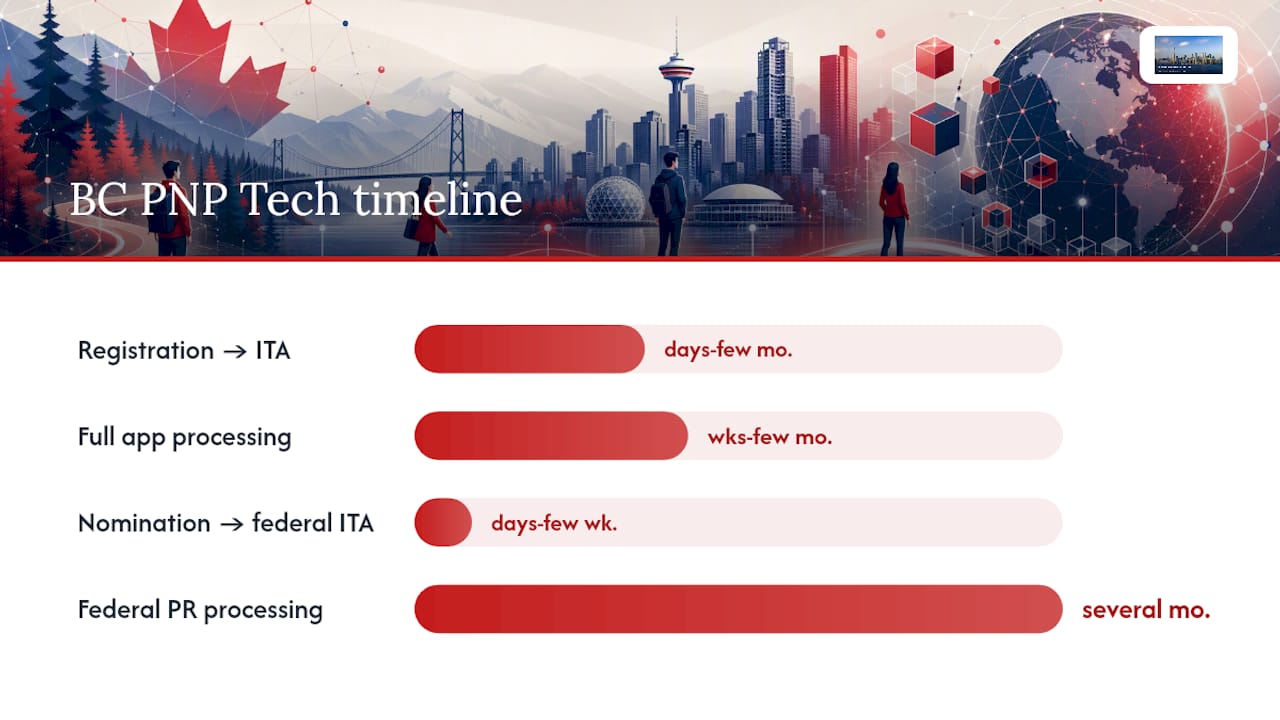
The weekly tech-draw cadence is what makes the front end faster than most alternatives. Because BC issues invitations roughly every week rather than every few months, a strong registration can clear in a matter of weeks instead of sitting idle for a full quarter waiting on a single annual or biannual draw cycle, which is common in some other provincial programs.
The realistic average case still involves patience. Your SIRS score, the volume of competing registrations that week, and how quickly your employer supplies verification documents all shape where you land on that range. Fastest-case applicants tend to have unusually strong wages, clean documentation ready on day one, and employers who respond to verification requests within days rather than weeks.
What Happens After Your Provincial Nomination
Once BC nominates you, the clock starts running. You generally have around six months from the nomination date to either upload it into your Express Entry profile or submit your federal permanent residence application to IRCC, so don’t sit on this step.
Your nomination adds 600 CRS points immediately, and if you’re in the Express Entry pool, you’ll very likely receive a federal Invitation to Apply in the next draw. Firm-published draw summaries show how consistently this plays out; a recent Express Entry round invited 277 PNP-nominated candidates in a single draw, illustrating how reliably nominated candidates get pulled once they’re in the pool.
While your federal PR application processes, you’ll likely need a bridge on the work permit side. Options include applying for an employer-specific work permit tied to your nomination, or porting and extending an existing work permit if you’re already working in Canada. Timing matters here, since gaps in valid status create complications that are far harder to fix after the fact than to prevent beforehand.
Pro Tip: Start collecting police certificates and booking your medical exam as soon as you’re nominated, not after your ITA arrives. Police certificates from certain countries can take weeks or months to process, and a slow certificate is one of the most common reasons applicants miss their federal application deadline.
Common Mistakes That Slow Down or Sink a BC PNP Tech Application
Most refusals and delays trace back to a small handful of preventable errors. Watch for:
- Incorrect NOC classification. Declaring the wrong 5-digit code, whether by accident or by stretching a job description to fit Appendix 1, is the single most common cause of rejected registrations.
- Employer that doesn’t meet BC presence tests. No active WorkSafeBC account, no verifiable payroll, or a registered address that turns out to be a mail drop.
- Wage below the provincial median. Even a small shortfall against the median wage for your occupation can disqualify an otherwise strong offer.
- Incomplete or inconsistent documentation. Mismatched dates between your offer letter and reference letters, or missing pages in supporting files.
Mitigating these is mostly about discipline, not luck. Have your employer pull the exact NOC code description from the official classification system and compare it line by line against your actual duties before registering. If your wage sits close to the median, ask your employer whether they can round up, since a marginal wage gap is an easy fix before submission but a hard rejection after.
Red flags that trigger deeper verification include employer information that doesn’t match public business registries, job offers issued shortly after a company’s incorporation date, and wage offers that seem unusually high relative to the role. None of these automatically sink an application, but they invite scrutiny that slows everything down.
Pro Tip: If your SIRS score is sitting just below recent cutoffs, ask whether your employer can adjust the wage offer upward or whether you can document additional BC-specific work experience before registering. Small, honest adjustments to your registration inputs can be the difference between clearing a cutoff and waiting months for the next favorable draw.
When a Licensed RCIC Makes a Real Difference
A licensed Regulated Canadian Immigration Consultant earns their fee where the process stops being straightforward: ambiguous NOC classification, employer verification issues, or a situation where choosing between EEBC and the standard route isn’t obvious from the guide alone.
Services a licensed RCIC typically handles include a full eligibility assessment against Appendix 1 and current SIRS trends, preparing and reviewing employer support documentation before submission, filing the registration and application through BCPNP Online, managing post-nomination steps including the Express Entry transition, and communicating directly with BC PNP on your behalf if questions arise during review.
You don’t need professional help for every case. If your occupation clearly matches Appendix 1, your employer has clean records, and your wage comfortably clears the median, a well-organized applicant can often handle registration independently. Hire help when your employer situation is complicated (multiple business locations, recent incorporation, unclear payroll history), when your job duties straddle two possible NOC codes, or when you’ve already faced a refusal or a request for additional verification that you’re unsure how to answer.
Minerva McCoon McBean, the licensed RCIC leading Canada Number One Immigration, works through exactly these ambiguous cases regularly, and the firm’s services page outlines how that support gets structured for tech applicants specifically.
What the Pattern Behind Most Applications Tells Us
The cases that stall almost always share one trait: someone assumed their job title was close enough to an Appendix 1 occupation without checking the actual NOC description line by line. It’s an understandable mistake. Job titles in tech shift constantly, and nobody expects a “platform engineer” to need a classification lookup before applying for immigration. But BC doesn’t nominate job titles. It nominates verified NOC codes attached to verified employers.
The realistic timeline surprises people too, usually in a good way. Applicants who expect a years-long wait, because that’s the reputation Canadian immigration carries broadly, are often caught off guard by how quickly a clean tech registration can clear a weekly draw. The bottleneck isn’t usually the government’s processing speed. It’s how long it takes an applicant and employer to assemble clean, consistent documentation before they even register.
Where a consultant adds the most value isn’t filling out forms. It’s catching the mismatch between a job description and its NOC code before submission, and knowing which employer documentation gaps are minor versus which ones will trigger a formal request for information that costs weeks. That’s judgment built from seeing the same handful of failure patterns repeat across different employers and different applicants.
Get Expert Help With Your BC PNP Tech Application
Reading Appendix 1 correctly and assembling airtight employer documentation is doable on your own, but it’s also exactly where a small error costs you months, not days. Canada Number One Immigration offers a straightforward path around that risk: a direct eligibility review from a licensed RCIC before you register, so you find out whether your NOC classification and employer profile will actually hold up under BC’s scrutiny, instead of finding out after a refusal.
If your case involves a fixed-term contract, a hybrid work arrangement, or an employer with a complicated corporate structure, that’s precisely where independent guidance pays for itself. Review the firm’s immigration consulting services and fee structure, then book a consultation to get your NOC code and employer documentation checked before you submit your BCPNP Online registration.
Sources
Cross-check every claim in this guide against BC’s own published materials before you register, since program details do get updated.
Consult each source directly at the time you apply, since fee amounts, wage medians, and occupation lists get revised periodically, and this article should not replace a direct read of BC’s current published guidance or advice from a licensed immigration professional for your specific circumstances.
This article is general information, not a substitute for advice from a qualified lawyer. Consult a qualified legal professional about your own circumstances before acting on anything here.
Recommended
- Canada invites PNP candidates in latest Express Entry draw | McBean Immigration
- Canadian Immigration Blog | McBean Immigration
- Canadian Immigration Programs to Target in 2026 | McBean Immigration
- Canada Announces New TR-to-PR Pathway in 2026: A New Opportunity for Temporary Workers | McBean Immigration
Stay Updated
Subscribe to our newsletter for the latest immigration news and tips.