Citizenship Application Checklist for Canadian Permanent Residents

Your package needs one thing on top: the validated CIT 0002 application with its barcode page, followed immediately by the completed CIT 0007 document checklist. Behind those two forms, IRCC expects your Online Physical Presence Calculator printout (dated to match your signature), copies of every used passport and travel document page covering your eligibility period, two citizenship photos, proof of language ability if you’re between 18 and 54, evidence of your permanent resident status, two pieces of personal ID, tax-filing proof, police certificates if requested, and your fee payment receipt.
Two things to do right now, before you gather another document. First, confirm you have the current version of both forms and click “Validate” in the PDF to generate your barcode page. Second, run the Online Physical Presence Calculator using the exact date you intend to sign your application, then print the results.
Pro Tip: Staple or clip nothing until the barcode page and the completed CIT 0007 are sitting on top of the stack. That’s the first thing an intake officer sees, and it sets the tone for how the rest of your package gets read.
Key Takeaways
A complete Canadian citizenship application succeeds or fails on form currency, signature-date synchronization, and document order, not on how thorough the applicant feels.
| Point | Details |
|---|---|
| Lead with the barcode page | Place the validated CIT 0002 barcode page and completed CIT 0007 on top of every package. |
| Sync your dates | Use the same date on your signed application and your Online Physical Presence Calculator printout. |
| Meet the physical presence rule | Confirm sufficient days of physical presence in Canada, including an appropriate duration as a permanent resident, within the five years before signing. |
| Don’t skip language proof | Applicants aged 18 to 54 need LINC/CLIC records, accepted test results, or education proof in English or French. |
| Get complex files reviewed | Canada Number One Immigration’s licensed RCIC review catches form-version and document-order errors before mailing. |
Table of Contents
- What Documents Go in a Citizenship Application Checklist?
- How Do You Fill Out and Validate the CIT 0002 Form?
- How Do You Prove Physical Presence for 1,095 Days?
- What Language Proof Do You Need for Citizenship?
- Photo, Translation, and Police Certificate Rules
- Where and How Do You Submit a Citizenship Application?
- Why Do Citizenship Applications Get Returned?
- When Should You Hire a Licensed Immigration Consultant?
- A Forms-First Approach Actually Works
- Get Your Citizenship Package Reviewed Before You Mail It
- Frequently Asked Questions
- Sources
What Documents Go in a Citizenship Application Checklist?
Think of the CIT 0007 as your packing order, not just a checklist. It tells IRCC intake staff what should be in the envelope and roughly what order to expect it in, which is exactly why your own citizenship application checklist should mirror it document for document.
Required for every adult applicant:
- Signed and validated CIT 0002 application form, with the barcode page attached
- Completed CIT 0007 document checklist
- Proof of permanent resident status (PR card or Confirmation of Permanent Residence)
- Copies of passport and travel document pages covering your entire eligibility period
- Two citizenship photos meeting IRCC’s specifications
- Two pieces of personal identification
- Proof of application fee payment
Age-dependent and conditional documents:
- Language proof and, where applicable, evidence tied to the citizenship test, required for applicants aged 18 to 54
- Tax-filing proof, such as Canada Revenue Agency notices of assessment or filed returns, for the years IRCC specifies
- Police certificates, if IRCC requests them or if you lived outside Canada during part of the eligibility window
- Certified translations for any document not already in English or French
Special-case documents:
- Use of a Representative (IMM 5476), if someone is being paid to help with your file
- Residence Outside Canada (CIT 0177), for applicants who spent time abroad tied to a Canadian employer or accompanying a Canadian spouse
- Legal documents for any name or date-of-birth change
- Waivers or supporting medical documentation, where an exemption applies
Complete citizenship application documents, according to one compiled checklist reference, consistently include these same core items: CIT 0002, CIT 0007, passport photocopies, two photos, language proof, two IDs, and the fee receipt.
Pro Tip: Photocopy your passport pages in color, even the blank ones bearing entry or exit stamps. Black-and-white copies of stamps are one of the quiet reasons files get flagged for more information.
How Do You Fill Out and Validate the CIT 0002 Form?
Check the lower-left corner of your CIT 0002 and CIT 0007 forms before you type a single word. IRCC updates these forms periodically, and an outdated version is grounds for the whole package to come back to you unprocessed, sometimes months after you mailed it.
- Download the current forms directly from the application forms and guides page rather than reusing a saved copy from a previous attempt.
- Fill out the PDF on a computer, not by hand, then click the Validate button. This generates a barcode page that IRCC’s system uses to scan and route your file.
- Print the barcode page, place it on top of your package, and sign the paper copy by hand. A digital signature does not satisfy the paper submission requirement.
Pro Tip: Sign the printed application on the same date you plug into the physical presence calculator. A mismatch between those two dates is a small clerical slip that causes outsized delays.
How Do You Prove Physical Presence for 1,095 Days?
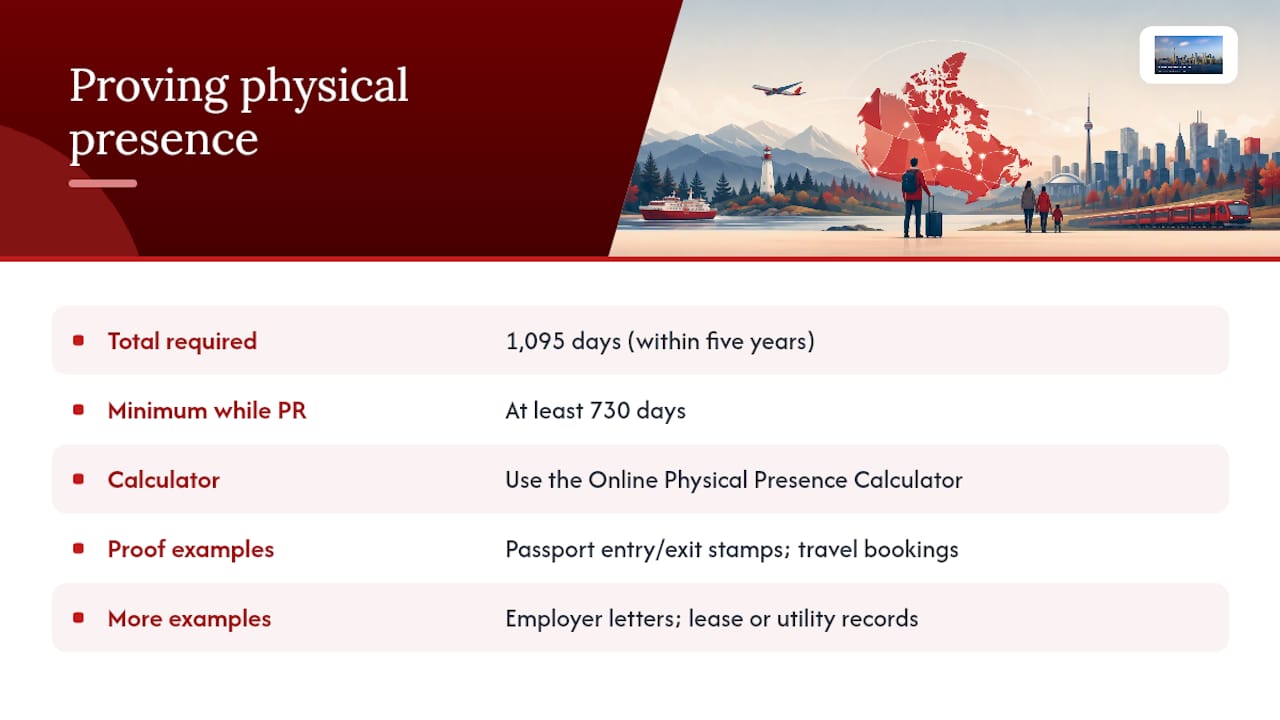
You need 1,095 days of physical presence in Canada within the five years immediately before you sign your application, and at least 730 of those days must have been while you held permanent resident status. That’s the whole rule. What trips people up is proving it cleanly.
Use the Online Physical Presence Calculator and, again, enter the exact date you’ll sign your application. Print the output and slot it into your package near the front, right after your forms. Supporting evidence worth keeping handy includes passport entry and exit stamps, flight or travel booking confirmations, employer letters covering your work dates, and lease or utility records showing you were living in Canada during the period claimed. Keep the originals in your own file; the copies go to IRCC.
What Language Proof Do You Need for Citizenship?
If you’re between 18 and 54 on the day you sign your application, you must show adequate knowledge of English or French. Acceptable language proof generally falls into three categories: LINC or CLIC program transcripts, results from an accepted third-party language test, or documentation of completed education conducted in English or French.
- Attach clean, legible copies of whichever certificate or transcript applies to you
- If your evidence uses program shorthand or abbreviations, add a short cover note explaining what it means
Pro Tip: If your language evidence feels borderline, don’t rely on a single document. Pairing a LINC transcript with a secondary school transcript in English or French gives an officer two independent reasons to accept your file the first time.
Photo, Translation, and Police Certificate Rules
Your two citizenship photos must follow IRCC’s photograph specifications precisely, covering size, background color, and how recently the photo was taken. A photo that passes for a passport application won’t automatically pass here.
- Any document not already in English or French needs a certified translation, plus the translator’s signed statement attesting to accuracy. A translation from a family member, however fluent, does not meet this standard.
- If you lived outside Canada during part of your eligibility period, or IRCC specifically requests it, include a police certificate for that country along with a certified translation if the original isn’t in English or French.
Where and How Do You Submit a Citizenship Application?
Pay the application fee and keep proof of that payment inside your package, whether that’s a receipt from an online transaction or a printed confirmation. Missing fee proof is one of the more avoidable reasons a file stalls at intake.
Most applicants can apply online now, but paper submission is still mandatory for some applicants, including certain birth-date ranges and specific immigration histories. Check current IRCC guidance before assuming either method applies to you.
- If applying on paper, include the payment receipt and barcode page as described above
- If applying online, upload document copies exactly as the portal specifies, since the same completeness standard applies either way
Why Do Citizenship Applications Get Returned?
IRCC only considers a file “received” once it’s complete. An application missing even one required piece typically gets returned rather than processed with a note. The repeat offenders are predictable:
- Using an outdated CIT 0002 or CIT 0007 form version
- Missing the validated barcode page entirely
- A signature date that doesn’t match the physical presence calculator printout
- Missing certified translations for foreign-language documents
- Incomplete passport page copies that don’t cover the full eligibility period
- No fee payment receipt included
- An incomplete or unsigned CIT 0007 checklist
Stack your package in this order before sealing the envelope:
- Barcode page from your validated CIT 0002
- Completed CIT 0007 checklist
- Proof of PR status
- Physical presence calculator printout
- Passport and travel document copies
- Photos, language proof, and remaining supporting documents in the order CIT 0007 lists them
- Fee payment receipt
When Should You Hire a Licensed Immigration Consultant?
Some files carry more risk than a straightforward checklist can manage. Complicated travel histories spanning a dozen countries, a PR status period with unclear gaps, missing original documents from decades ago, a prior refusal on your record, or a stack of documents that all need certified translation are the situations where a second set of trained eyes pays for itself.
A missed form version, an unsynchronized signature date, or a document placed out of CIT 0007’s expected order can each independently trigger a return, and none of those errors are visible to someone looking at their own file for the first time.
Canada Number One Immigration, led by licensed RCIC Minerva McCoon McBean, works with applicants on exactly these files. Regulated representation means someone is checking form currency, confirming your dates line up, and building your stack to IRCC’s expected order before it ever reaches a mailbox.
Pro Tip: If you’ve been refused once before on any Canadian immigration application, treat that as a signal to get a professional review this time, not just a more careful DIY attempt.
A Forms-First Approach Actually Works
I’ve watched enough files get bounced over a wrong form date or a mismatched signature to believe the forms-first approach isn’t overcautious, it’s just accurate. My work with Canada Number One Immigration keeps coming back to the same lesson: the checklist itself prevents more delays than any amount of general advice about “being thorough.”
Get Your Citizenship Package Reviewed Before You Mail It
A DIY citizenship application checklist gets you most of the way there, but the errors that cause returns tend to be the ones you can’t see in your own paperwork. Canada Number One Immigration offers a paid application review that checks your form versions, confirms your signature date lines up with your physical presence calculator printout, verifies your document order against CIT 0007, and, where needed, provides full representation with IRCC.

If you’d rather have a licensed RCIC assemble and check your package than risk a return months from now, start with our citizenship application services page to see what a paid review includes, or check current consultation fees before you book.
Frequently Asked Questions
How many documents does a citizenship application checklist require?
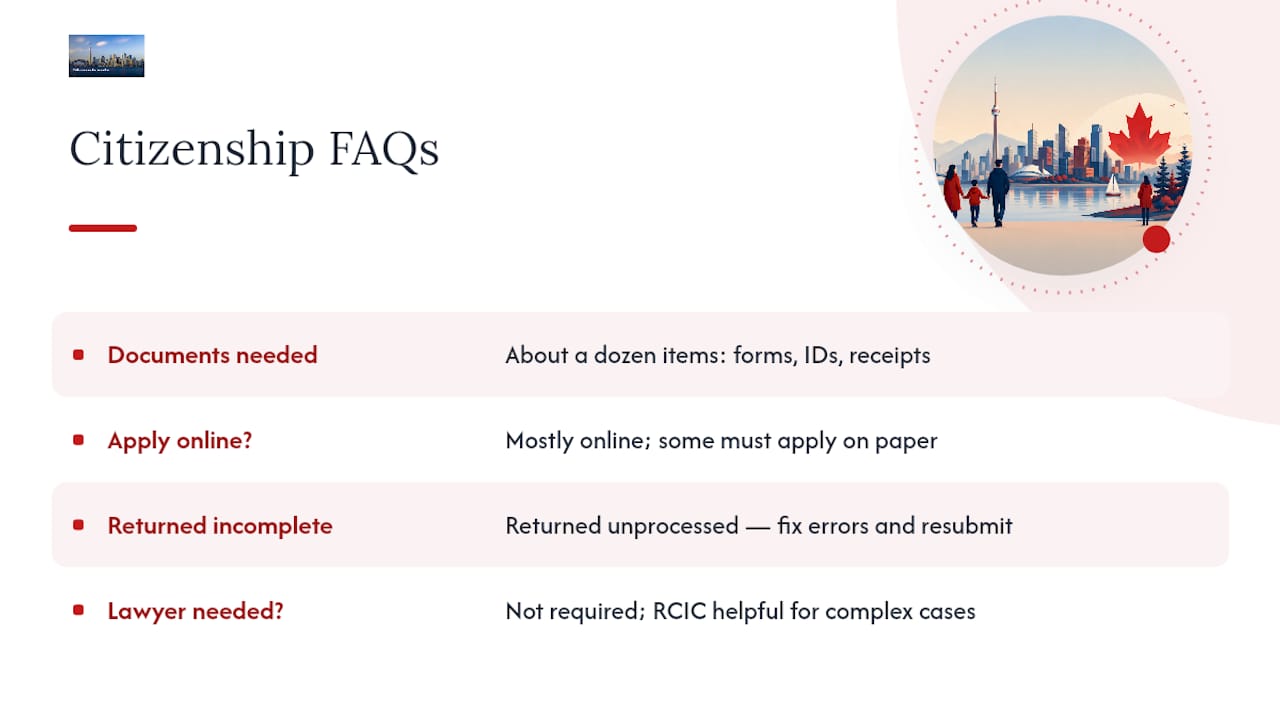
The core package requires roughly a dozen items: the CIT 0002 form with barcode page, CIT 0007 checklist, PR status proof, passport copies, two photos, two IDs, a fee receipt, and, depending on your age and history, language proof, tax evidence, and police certificates.
Can I apply for Canadian citizenship online?
Most applicants can apply online, but some, based on specific birth dates or immigration histories, must still apply on paper. Check current eligibility guidance before choosing a method.
What happens if IRCC returns my application as incomplete?
Your package comes back unprocessed rather than denied. You correct the missing item, an outdated form, a translation, a mismatched date, and resubmit. Fixing the root cause before resending matters more than resending quickly.
Do I need a lawyer or consultant to apply for citizenship?
No, but a licensed RCIC becomes genuinely useful when your file involves complicated travel history, unclear PR status periods, or a previous refusal. Canada Number One Immigration offers paid reviews for exactly these situations.
This article is general information, not a substitute for advice from a qualified lawyer. Consult a qualified legal professional about your own circumstances before acting on anything here.
Sources
Recommended
- Canadian Citizenship Applications | McBean Immigration
- Navigating the Canadian Immigration System: A Guide for Newcomers | McBean Immigration
- Navigating Canada’s Revised Visitor Visa Guidelines | McBean Immigration
- Canada’s May 4th TR to PR Announcement: What Temporary Residents Need to Know | McBean Immigration
Stay Updated
Subscribe to our newsletter for the latest immigration news and tips.