Avoid Returned Files: Pick 5(2) or 5(1) for Canadian Minor Citizenship

Yes, a minor can apply for Canadian citizenship, and the fastest way to a clean approval is picking the right lane before you fill in a single field. Choose Minor 5(2) if the child has a Canadian parent, or Minor 5(1) if they don’t. Either way, the processing fee is $100(https://www.canada.ca/en/immigration-refugees-citizenship/services/canadian-citizenship/adult-minor/who/minor-types.html), and your first move is confirming the child’s permanent resident status before opening the corresponding form.
TL;DR:
- Applicants under Minor 5(2) must have a Canadian parent or parent applying for citizenship simultaneously, while Minor 5(1) applies when no parent is Canadian or applying.
- The child’s PR status must be finalized, with at least 1,095 days of physical presence in Canada if applying under 5(1), and any foreign residence considered at half days.
- All eligibility checks, signatures, and supporting documents must be accurate and current the day before signing; incomplete or incorrect forms cause delays.
- Use the correct form (CIT 0003 or CIT 0403), gather all documents in advance, and respond quickly to IRCC requests to avoid processing delays.
- Professional assistance is highly recommended in complex cases such as split custody, gaps in PR history, or physical presence calculations to prevent costly application returns.
Table of Contents
- Which Minor Pathway Applies: 5(2) Versus 5(1)?
- Eligibility Essentials: PR Status, Presence, Taxes, and Signatures
- Forms and Supporting Documents to Gather Before You Start
- How to Apply Step by Step: Online Versus Paper
- Fees, Processing Times, and Why Applications Get Delayed
- Common Mistakes and a Quick Pre-Submit Checklist
- When to Bring in a Licensed RCIC for a Minor’s Case
- Get Your Child’s Citizenship Application Right the First Time
- Official IRCC Links Worth Bookmarking
- Sources
Which Minor Pathway Applies: 5(2) Versus 5(1)?
The two pathways exist because the child’s connection to a Canadian parent changes what has to be proven. Get this wrong and IRCC sends the whole package back, which is one of the most common reasons minor applications stall.
- Minor 5(2): used when the child has a Canadian parent, or when a parent is applying for citizenship at the same time as the child. The parent’s citizenship status essentially carries the case.
- Minor 5(1): used when the child has no Canadian parent, or no parent applying alongside them. Here, the child’s own physical presence and tax history in Canada carry the case instead.
A quick example: if a permanent resident mother became a Canadian citizen last year and her 10-year-old son is still a PR, he almost certainly qualifies under 5(2), since her citizenship establishes his eligibility. But if both parents are permanent residents with no citizenship application of their own in progress, the child has to qualify independently under Minor 5(1), which means the physical presence clock starts to matter a great deal.
Eligibility Essentials: PR Status, Presence, Taxes, and Signatures
Before anyone signs anything, four boxes need to be checked, and they need to be checked as of the day before signing, not the day you started gathering paperwork.
- Permanent resident status. The minor must hold PR status at the time of application. A pending PR application doesn’t count; approval has to be final.
- Physical presence (5(1) only). The child needs at least 1,095 days of physical presence in Canada within the five years immediately before signing. Time spent in Canada as a temporary resident or protected person before becoming a PR can count, but only at half a day per day, capped at 365 days total.
- Tax filing. Where applicable, the minor may need to have filed income taxes for at least three of those five years. Most children have no income to report, but if there’s any doubt, check it before submitting.
- Signatures and oath. Minors aged 14 to 17 must co-sign the application themselves and must take the Oath of Citizenship. Kids under 14 don’t sign and don’t take the oath, though they can attend the ceremony.
Every one of these has to hold true the day before you sign the form, not just at some point during the process. IRCC checks the timeline closely, and a PR card that lapses two weeks before signing can undo months of preparation.
Forms and Supporting Documents to Gather Before You Start
Half of the delays parents run into come down to one missing signature or one document nobody thought to translate. Build your stack before you touch the application itself.
- The application form itself: CIT 0003 for most minor applications, or CIT 0403 for a minor applying alone under 5(1), or the equivalent online flow.
- PR card or confirmation of permanent residence.
- Passport and long-form birth certificate, or the adoption order if the child was adopted.
- Proof of legal custody or guardianship where the applying parent isn’t listed as the sole legal guardian on the birth certificate.
- Proof of the Canadian parent’s citizenship, when applying under 5(2).
- Two identical passport-style photos, certified translations for any non-English or non-French document, and the fee receipt.
- For paper applications, the printed barcode page generated after validating the form on a computer.
Pro Tip: Sign with the exact signature you use on your passport or driver’s license. IRCC compares signatures across documents, and a rushed, different-looking scrawl on the citizenship form is a surprisingly common reason applications bounce back.
Parents sign the way they normally sign. Minors between 14 and 17 must add their own signature next to the parent’s, since a missing co-signature from a teen applicant is one of the most frequent reasons these files come back incomplete.
How to Apply Step by Step: Online Versus Paper
The workflow is the same whether you’re applying online or on paper. Only the mechanics of submission change.
- Confirm the correct pathway, 5(2) or 5(1), based on the child’s parent’s status.
- Run the Physical Presence Calculator for 5(1) applicants to get an exact day count and print the result.
- Create an online account, or download the paper form package if paper applies to your case.
- Complete every field, validate the form on-screen to generate the barcode page for paper submissions, and gather signatures.
- Pay the $100 fee and submit.
Online applications are generally faster, but paper is mandatory in a handful of situations, including certain Crown-servant residency calculations or cases where a representative must file on the applicant’s behalf. If a minor is applying alone under 5(1) without a parent submitting on their behalf, they need to select the waiver checkbox in the signature section and follow a slightly different online sequence.
Pro Tip: If applying on paper, mail the completed package within 90 days of validating the form. Waiting longer risks the barcode data falling out of sync with what IRCC has on file.
Once submitted, expect an acknowledgment of receipt, followed by possible requests for additional documents. Teens aged 14 to 17 will eventually get a notice for the oath ceremony, which is the last formal step before the citizenship certificate arrives.
Fees, Processing Times, and Why Applications Get Delayed
The minor processing fee is a flat $100, separate from the adult right-of-citizenship fee that only applies once a person turns 18. That’s the only figure you need to budget for a straightforward minor file.
Processing times aren’t fixed, and IRCC is upfront that incomplete or non-routine applications take longer than straightforward ones. The gap between a clean file and a messy one can be significant.
Common causes of delay include:
- A missing or mismatched signature, especially the co-signature for applicants aged 14 to 17.
- Missing custody or guardianship proof when the applying parent isn’t the sole guardian listed on the birth certificate.
- An incorrect physical presence calculation that doesn’t match the calculator’s output.
- Untranslated or uncertified foreign-language documents.
If IRCC sends a request for more information, respond as fast as you reasonably can. Slow replies are one of the few delay factors entirely within your control.
Common Mistakes and a Quick Pre-Submit Checklist
Run through this list before you seal the envelope or click submit. It catches the errors that cause the most returns.
- Confirmed the correct pathway (5(2) or 5(1)) based on parent status.
- Verified the child’s PR status is current and unexpired.
- Printed the physical presence calculator output for 5(1) applicants.
- Gathered all signatures, including the teen’s co-signature for ages 14 to 17.
- Included custody or guardianship proof if applicable.
- Certified and translated any non-English or non-French documents.
- Kept the fee receipt and, for paper files, the validated barcode page.
Pro Tip: Keep both a digital scan and a printed copy of every document you submit. If IRCC follows up months later asking for clarification, you won’t be scrambling to relocate a birth certificate you mailed away in the original package.
If a signature or oath requirement can’t be met due to a documented disability or exceptional circumstance, ask about a waiver rather than submitting an incomplete file and hoping for the best.
When to Bring in a Licensed RCIC for a Minor’s Case
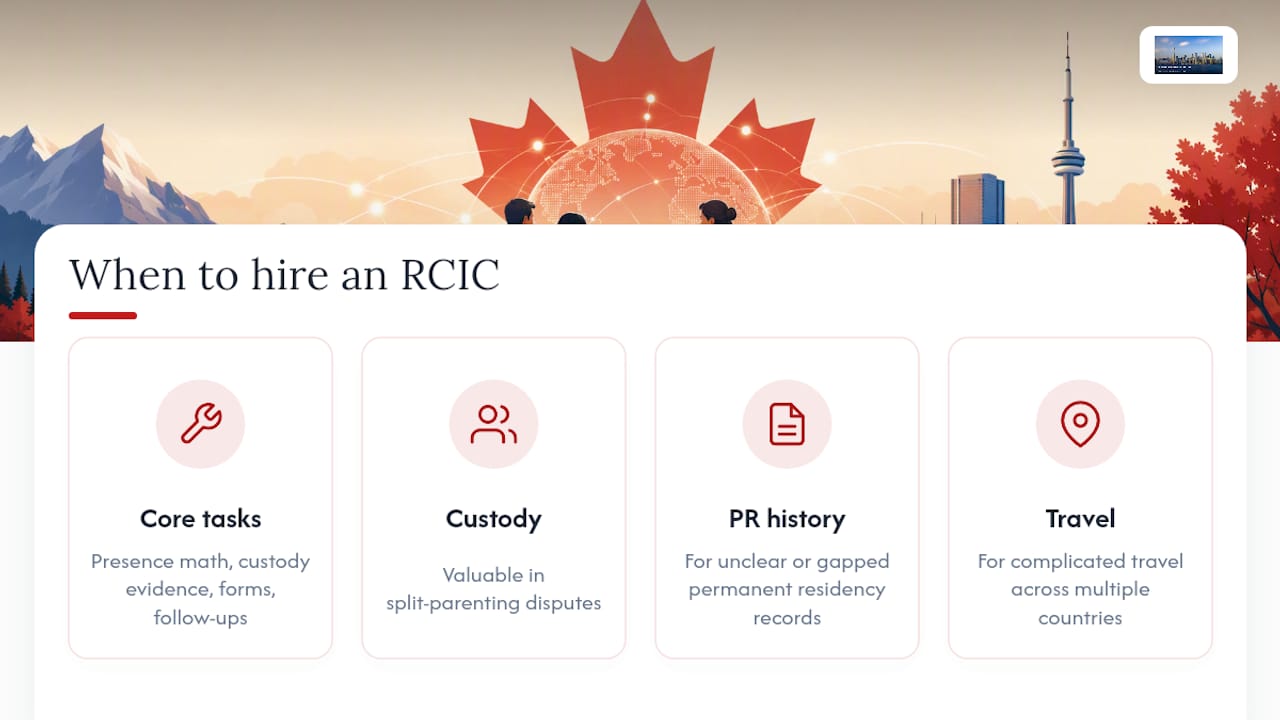
A Regulated Canadian Immigration Consultant typically handles the parts that trip up parents most: running the physical presence math correctly, assembling custody evidence in split-parenting situations, completing the forms cleanly, and following up on IRCC requests without missing a deadline.
Professional help earns its cost most clearly in custody disputes, unclear or gapped PR history, or families with complicated travel records spanning several countries. Those are exactly the files where a small counting error turns into a months-long delay.
— Micah
Get Your Child’s Citizenship Application Right the First Time
Filing a minor’s citizenship application yourself is entirely doable when the file is simple. Where families run into trouble is split custody, gaps in PR history, or a physical presence count that doesn’t quite add up, and that’s exactly where a returned application costs you the most time. Professional immigration consultancies review the eligibility math, the custody documentation, and every signature before anything goes to IRCC, so you’re not finding out about a missing form six months into processing.
Minerva McCoon McBean and her team handle citizenship applications for minors as part of a broader immigration services practice, and they can review your child’s file, confirm the correct pathway, and prepare the package for submission. If you’d rather not risk a return over a co-signature or a presence calculation, book a consultation and get the application moving with someone who checks it before IRCC does.
Official IRCC Links Worth Bookmarking
- Minors applying for citizenship: confirms which pathway, 5(2) or 5(1), applies to your child.
- Who can apply: full eligibility rules, including physical presence counting.
- CIT 0003 minor application form: the paper form and instructions most minor cases need.
- Apply for Canadian citizenship online: the online portal for creating an account and submitting digitally.
- Adults and minor children overview: general processing time and application guidance.
This article is general information, not a substitute for advice from a qualified lawyer. Consult a qualified legal professional about your own circumstances before acting on anything here.
Sources
Recommended
Stay Updated
Subscribe to our newsletter for the latest immigration news and tips.