Canadian Citizenship Test Preparation: Official Study Plan

The fastest path through citizenship test preparation is straightforward: download the Discover Canada study guide, build a multi-week schedule around it, and run timed mock tests until you’re consistently scoring well above the passing threshold. The test itself is 20 questions over 45 minutes, and you need a high proportion of correct answers to pass.
Three things to do right now:
- Download Discover Canada in your preferred format (HTML, PDF, eBook, or audio) from canada.ca — it’s free.
- Block study time for the next 2–6 weeks, depending on your starting knowledge.
- Run timed mock tests from the first week, not just after you finish reading.
Pro Tip: Set a target of 18/20 on practice tests before your actual test date.
Key Takeaways
Passing the Canadian citizenship test comes down to one thing: studying the right source with the right method — Discover Canada, timed mocks, and a consistent 18/20 target before test day.
| Point | Details |
|---|---|
| Use only Discover Canada | Every test question traces to this free official guide; download it in HTML, PDF, eBook, or audio. |
| Know the passing threshold | 20 questions, 45 minutes, a high proportion of correct answers required to pass. |
| Run timed mocks early | Shift to full 45-minute timed tests after your first guide pass; aim for 18/20 consistently. |
| Check your tech before test day | Chrome or Safari, working webcam, well-lit room, no VPN — a failed setup counts as one attempt. |
| Canadanumberoneimmigration | Licensed RCIC support for application review, hearing prep, and test logistics in Toronto. |
Table of Contents
- What are the official study materials for the Canadian citizenship test?
- What does the Canadian citizenship test look like?
- What topics does the citizenship test actually cover?
- Where can you find reliable practice tests in Canada?
- How to build a several-week study plan that actually works
- Where can you find citizenship classes and local support in Canada?
- What IRCC warns about third-party materials — and common mistakes to avoid
- What happens after you take the test?
- How to study Discover Canada so the facts actually stick
- Why the official guide is the only study tool that matters
- How Canadanumberoneimmigration supports your citizenship application
- Sources
What are the official study materials for the Canadian citizenship test?
Every question on the citizenship test comes directly from Discover Canada: The Rights and Responsibilities of Citizenship. IRCC publishes it free in four formats:
- HTML — readable in any browser, chapter by chapter, at canada.ca
- PDF — downloadable for offline study or printing
- eBook — compatible with most e-readers
- Audio — useful for commuters or auditory learners
To order a free printed copy, visit the IRCC study page and follow the “order a copy” link. Printed copies ship within Canada at no charge.
On the question of third-party guides, IRCC is unambiguous:
That warning matters. Unofficial guides sometimes contain outdated facts, wrong dates, or questions that don’t reflect the actual test format. Use them only to supplement timed practice — never as your primary source.
What does the Canadian citizenship test look like?
| Feature | Detail |
|---|---|
| Number of questions | 20 |
| Question types | Multiple choice and true/false |
| Time allowed | 45 minutes |
| Passing score | 18/20 |
| Maximum attempts | 3 before a hearing is scheduled |
| Default format (2026) | Online with remote proctoring |
| Age exemption | Applicants 55 and over do not write the test |
A few points worth knowing before you book:
- Language proficiency is assessed separately during the application process, not as part of the written test.
- The online proctored format became the default for applicants aged 18–54 as of March 2026. You need a desktop, laptop, or tablet with a working webcam and either Chrome or Safari.
- Blurred ID photos or unclear face images can invalidate your session and count as one of your three attempts.
- Applicants who cannot complete the online test due to accessibility needs should contact IRCC directly to discuss alternatives.
What topics does the citizenship test actually cover?
The test draws from six core content areas in Discover Canada. Knowing which chapters carry the most weight helps you study for canadian citizenship test content more efficiently:
- Rights and responsibilities — the Canadian Charter of Rights and Freedoms, voting rights, and civic duties (Chapter 2)
- Canadian history — from Indigenous peoples through Confederation to the modern era (Chapters 3–4)
- Modern Canada — immigration, multiculturalism, and national identity (Chapter 5)
- Government and governance — how Parliament works, the role of the Crown, federal/provincial division of powers (Chapter 6)
- Elections — how to vote, electoral districts, and the role of elected officials (Chapter 7)
- Symbols and geography — the flag, anthem, provinces, territories, and capital cities (Chapter 8)
The test tends to fail applicants on specific factual items: Confederation dates, the names of constitutional documents, and the exact rights listed in the Charter. Conceptual understanding helps, but the questions are precise. Map each practice question you get wrong back to its Discover Canada chapter, re-read that section, and re-test two days later.
Pro Tip: Build a one-page reference sheet of key dates, names, and numbers as you read each chapter. Confederation (1867), the Charter (1982), and the number of provinces (10) and territories (3) are the kind of facts that appear repeatedly.
Where can you find reliable practice tests in Canada?
Three sources stand out for Canadian applicants:
- IRCC’s official sample test — a short set of questions at canada.ca that mirrors the real format. Use it early to calibrate, not as your main practice tool.
- Richmond Public Library practice tests — a well-known example of library-run mock tests available across Canada. Many public libraries offer similar sessions; check your local branch.
- CitizenshipCounts — an online quiz built around Discover Canada content, widely used by Canadian applicants for self-testing.
The best practice workflow runs in two phases. First, go untimed. Work through questions chapter by chapter to learn the material without clock pressure. Once you’ve completed the full guide, shift to timed 45-minute full-length mocks. Aim for 18/20 consistently before your test date — not just once, but across three or four consecutive attempts.
Pro Tip: Keep an error log. Every question you get wrong, write down the topic and the correct answer. Review that log the morning before your test. It’s a faster review than re-reading the whole guide.
After timed mocks, check your device setup:
- Use Chrome or Safari on a desktop, laptop, or tablet
- Test your webcam in advance
- Choose a well-lit, quiet room with no other people present
- Close all other browser tabs and disable your VPN
How to build a several-week study plan that actually works
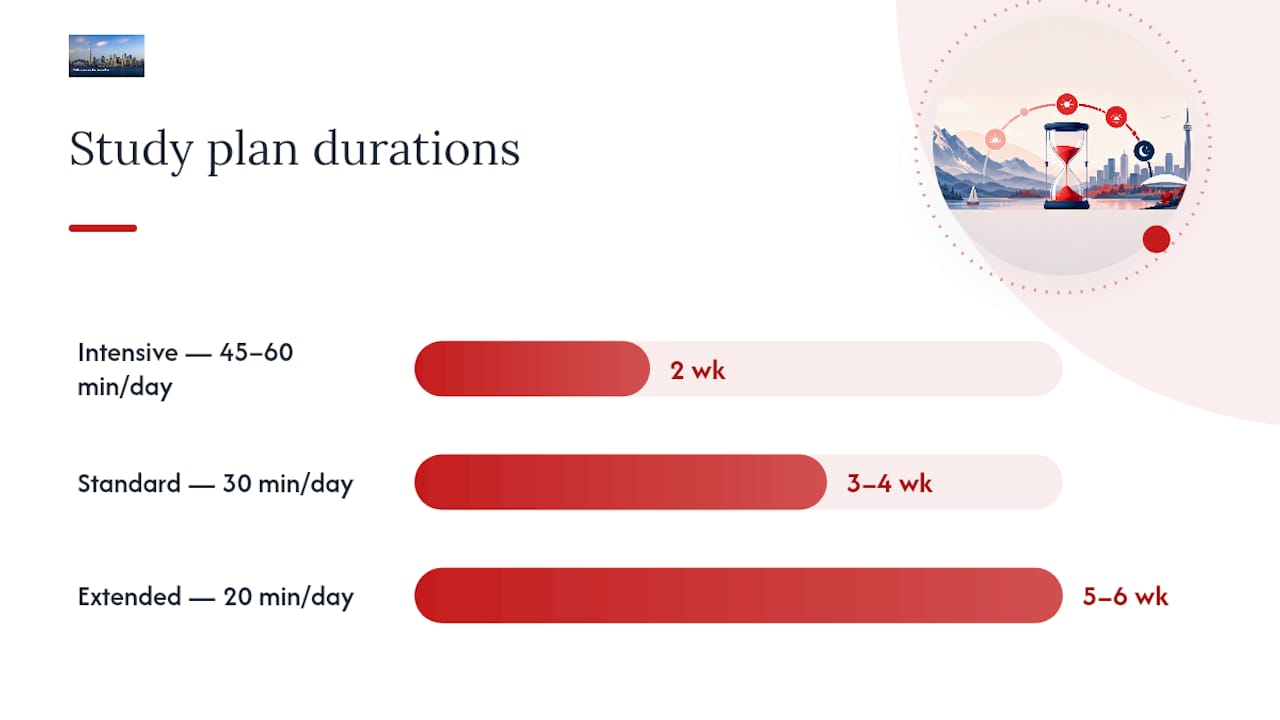
Three realistic timelines, depending on your starting point:
Intensive: 2 weeks (45–60 minutes/day)
- Days 1–4: Read Discover Canada chapters 1–4, write 5–10 key facts per chapter
- Days 5–7: Read chapters 5–8, complete your reference sheet
- Days 8–10: Run two full timed mocks, review error log, re-read flagged chapters
- Days 11–14: Daily timed mocks, target 18/20 before stopping
Standard: 3–4 weeks (30 minutes/day)
- Week 1: Read the full guide, one chapter per session, take notes
- Week 2: Complete IRCC sample test and two full timed mocks; review errors
- Week 3: Daily timed mocks, flashcard review of weak areas
- Week 4 (if needed): Final mock series, device check, test-day prep
Extended: 5–6 weeks (20 minutes/day)
- Weeks 1–2: Read guide slowly, one chapter every two days
- Weeks 3–4: Alternate between flashcard review and untimed practice questions
- Weeks 5–6: Shift fully to timed mocks, aim for consistent 18/20
Milestones to track: finish the full guide by the end of week one (or week two for extended plans), complete at least five full timed mocks before test day, and hit 18/20 on three consecutive attempts.
Pro Tip: The moment you finish reading the guide once, stop re-reading and start testing. Passive re-reading gives diminishing returns after the first pass. Timed mocks reveal exactly what you don’t know — re-reading doesn’t.
Where can you find citizenship classes and local support in Canada?
Discover Canada itself recommends contacting local schools, community centres, and settlement agencies for in-person support. Here’s where to look:
- Public libraries — many run free citizenship preparation sessions. Richmond Public Library is one widely cited example; your local branch likely has something similar or can point you to one nearby.
- Settlement agencies — federally funded organizations that serve newcomers often run citizenship prep classes at no cost. Search “settlement services” plus your city name.
- School boards and community colleges — adult education programs frequently include citizenship prep as part of their ESL or newcomer integration offerings.
- Community centres — especially in larger cities, multicultural community centres run study groups aligned with Discover Canada.
When you contact a class organizer, ask three things: whether the curriculum is based on Discover Canada, whether the class includes timed practice tests, and whether language accommodations are available.
Free language training is worth pursuing alongside test prep. Strong English or French comprehension speeds up reading and reduces misreading questions under time pressure. IRCC-funded language programs are available through many of the same settlement agencies listed above.

Once you’ve passed and are thinking about longer-term settlement planning, resources on navigating the Canadian immigration system can help you understand what comes next.
What IRCC warns about third-party materials — and common mistakes to avoid
IRCC’s position on unofficial guides is clear:
The most common mistakes applicants make:
- Over-relying on memorized lists without understanding context. The test asks why certain rights exist, not just what they are.
- Skipping timed practice entirely and only reading. Reading feels productive; timed mocks reveal the gaps.
- Ignoring device and browser requirements for the online test. A failed webcam check or a VPN running in the background can invalidate your session.
- Using third-party questions as primary study material without cross-checking them against Discover Canada.
Pro Tip: When you encounter a third-party practice question, find the specific sentence in Discover Canada that supports the correct answer. If you can’t find it, the question may be inaccurate. This habit also reinforces the guide’s content.
What happens after you take the test?
Results are typically communicated through your IRCC online account or by mail, depending on how your application is being processed. A passing result keeps your application moving forward on the standard timeline.
If you don’t pass:
- IRCC will notify you and provide instructions for scheduling a second attempt.
- You have up to three attempts total before IRCC may schedule an oral hearing with a citizenship official.
- At a hearing, a citizenship judge reviews your knowledge and language ability in person — it is not automatically a denial, but it adds time to your process.
Immediate steps after a non-passing result:
- Update your error log with any topics you recall struggling with
- Request a new test link through your IRCC account
- Return to the specific Discover Canada chapters covering your weak areas
- Run additional timed mocks before your next attempt
One technical note: a session invalidated by a webcam or ID issue counts as an attempt under the three-attempt rule. That’s why the device check before your test date matters as much as the study plan.
How to study Discover Canada so the facts actually stick
Passive reading doesn’t build the recall you need for a timed test. These techniques work better:
- Active recall after each chapter: close the guide and write down 5–10 key facts from memory. Check what you missed.
- Flashcards for dates, names, and numbers: Confederation (1867), the Charter of Rights and Freedoms (1982), the number of senators (105), the number of members of Parliament (338). These are the facts the test targets most.
- Spaced repetition: review flashcards on day 1, day 3, day 7, and day 14. Apps like Anki work well for this, or a simple paper deck.
- Wrong-answer tracing: every incorrect practice answer gets traced back to its exact Discover Canada chapter. Re-read that section, then re-test two days later.
Applicants who switch from passive reading to regular timed full-length mock tests after one or two chapter passes tend to see meaningful improvement in first-attempt results. The target is consistent 18/20 mock scores before test day.
Pro Tip: Study in your strongest language first for comprehension, then practice questions in English or French — whichever you’ll use on test day. Understanding the concept in your native language before translating it into the test language reduces confusion on tricky phrasing.
Why the official guide is the only study tool that matters
The citizenship test is not designed to trick you. It tests whether you know what’s in Discover Canada — nothing more, nothing less. Every question traces back to a specific sentence or paragraph in that guide. That’s not a guess; that’s how IRCC built the test.
What I see applicants get wrong most often is treating the test like a general knowledge quiz about Canada. They study news articles, Wikipedia pages, and third-party apps — and then miss questions about the exact wording of a constitutional right or the precise year of a historical event. The guide uses specific language for a reason. Learn that language.
The other underestimated factor is the online proctoring setup. A blurred webcam photo or a forgotten VPN can end a session before the first question loads. That counts as an attempt. Three attempts is not a lot of runway if you’re burning one on a technical failure.
Most applicants who follow a focused plan — read the guide once, run timed mocks, hit 18/20 consistently — pass on the first try. The process is manageable. The guide is readable. The test is fair. What it rewards is preparation that’s specific and deliberate, not broad and passive.
How Canadanumberoneimmigration supports your citizenship application
Studying for the test is your responsibility, and Discover Canada is the tool IRCC gives you for it. Where a licensed consultant adds real value is everywhere around the test: reviewing your application for completeness before submission, helping you understand the test scheduling process, and preparing you for an oral hearing if one is required.
Canadanumberoneimmigration is led by Minerva McCoon McBean, a licensed Regulated Canadian Immigration Consultant (RCIC) based in Toronto. If your application has complications — prior refusals, gaps in documentation, or a hearing on the horizon — that’s where professional representation changes the outcome. Review the full range of citizenship and immigration services or visit the services overview to book a consultation. Study materials stay official; the application strategy doesn’t have to be navigated alone.
This is a paid consulting service. All test study materials remain official IRCC resources available free at canada.ca.
Sources
All study should start and end with IRCC’s own pages. Here are the direct links:
- Citizenship test: Study for the test
Cross-check every third-party practice question against the Discover Canada guide before treating it as reliable. IRCC’s own pages are the only authoritative source for format updates, exemption rules, and scheduling instructions.
This article is general information, not a substitute for advice from a qualified lawyer. Consult a qualified legal professional about your own circumstances before acting on anything here.
Recommended
Stay Updated
Subscribe to our newsletter for the latest immigration news and tips.