5 Steps to Verify Co-op Work Authorization in Canada (RCIC Tips)

As of April 1, 2026, eligible post-secondary international students no longer need a separate co-op work permit to start a mandatory work placement. Your study permit does the job instead, as long as it carries the correct work-authorization remark, your placement is required by your program, and it runs no longer than 50% of your total program length. Secondary-school students are excluded from this change and still need the co-op work permit.
TL;DR:
- Students must have a study permit with the correct work-authorization remark, valid and close to expiry, before starting a placement.
- The placement must be required by the program, fully in-line with the DLI’s official letter, and no longer than 50% of the total program length.
- IRCC will withdraw pending co-op permit applications for eligible students, but already-issued permits remain valid until their expiration date.
- You should verify your permit’s remarks and coordinate with your DLI early to avoid delays or unauthorized work, especially if close to permit expiration.
- Students with complex cases, medical or licensing conditions, or expired permits should seek professional guidance from licensed RCICs before proceeding.
Table of Contents
- Co-Op Work Permit Eligibility Checklist for Post-Secondary Students
- What Changed on April 1, 2026, and Why It Matters
- How to Check and Fix Your Study Permit’s Work Authorization
- Already Applied for a Co-Op Permit? Here’s What Happens Next
- Pre-Placement Checklist: SIN, Hours, Medicals, and Employer Sign-Off
- When a Licensed RCIC Should Get Involved
- What Students Actually Need to Prioritize Here
- Get Help Confirming Your Study Permit Is Placement-Ready
- Sources
Co-Op Work Permit Eligibility Checklist for Post-Secondary Students
Before you accept or start a placement, confirm you actually clear the bar Immigration, Refugees and Citizenship Canada (IRCC) has set. Missing one condition can mean working without authorization, even if you genuinely believe you’re covered.
- Valid study permit with the right remark. Your permit needs language authorizing work under Regulation 186 conditions, not just general study authorization. If it’s expired or expiring soon, you need an extension filed before the current one lapses.
- A mandatory-placement letter from your designated learning institution (DLI). This isn’t optional paperwork. IRCC and your school both need it on file to confirm the co-op, internship, or practicum is a requirement of your program, not an elective add-on.
- Full-time enrollment, maintained through the placement period.
- Placement length capped at 50% of your program. A four-semester diploma with two semesters of placement, for instance, would blow past that limit.
- Special conditions for health and K-12 training placements. Regulated health programs and practicum placements in schools sometimes carry additional permit conditions or medical exam requirements tied to public health protection.
Pro Tip: Ask your DLI’s international student office for a sample of the exact wording they put in placement letters. Submitting a letter that’s vague about “mandatory” status is one of the most common reasons amendment requests stall.
What Changed on April 1, 2026, and Why It Matters
IRCC’s notice is narrower than a lot of students assume. It doesn’t eliminate work authorization requirements. It eliminates the need for a second, separate permit when your study permit can already do the same job.
IRCC has removed the requirement for eligible post-secondary international students to hold a separate co-op work permit for mandatory student work placements, and will withdraw pending co-op applications while already-issued permits remain valid until expiry.
The scope stops at post-secondary students in mandatory placements. If your co-op is optional, or if you’re finishing high school through a career and technical program, none of this applies to you. Practically, the change simplifies one document into another: instead of tracking two separate approvals, you’re managing one study permit with the correct conditions attached.
How to Check and Fix Your Study Permit’s Work Authorization
Look at the conditions section of your study permit first. If it authorizes work under the co-op or intern provisions, you’re set. If it doesn’t, or if it’s silent on the point, treat that as a problem to solve before your placement start date, not after.
- Pull up your study permit and read the remarks field. It typically references authorization to work under a specific regulation tied to internships or co-op placements.
- Get your co-op letter from your DLI. This needs to state plainly that the placement is a mandatory program requirement.
- File an amendment or extension application through IRCC’s online portal if the remark is missing or your permit is close to expiry. Nearly all study permit applications must be submitted electronically now, with only limited exceptions.
- Attach your co-op letter, proof of continuing enrollment, and your passport’s biographical and stamp pages.
- Don’t start the placement until authorization is confirmed. If you’re mid-application and your current permit has expired, Canada’s maintained status rules may let you keep studying, but they don’t automatically authorize new work.
Processing times vary by application type and your specific circumstances, so build in a buffer rather than assuming a same-week turnaround. Pro Tip: File your amendment or extension the moment your DLI issues the co-op letter, not the week before placement starts. A late submission with no maintained status is the single most avoidable way students end up unauthorized.
Already Applied for a Co-Op Permit? Here’s What Happens Next
If you’re mid-application or already holding a co-op work permit, you don’t need to panic or scramble to redo anything.
- Permits already issued stay valid until their printed expiry date. No action required.
- Pending applications for eligible post-secondary students are being withdrawn by IRCC, since the study permit now covers the same authorization.
- You can request a voluntary cancellation through IRCC’s web form if you’d rather tidy up your immigration record than wait for the automatic withdrawal.
- If you got a Port of Entry letter or instructions that seem to contradict this, save every document and get advice before acting on it. Border and airport officers sometimes work from older guidance during a transition period.
Pre-Placement Checklist: SIN, Hours, Medicals, and Employer Sign-Off
Getting your permit right is half the job. The other half is the paperwork your employer and program will actually ask to see on day one.
- Keep a dated copy of your co-op or program letter somewhere you can access instantly, not buried in an old email thread.
- Apply for or renew your social insurance number (SIN) if you don’t already have one valid through your placement dates. Employers cannot legally pay you without it.
- Confirm your hours with your DLI. Mandatory placements typically allow full-time hours, but your school’s co-op office should verify this against your specific program terms.
- Check whether your placement requires an upfront medical exam. Roles involving public health protection, certain clinical rotations included, may require proof of a completed medical before you start.
- Make sure your employer understands your study permit is your authorization, not a separate work permit. Some HR departments still ask for a document that no longer exists for eligible students.
Pro Tip: Print your study permit’s conditions page and bring it to your first day. HR staff unfamiliar with the April 2026 change sometimes ask for a co-op work permit that you’re no longer required to have.
When a Licensed RCIC Should Get Involved
Most students clear this process without a hitch. But a few situations call for professional help rather than guesswork: a study permit missing the work-authorization remark, a refused extension application, timing that puts you between permits, a health-field placement with extra medical or licensing conditions, or an employer who won’t accept your study permit as sufficient authorization.
A licensed Regulatory Consultant of Immigration to Canada (RCIC) like Minerva McCoon McBean at Canadanumberoneimmigration can review your documents, map out the right amendment or extension strategy, and communicate with IRCC directly on your behalf when a case gets complicated. Before a consult, gather your current study permit, your DLI’s co-op letter, your acceptance letter or program outline, and any correspondence from IRCC. Having that ready cuts the back-and-forth down considerably.

What Students Actually Need to Prioritize Here
The biggest misread of this policy change is treating it as “you don’t need paperwork anymore.” That’s backwards. IRCC consolidated two documents into one, but the one that’s left, your study permit’s work-authorization remark, still has to be correct, current, and matched to a genuine mandatory placement letter from your DLI. Skip that step and you’re just as unauthorized as someone who never had a co-op permit at all.
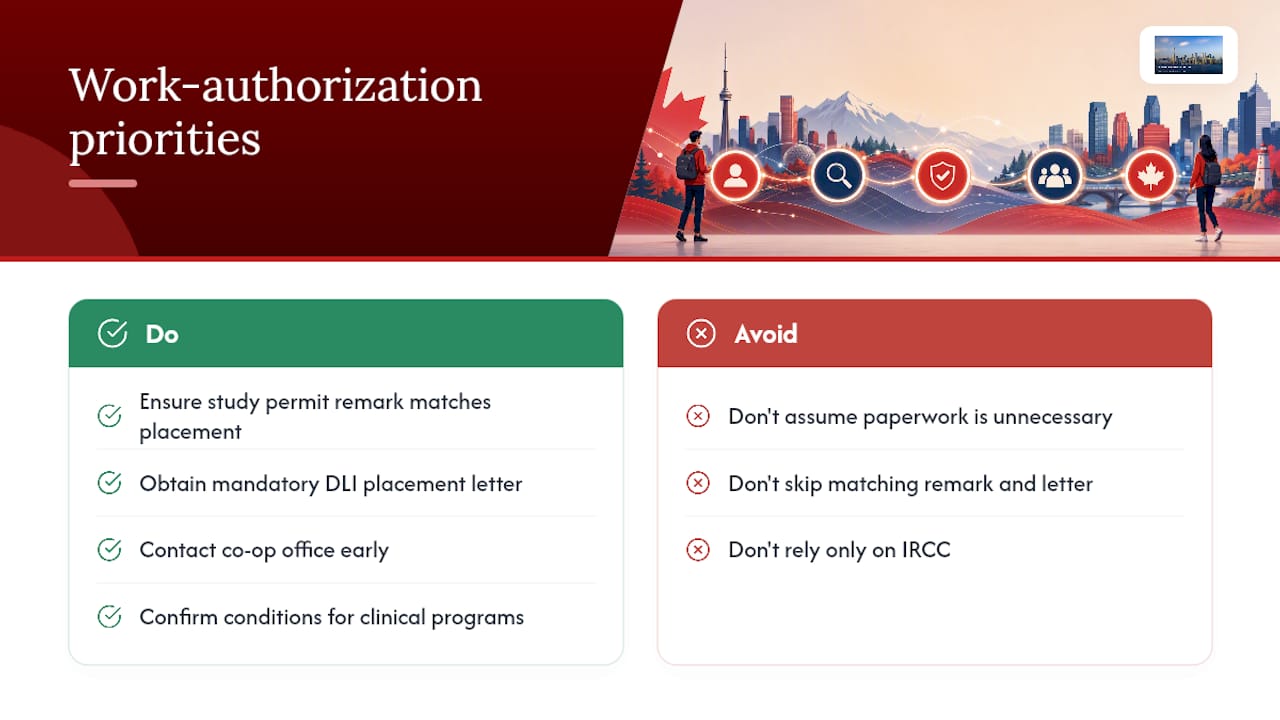
Where conventional advice falls short is in treating this as purely an IRCC problem. In practice, your school’s co-op office is doing as much of the operational work as IRCC is: issuing the letter, confirming the 50% threshold, and telling employers what’s actually required now. Talk to that office early, not after your placement is confirmed.
If you’re a health-sciences or clinical-placement student, don’t assume the general rule covers you cleanly. Regulated professions and public-health-protected roles carry extra conditions worth confirming before you sign anything.
— Minerva McBean
Get Help Confirming Your Study Permit Is Placement-Ready
Reading IRCC’s notice and confirming your own study permit actually matches it are two different things, and the gap between them is where most avoidable delays happen. Canadanumberoneimmigration reviews your permit conditions, prepares amendment or extension applications, and handles the IRCC paperwork directly so you’re not guessing whether your remark, your co-op letter, and your placement dates all line up correctly.
Our study permit and PGWP services cover exactly this kind of review, along with amendment requests for students whose permits weren’t issued with the correct work-authorization wording. Led by licensed RCIC Minerva McCoon McBean, Canadanumberoneimmigration has built a 98% success rate helping students and families move through Canada’s immigration system with fewer surprises. Check our consultation fees and book a review before your placement start date, not after a problem shows up at orientation.
Sources
This article is general information, not a substitute for advice from a qualified lawyer. Consult a qualified legal professional about your own circumstances before acting on anything here.
Recommended
Stay Updated
Subscribe to our newsletter for the latest immigration news and tips.