CAD $15,263 Minimum? Prove Express Entry Funds With Exact Bank Letters

If you’re applying under the Federal Skilled Worker or Federal Skilled Trades program, you must show settlement funds; if you’re already in the Canadian Experience Class or hold a valid job offer that authorizes you to work in Canada, you’re exempt. Check the IRCC minimum for your exact family size today, and start requesting bank letters now, since the numbers update annually, and the funds have to stay in place until your permanent residence is actually issued.
TL;DR:
- Applicants using the Federal Skilled Worker or Federal Skilled Trades program must provide official bank letters showing proof of funds, with the amount adjusted for family size and updated annually.
- The required minimums range from CAD $15,263 for one person to over CAD $40,373 for seven or more family members, with a recommended buffer of 10-15 percent to account for currency fluctuations.
- Bank letters must include specific details like account numbers, opening dates, current and six-month average balances, and be issued within a few months of submission to be accepted.
- Acceptable proof includes verified cash in accounts, liquid securities, GICs, and government bonds, while assets like property equity or retirement accounts are not considered liquid funds.
- It is highly recommended to have a professional review proof of funds documents before submitting to avoid delays caused by missing items or unexplained large deposits.
Table of Contents
- Who Needs Express Entry Proof of Funds (and Who Doesn’t)
- How Much Money Do You Actually Need?
- What Counts as Proof of Funds for Express Entry
- Timing Rules and the Mistakes That Trigger Extra Scrutiny
- A Practical Checklist and When to Call a Licensed RCIC
- Beyond Bank Letters: Other Financial Documents IRCC Will Accept
- Organizing Your Documents So Your Application Doesn’t Stall
- How to Document Large or Unusual Deposits
- Why the Paperwork Matters More Than the Balance
- Get Your Proof-of-Funds Documents Reviewed Before You Submit
- Sources
Who Needs Express Entry Proof of Funds (and Who Doesn’t)
Two of the three Express Entry programs require proof of settlement funds: the Federal Skilled Worker Program and the Federal Skilled Trades Program. If you’re applying through either one, IRCC wants documented evidence you can support yourself and your family after landing, on top of whatever points your profile earns.
Two groups skip this step entirely. Canadian Experience Class applicants are exempt, since IRCC assumes recent Canadian work history already demonstrates financial stability. So are applicants who hold a valid job offer authorizing them to work in Canada, because guaranteed income replaces the need for a savings cushion. Provincial nomination alone doesn’t create an exemption. PNP candidates still need to prove funds unless they separately qualify under CEC or the job-offer exemption.
Family size counting trips people up more than the exemption rules themselves:
- Count yourself, your spouse or common-law partner, and every dependent child, whether or not they’re moving with you.
- Include financially dependent relatives even if they’re staying behind for now.
- Do not count a spouse or child who is a Canadian citizen or permanent resident already living in Canada.
How Much Money Do You Actually Need?
IRCC sets settlement fund minimums as a fixed table tied to family size, and the numbers went up on July 7, 2025. A single applicant now needs a minimum of CAD $15,263, up from $14,690 before the update.
Here’s the current table by family size:
- 1 person: $15,263
- 2 people: $19,001
- 3 people: $23,360
- 4 people: $28,362
- 5 people: $32,159
- 6 people: $36,266
- 7 people: $40,373
- Each additional member beyond seven: add $4,112
IRCC calculates these figures at roughly 50% of Statistics Canada’s low-income cut-off, then reviews them every year, which is why the amount you saw quoted last year may already be stale. Don’t cut it close to the minimum. A 10 to 15% buffer above the IRCC number protects you against currency swings between the day you submit and the day you land, and it gives you breathing room if the annual update lands mid-application. If your funds are sitting in rupees, pesos, or pounds, that buffer matters more than it looks on paper.
What Counts as Proof of Funds for Express Entry
IRCC doesn’t accept a screenshot of your online banking app or a printed statement you formatted yourself. It wants an official letter from each financial institution, and that letter has a specific job: prove the money is real, stable, and yours.
Here’s exactly what a compliant bank letter needs to include:
- The bank’s letterhead, with the institution’s name, address, and phone number printed on the page.
- The account holder’s full name matching your application exactly.
- Each account number tied to the funds you’re claiming.
- The date each account was opened.
- The current balance in each account, as of the letter’s date.
- The average balance over the six months prior, not just a snapshot.
- Any outstanding loans, lines of credit, or debts attached to the account holder.
- A signature and date from a bank official, with contact information IRCC can use to verify authenticity.
Acceptable funds include money in chequing and savings accounts, GICs that mature before your planned arrival, and publicly traded stocks or securities you can liquidate quickly. What doesn’t count: equity in a house or condo, money borrowed through a personal loan, retirement accounts you can’t access without penalty, and most cryptocurrency holdings unless they sit in a custodial account you can convert to cash on short notice.
If your bank letter isn’t in English or French, get a certified translation attached to the original. IRCC also reserves the right to contact the bank directly to confirm the letter is genuine, so don’t hand in anything that doesn’t match what the bank has on file.
Pro Tip: Call your bank’s immigration or newcomer department before you request the letter. Many Canadian and international banks have a template that already matches IRCC’s format, which saves you a second trip when the branch manager hands you something incomplete.
Timing Rules and the Mistakes That Trigger Extra Scrutiny
Your proof of funds has to be current, not just accurate. IRCC generally wants bank letters dated within the last few months of submission, and the money has to remain available both when you apply and again when your permanent residence is actually issued, not just when you first uploaded documents. If your case sits in processing for a year, expect to refresh those letters before landing.
The July 2025 fund increase came with a practical wrinkle: candidates who already had profiles in the pool needed to update their declared proof of funds to reflect the new minimums, and missing that kind of deadline can stall an otherwise strong application.
A handful of patterns reliably trigger a request for more documents, or worse, a refusal:
- A large deposit appearing in the six-month average with no paper trail explaining where it came from.
- A “gift” that’s actually an undocumented loan from a relative.
- Home equity or unsold property listed as if it were liquid cash.
- Joint accounts where it’s unclear whether the applicant actually has access to the funds.
- A balance that looked sufficient in CAD equivalent last month but falls short after a currency swing.
IRCC leans on the six-month average balance specifically to catch sudden deposits designed to inflate a snapshot balance. Officers aren’t looking at your net worth. They’re looking for money that behaves like it’s actually yours.
A Practical Checklist and When to Call a Licensed RCIC
Most proof-of-funds problems come down to a bank letter missing one line item, or a document that explains money but not where it came from. Handing your bank a specific checklist upfront solves most of it. Ask for a letter that includes: your full legal name, every account number, the account opening date, the current balance, the six-month average balance, any attached debt, and the bank’s contact details on official letterhead.
Some situations are genuinely harder to document cleanly, and that’s where guidance from someone who reviews these letters daily starts to pay off: a recent inheritance mixed with existing savings, a joint account held with a non-accompanying spouse, or funds spread across three countries in three currencies. Canadanumberoneimmigration is led by Minerva McCoon McBean, a licensed RCIC who works through exactly these edge cases with clients preparing Express Entry files, and the firm tracks each Express Entry draw update as amounts and rules shift year to year.
If your financial picture involves more than a straightforward savings account, a short document review before you submit usually costs less than a request for clarification does in lost time.
Beyond Bank Letters: Other Financial Documents IRCC Will Accept
A bank letter covers cash sitting in an account, but plenty of applicants have money parked elsewhere, and IRCC does accept some of it, with conditions.
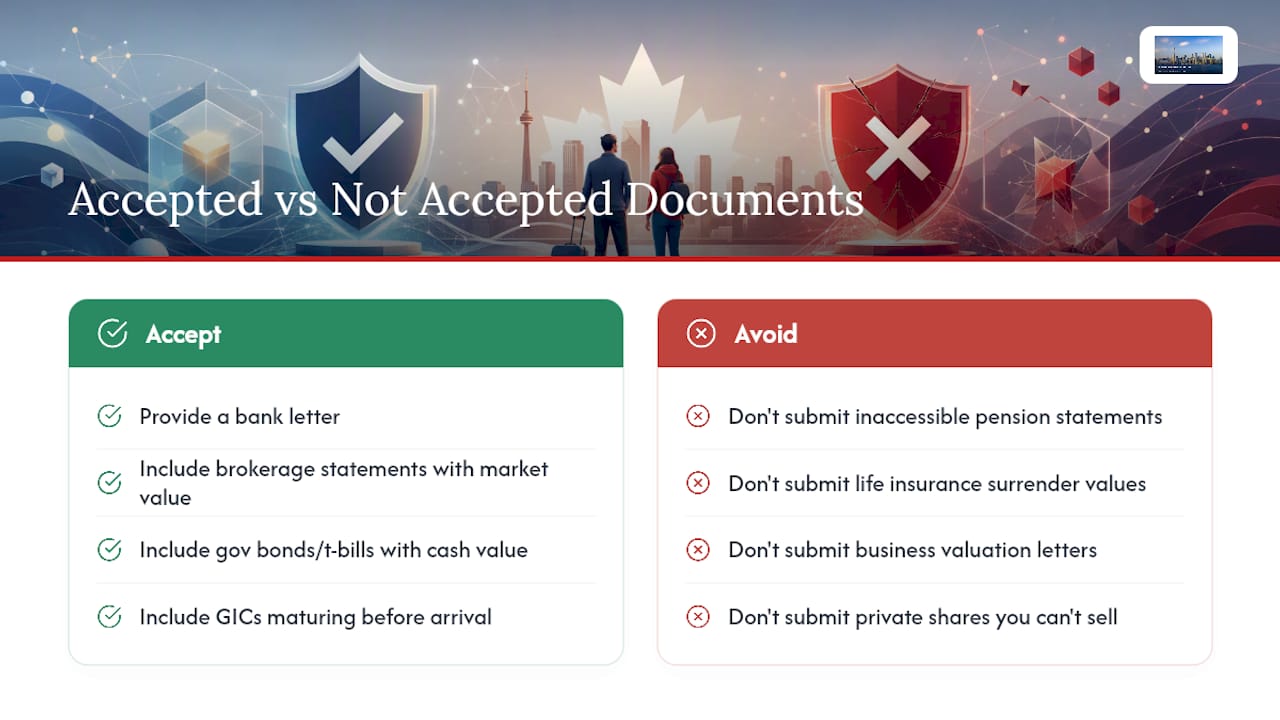
Investment account statements from a licensed brokerage count, provided they show the current market value of publicly traded stocks, bonds, or mutual funds and can be converted to cash within a reasonable window. Government bonds and treasury bills work the same way, as long as the maturity date and cash value are clearly stated and the bond isn’t locked for a decade. GICs are accepted if they mature before your planned arrival in Canada, or if the issuing institution confirms early withdrawal is possible without forfeiting the principal.
What doesn’t fly: a pension statement showing funds you can’t touch before retirement age, a life insurance policy’s cash surrender value if it requires a lengthy claims process, or a business valuation letter estimating what your company might be worth on paper. None of that is liquid in the way IRCC requires. Shares in a private company you can’t easily sell fall into the same trap, even if the paper value looks impressive.
The safest rule of thumb: if you can’t convert it to cash within a matter of weeks without a lawyer, a court process, or a buyer you haven’t found yet, don’t count on it as settlement funds. Stick to accounts and instruments a bank officer can verify with a phone call.
Organizing Your Documents So Your Application Doesn’t Stall
The applicants who sail through proof-of-funds review usually have one thing in common: their paperwork tells a consistent story without making an officer dig for context.
Start by matching every account to a single, current bank letter rather than submitting old statements alongside a newer letter that contradicts them. Order your documents so the letter with the highest balance or clearest explanation comes first, not buried in a stack of five accounts from three different banks.
Label everything. If you’re including a GIC certificate, a brokerage statement, and a chequing account letter, put a one-line cover note on top explaining which document supports which portion of your total. Officers reviewing hundreds of files appreciate not having to reconcile numbers themselves.
Keep every figure in one currency for your own math, even though IRCC converts amounts using its own exchange rate at the time of assessment. If you’re combining accounts in two currencies, do the conversion yourself first and show your math, so there’s no ambiguity about whether you actually clear the minimum.
Finally, don’t submit documents that are about to expire. A GIC maturing next week or a bank letter dated five months ago invites exactly the kind of follow-up request that adds weeks to your file.
How to Document Large or Unusual Deposits
A sudden spike in your six-month average is the single most common reason IRCC asks for more paperwork. The fix isn’t to hide the deposit. It’s to explain it with a document trail an officer can verify in under a minute.

If the money came from selling property, attach the sale deed or transfer agreement showing the sale price and closing date. If it’s an inheritance, include probate documents or an estate distribution letter naming you as beneficiary. A work bonus needs an employer letter on company letterhead plus the corresponding pay slip. A genuine gift from a family member requires a signed gift letter stating the amount, the relationship, and confirmation there’s no expectation of repayment, backed by a bank transfer record showing the money actually moved.
What officers routinely reject: an informal note with no bank record behind it, a verbal explanation with nothing in writing, or a deposit that shows up right before the six-month window closes with no supporting paper at all. The insight from IRCC’s own review process is that stable, traceable money matters more than a high balance. A $30,000 account that’s been steady for a year reads better than a $60,000 account that jumped last month with no explanation attached.
Why the Paperwork Matters More Than the Balance
Most guides on this topic treat proof of funds as a math problem: hit the number, submit the letter, done. That’s the wrong lens. IRCC isn’t grading your net worth. It’s grading whether your money looks stable, traceable, and genuinely yours, and a $20,000 balance with six months of consistent history will usually clear review faster than a $40,000 balance that spiked three weeks before you applied.
The conventional advice to “just meet the minimum” also undersells timing risk. Funds sitting comfortably above the threshold today can slip below it after a currency shift, or after processing drags past a year and IRCC raises the bar again, as it did in July 2025. Build in a cushion, keep your bank letters current, and treat any large unexplained deposit as a problem to solve before submission, not after IRCC flags it.
If there’s one thing worth prioritizing first, it’s the bank letter itself. A vague or incomplete letter causes more delays than an account balance that’s a few thousand dollars light.
— Minerva McBean
Get Your Proof-of-Funds Documents Reviewed Before You Submit
A bank letter with one missing line item can cost you weeks of processing delay, and there’s no way to fix it after you’ve already submitted. Canadanumberoneimmigration reviews proof-of-funds documentation before it goes anywhere near your Express Entry profile, catching the gaps a bank clerk won’t know to flag: missing six-month averages, unclear joint-account access, undocumented large deposits.

Whether you need a full bank-letter checklist tailored to your accounts, help documenting an inheritance or property sale, or representation through the entire Express Entry process, a document review consultation is the fastest way to know your file is ready. Book a consultation before you finalize your profile, not after IRCC sends back questions.
Sources
Stay Updated
Subscribe to our newsletter for the latest immigration news and tips.