
LMIA Advertising Requirements: A Compliance Checklist for Employers

To meet LMIA advertising requirements, you must post the position on the Government of Canada Job Bank and run consecutive advertising for at least 8 weeks (low-wage) or 4 weeks (high-wage) within the 3 months immediately before submitting your application. Two additional recruitment methods are mandatory, and you must keep documented proof of every step.
Here is what that means in practice before you read further:
- Job Bank posting with Job Match and Direct Apply features active throughout the process
- 8 consecutive weeks of advertising for low-wage positions; 4 consecutive weeks for high-wage positions, both within the 3-month window before filing
- Two additional recruitment methods beyond Job Bank, with specific targeting rules depending on wage stream
- Proof package including copies of all ads, timestamps, posting confirmations, and evidence the channels reached qualified Canadians
- Zero recruitment fees charged to temporary foreign workers at any point
That last point is not a technicality. Charging or recovering recruitment fees from a foreign worker triggers an automatic negative LMIA decision with no appeal path.
Key Takeaways
Meeting LMIA advertising requirements demands consecutive advertising on Job Bank plus two documented additional recruitment methods, all within 3 months of filing, with a complete evidence package and zero recruitment fees charged to foreign workers.
| Point | Details |
|---|---|
| Advertising timelines | Low-wage roles need 8 consecutive weeks; high-wage roles need 4, both within 3 months before filing. These requirements may not apply if your position falls under a formal variation—for example, academic, unionized, or certain maritime roles. Always verify with the official variations list before planning your advertising window. |
| Job Bank is mandatory | Post with Job Match and Direct Apply active; manage matches throughout the process, not just at submission. |
| Two additional methods | Low-wage must target different underrepresented groups; high-wage requires at least one national-scope channel. |
| Documentation is compliance | Keep timestamped screenshots, posting confirmations, invoices, and interview logs for every step. |
| Canadanumberoneimmigration | An RCIC-led readiness audit and ad review reduces filing errors and strengthens your evidence package before submission. |
Table of Contents
- What are the exact LMIA advertising timelines for low-wage vs. high-wage roles?
- Where must you advertise, and what counts as an additional recruitment method?
- What must every LMIA job advertisement actually include?
- What extra recruitment steps apply to low-wage and high-wage roles?
- What proof does Service Canada expect with your LMIA application?
- What advertising mistakes most often cause LMIA refusals?
- When do the standard advertising timelines not apply?
- A practical week-by-week checklist for LMIA advertising
- What fees and processing timelines should you budget for?
- When should you bring in an RCIC or third-party help?
- An employer’s perspective on LMIA compliance
- Canadanumberoneimmigration can handle your LMIA advertising from start to filing
- Sources
What are the exact LMIA advertising timelines for low-wage vs. high-wage roles?
The rule is straightforward, but the counting matters. Low-wage positions require 8 consecutive weeks of advertising; high-wage positions require 4 consecutive weeks, and both windows must fall entirely within the 3 calendar months immediately before your LMIA submission date.
“Consecutive” means no gaps. If your Job Bank posting lapses for even a day, the clock resets. “Within 3 months” means the last day of advertising must fall no earlier than 3 months before the date you submit the application. Running ads that ended 4 months ago does not count, even if the posting ran for 10 weeks.
Whether a position is low-wage or high-wage depends on how the offered wage compares to the provincial or territorial median hourly wage. Service Canada publishes these thresholds, and they shift periodically, so confirm the current median for your province before classifying the role. The low-wage stream has faced additional policy scrutiny in recent years, making timeline compliance especially critical.
Pro Tip: To plan your LMIA advertising timeline, mark your submission target date and count backward 3 months to estimate the earliest your advertising window can start. Build in a buffer of at least 2 weeks before the deadline so you have time to compile your evidence package without rushing.*
Where must you advertise, and what counts as an additional recruitment method?
The Job Bank posting is non-negotiable. Both low-wage and high-wage streams require it, and you must activate the Job Match and Direct Apply features, not just post the listing passively.
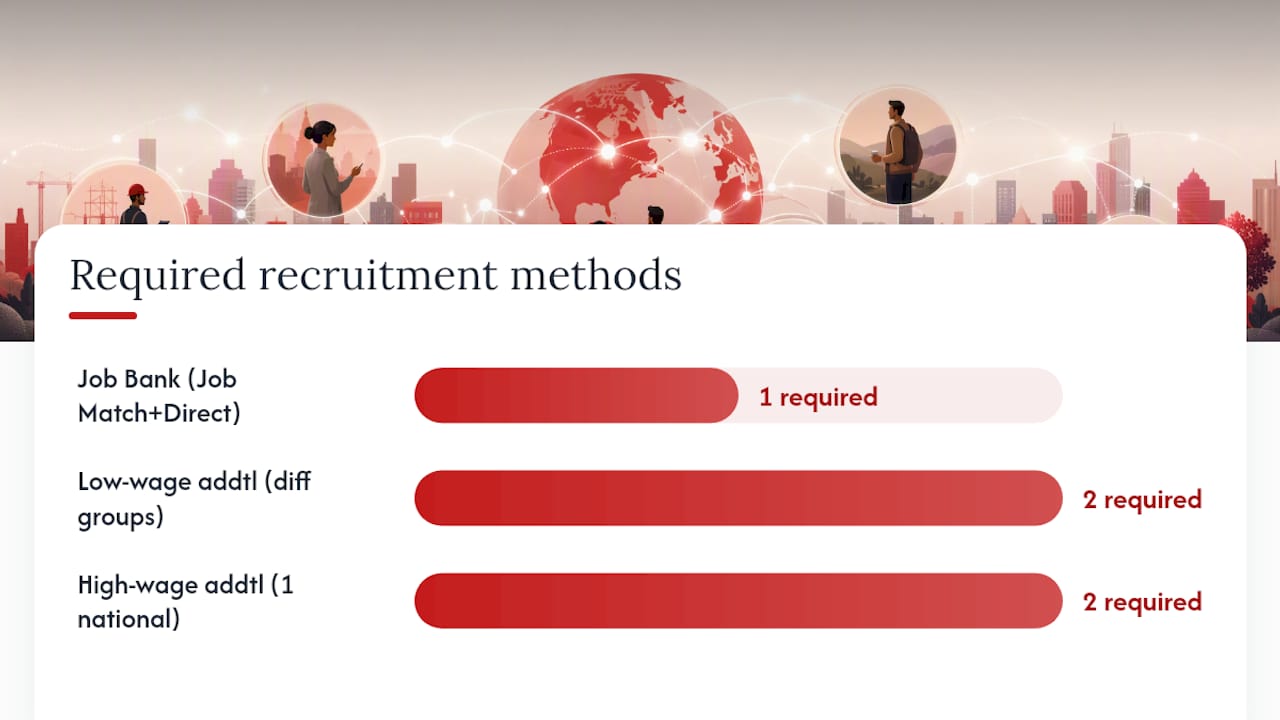
Beyond Job Bank, low-wage positions require at least 2 additional methods targeting different underrepresented groups. For high-wage positions, at least 2 additional methods are required, and one must be national in scope, meaning it must be reasonably accessible to job seekers in any province or territory.
Acceptable additional channels include:
- National job boards (general and sector-specific)
- Professional associations relevant to the occupation
- Community employment centers and provincial employment offices
- University and college career centers
- Job fairs (in-person or virtual)
- Social media outreach targeted to specific professional or demographic communities
- Indigenous employment organizations and disability employment services
| Channel | What it demonstrates | Documentation to keep |
|---|---|---|
| National job board posting | Broad Canadian reach | Posting confirmation, screenshot with URL and date |
| Professional association listing | Sector-specific audience | Confirmation email, invoice, association name |
| Campus career center posting | Youth and new-graduate outreach | Posting receipt, institution name, dates active |
| Disability employment service | Targeted underrepresented group | Confirmation from the organization, contact record |
Pro Tip: When selecting your two additional methods, choose channels that serve genuinely different audiences. Two general job boards do not satisfy the “different underrepresented groups” requirement for low-wage roles. Pair a national board with a targeted community organization instead.
What must every LMIA job advertisement actually include?
Service Canada checks ad content, not just ad existence. Every posting must include all of the following fields:
- Company operating name (the name the business trades under, not just a legal entity name)
- Business address (a physical location, not a P.O. box)
- Job title matching the NOC classification
- Detailed duties (specific enough that a qualified candidate can self-assess)
- Terms of employment (full-time/part-time, permanent/temporary, hours per week)
- Language of work (English or French only, unless a specific justification is documented)
- Wage information including any incremental pay, performance bonuses, or benefit details
- Location of work
- Contact information for applications
Here is a compact sample template showing how these fields look in a compliant posting:
Company: Maple Ridge Hospitality Inc. Location: 245 King Street West, Toronto, ON (sample business address) Position: Cook (NOC 63200) Duties: Prepare hot and cold dishes; maintain food safety standards; assist with menu planning; manage kitchen inventory. Terms: Full-time, permanent, 40 hours/week Wage: $22.50/hour, with annual performance review and potential 5% increase Language of work: English Benefits: Extended health, dental Apply to: careers@mapleridgehospitality.ca
On the language rule: only English and French may appear as job requirements unless you can provide a documented, job-specific justification. Listing Mandarin or Spanish as a requirement without that justification is a red flag that can delay or sink your application.
Pro Tip: Write duties in plain, specific language. “Performs various kitchen tasks” fails the specificity test. “Prepares soups, sauces, and entrées; portions and plates dishes; cleans and sanitizes workstations” passes it.
What extra recruitment steps apply to low-wage and high-wage roles?
Both streams require two additional recruitment methods, but the targeting rules differ in ways that matter.
For low-wage roles, each of the two additional methods must target a different underrepresented group. Service Canada looks for genuine outreach, not token postings. Acceptable targeted activities include:
- Youth job boards or campus career centers (targets youth)
- Indigenous employment organizations or band councils (targets Indigenous people)
- Disability employment services or vocational rehabilitation programs (targets persons with disabilities)
- Newcomer settlement agencies or immigrant employment programs (targets newcomers)
For high-wage roles, one of the two additional methods must be national in scope, meaning a job seeker in Newfoundland or British Columbia could realistically find and apply through that channel.
| Stream | Additional methods required | Targeting rule | National scope required |
|---|---|---|---|
| Low-wage | 2 | Different underrepresented groups | No |
| High-wage | 2 | No specific group targeting required | Yes, for at least 1 method |
Service Canada assesses whether your chosen channels actually reach the stated audience. A posting on a general local Facebook page does not demonstrate targeted outreach to persons with disabilities. The channel itself must have a documented connection to the group you claim to be reaching.
What proof does Service Canada expect with your LMIA application?
Service Canada requires copies of all advertisements, evidence of where and when they were posted, and proof that the outlets reach an audience with the appropriate qualifications. Mere posting is not enough. The evidence must show intent to reach qualified Canadians and permanent residents.
Your documentation package should include:
- Copies of all job ads (exact text as posted)
- Screenshots with visible URL, posting date, and platform name
- Posting confirmation emails or receipts
- Invoices from paid job boards, job fairs, or print placements
- Job Bank match records and records of invitations sent to matched candidates
- Applicant shortlist and interview notes (dates, names, outcomes)
- Any correspondence with underrepresented group organizations
| Document | What it proves | Acceptable format |
|---|---|---|
| Ad copy with posting date | Ad ran during the required window | PDF, screenshot with metadata |
| Posting confirmation email | Platform and date of posting | Email PDF or screenshot |
| Invoice from job board/fair | Paid outreach occurred | PDF invoice with date and platform |
| Job Bank match records | Job Match/Direct Apply features were used | Screenshot or exported report |
| Interview log | Active recruitment beyond advertising | Dated notes, email threads |
Pro Tip: The moment you post an ad online, save the confirmation email and take a full-page screenshot using your browser’s print-to-PDF function. That single file captures the URL, date, and ad content in one tamper-evident document.
Note that Service Canada reviews recruitment activities until a final decision is issued, not just at the time of submission. Keep your Job Bank posting active and compliant throughout.
What advertising mistakes most often cause LMIA refusals?
The most common errors are preventable. Here are the pitfalls that consistently lead to negative decisions:
- Gaps in the advertising window: A lapsed Job Bank posting breaks the consecutive-week count.
- Missing Job Bank features: Posting without activating Job Match or Direct Apply is non-compliant.
- Failing to invite matched candidates: For high-wage roles, employers must invite Job Bank matches rated 4 stars or more within the first 30 days must be invited for interviews for high-wage roles. days. Missing this window is a documented failure.
- Vague wage information: Listing “competitive salary” instead of a specific wage or range violates ad content rules.
- Non-official language requirements: Listing a language other than English or French without justification.
- Insufficient targeting: Using two general job boards for low-wage roles instead of channels that demonstrably reach underrepresented groups.
- Weak documentation: Screenshots without dates, missing invoices, or no interview records.
When do the standard advertising timelines not apply?
Formal variations to advertising requirements exist for specific occupations and circumstances. Do not assume the standard 4-week or 8-week rules apply to your position before checking.
Common variation categories include:
- Tenure-track academic positions at universities and colleges
- Collectively bargained roles covered by a union agreement with specific hiring provisions
- Certain maritime occupations with sector-specific rules
- Provincial or territorial rules that modify the standard requirements for particular streams
To verify whether a variation applies, consult the official variations list on Canada.ca before drafting your advertising plan. If a variation applies, document it explicitly in your application and keep the relevant collective agreement or occupational classification evidence on file.
Pro Tip: If you believe a variation applies but are unsure, contact Service Canada’s employer line before you begin advertising. A documented pre-filing inquiry is far easier to defend than a post-refusal appeal.
A practical week-by-week checklist for LMIA advertising
Follow these steps in sequence, starting from your target LMIA submission date and counting backward:
- Determine wage stream. Compare the offered wage to the current provincial/territorial median. Confirm whether a variation applies.
- Draft a compliant job ad. Include all mandatory fields: company name, address, title, duties, terms, language, wage details, and contact.
- Post on Job Bank. Activate Job Match and Direct Apply immediately. Note the posting date.
- Launch two additional recruitment methods. For low-wage, target different underrepresented groups. For high-wage, ensure one method is national.
- Manage Job Bank matches. For high-wage roles, it is important to invite candidates rated 4 stars or more within 30 days of posting. days of posting.
- Run advertising for the full required window. 8 consecutive weeks for low-wage; 4 for high-wage. No gaps.
- Document as you go. Save confirmation emails, take dated screenshots, keep invoices, and log all applicant contacts.
- Conduct interviews. Keep dated notes on every candidate reviewed, including reasons for non-selection.
- Compile your evidence package. Organize documents by category: ads, posting proofs, Job Bank records, interview logs.
- Submit the LMIA application within 3 months of the advertising window’s start, with all evidence attached.
A sample timeline for a high-wage role targeting a submission in late March: begin Job Bank posting in early January, run the 4-week window through early February, conduct interviews through February, and assemble the evidence package in early March.
What fees and processing timelines should you budget for?
LMIA applications carry a processing fee payable to Service Canada. Budget for additional costs including job board posting fees, job fair registration, and any consultant or legal fees if you engage outside help.
Typical cost categories:
- LMIA application processing fee (check current amounts on Canada.ca, as fees are subject to change)
- Job board fees for national platforms or sector-specific associations
- Job fair registration if used as an additional recruitment method
- Consultant or RCIC fees for application preparation and evidence review
Processing timelines vary by stream and volume. Build at least 4–6 months of lead time into your hiring plan from the start of advertising through a likely LMIA decision, and factor in the worker’s subsequent work permit application time before they can begin employment.
When should you bring in an RCIC or third-party help?
Engage a licensed Regulated Canadian Immigration Consultant (RCIC) when your position involves a variation, when your internal HR team is unfamiliar with Service Canada’s evidence standards, or when a previous LMIA application was refused. An RCIC can review your ad copy before posting, audit your recruitment plan against current requirements, organize your evidence package, and submit the application on your behalf.
What an RCIC cannot do: charge recruitment fees to the foreign worker or guarantee a positive outcome. The employer remains legally responsible for compliance regardless of who prepares the file.
Services an RCIC typically provides for LMIA advertising:
- Pre-filing LMIA readiness audit
- Job ad drafting and compliance review
- Recruitment channel selection and documentation guidance
- Job Bank match management support
- Evidence package assembly and application submission
An employer’s perspective on LMIA compliance
The employers who run into trouble with LMIA advertising are rarely the ones who ignored the rules. They are the ones who assumed a good-faith effort would be enough. Service Canada is not evaluating your intentions. It is evaluating your paper trail. An ad that ran for the right number of weeks but lacks a timestamped screenshot is, from a compliance standpoint, an ad that cannot be proven to have run. The documentation is the compliance.
The second thing most employers underestimate is the Job Bank match obligation. Posting on Job Bank and walking away is not compliant. You have to actively manage the matches, invite qualified candidates, and keep records of what you did with each one. That is a live administrative task, not a one-time posting.
Working with an RCIC does not transfer your legal responsibility, but it does give you a structured process and a second set of eyes on your evidence before it reaches a Service Canada officer. For complex roles or first-time applicants, that review is usually worth the cost.
Canadanumberoneimmigration can handle your LMIA advertising from start to filing
Getting LMIA advertising right the first time saves months of delays and avoids a negative decision that closes the door on your hire. Canadanumberoneimmigration, led by licensed RCIC Minerva McCoon McBean, offers employers a structured path from ad drafting through application submission.
Services include a pre-filing LMIA readiness audit, compliant job ad review, recruitment channel guidance, Job Bank match management support, and full evidence package assembly. The firm’s 98% success rate reflects a documentation-first approach that Service Canada officers find credible. Employers remain responsible for compliance, but a reviewed file is a stronger file.
To get started, visit the LMIA and work permits service page or book a consultation through the services overview to discuss your specific position, wage stream, and timeline.
Sources
These are the primary Government of Canada pages that govern LMIA advertising. Download or bookmark them before you begin your recruitment process and use them as the basis for your documentation.
- Canada
This article is general information, not a substitute for advice from a qualified lawyer. Consult a qualified legal professional about your own circumstances before acting on anything here.
Recommended
Stay Updated
Subscribe to our newsletter for the latest immigration news and tips.