PR Travel Document: How to Get Back to Canada

If you’re a Canadian permanent resident outside Canada without a valid PR card, you need a Permanent Resident Travel Document (PRTD) to board any commercial carrier bound for Canada. Start your application now through the Permanent Residence Portal online or contact the nearest Canadian visa office or Visa Application Centre (VAC) for the Travel Document (Permanent Resident Abroad). The key references you’ll use throughout this process are IRCC (Immigration, Refugees and Citizenship Canada), Guide 5529, and form IMM 5444.
The PRTD is not a long-term replacement for your PR card. IRCC designed it specifically to satisfy commercial carriers and get you back to Canada when your PR card isn’t available. Once you land, your next step is applying for a new PR card through the Permanent Residence Portal.
One thing many applicants get wrong: you cannot apply for a PR card from outside Canada. Secure the PRTD first, return, then handle the PR card renewal. Getting that sequence backwards costs weeks.
Key Takeaways
A permanent resident outside Canada without a valid PR card must obtain a PRTD to board any commercial carrier to Canada, using form IMM 5444 and Guide 5529 as the primary application references.
| Point | Details |
|---|---|
| PRTD is required for commercial travel | Without it, airlines and other carriers can deny boarding — a private vehicle crossing has more flexibility. |
| Core eligibility: four conditions | You must be a PR, outside Canada, without a valid PR card, and traveling by commercial carrier. |
| 730-day residency rule applies | You need 730 days of Canadian presence in the past five years; organize evidence chronologically by year. |
| Urgent processing needs real evidence | Qualifying reasons include job start, serious illness, death, or lost PR card — vague requests are not prioritized. |
| Canadanumberoneimmigration | Toronto-based RCIC-led firm offering document review and urgent filing assistance for PRTD applicants abroad. |
Table of Contents
- Who qualifies for a PR travel document?
- How to apply for a PR travel document step by step
- What documents do you need for a PRTD application?
- When can you request urgent PRTD processing?
- Residency obligation: what happens if IRCC questions your status
- What happens after you apply and how the PRTD works for re-entry
- What working with a licensed consultant actually changes
- Get help with your PRTD application
- Official resources to bookmark
- Sources
Who qualifies for a PR travel document?
Before you spend time gathering documents, confirm you meet all four eligibility conditions IRCC requires for a PRTD application:
- You hold Canadian permanent resident status
- You are physically outside Canada at the time of application
- You do not have a valid PR card in your possession
- You plan to travel to Canada on a commercial carrier (airline, train, bus, or boat)
You also need to meet the residency obligation, which means 730 days of physical presence in Canada within the past five years. More on that in a dedicated section below.
Do not apply for a PRTD if you intend to renounce your PR status. There is a separate renunciation process for that. Applying for a PRTD while planning to give up your status wastes your time and the officer’s.
A few common situations worth clarifying:
- Lost or stolen PR card: You still qualify for a PRTD. Include a police report with your application.
- Expired PR card: An expired card is not a valid PR card. You need a PRTD to board a commercial carrier. Most PR cards expire every five years, though some issued to new PRs expire after one year. Check the expiry date before you travel.
- Travelling by private vehicle: If you’re crossing into Canada by car, you may be able to use other immigration documents at the border. The strict PRTD requirement applies to commercial carriers only.
Pro Tip: If your PR card expired while you were abroad and you didn’t realize it, don’t panic. The process is the same as for a lost card — gather your proof of status and start the IMM 5444 application.
How to apply for a PR travel document step by step
The application process has a clear sequence. Follow it in order and you’ll avoid the most common delays.
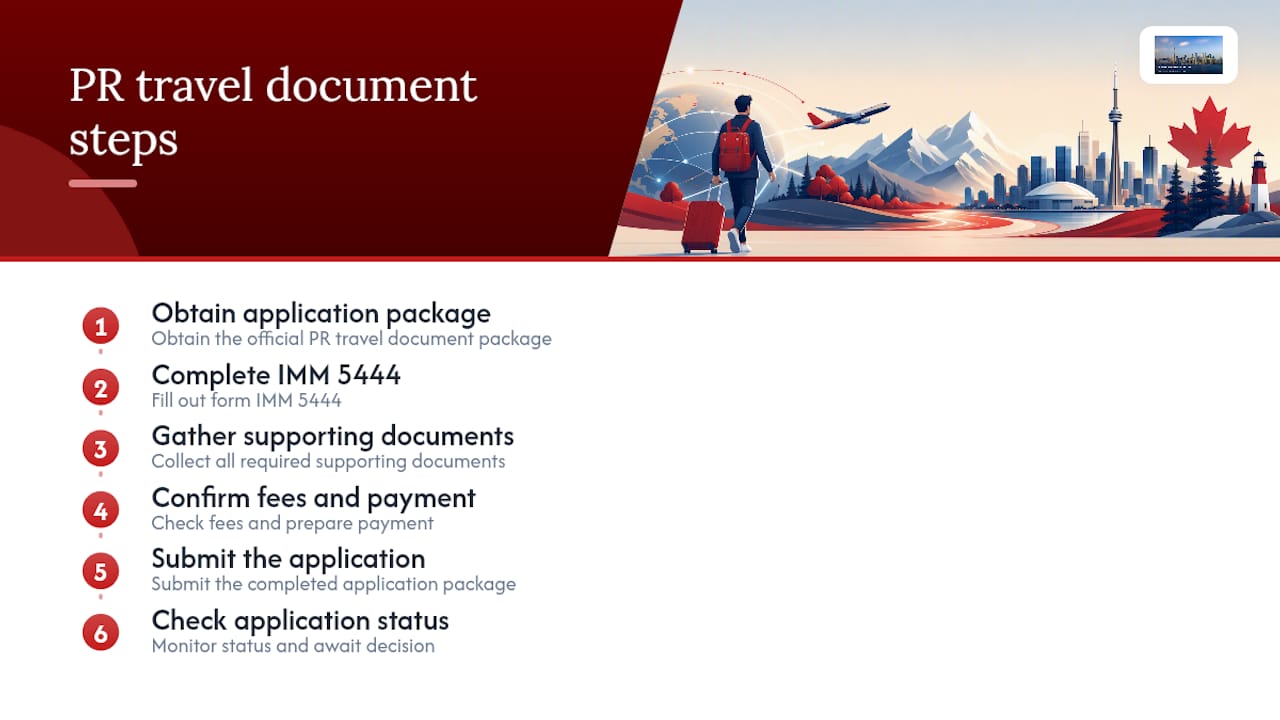
Step 1: Get the application package
Download or access the application package through Canada.ca. You need form IMM 5444 (Application for a Permanent Resident Card or Permanent Resident Travel Document) and the document checklist from Guide 5529. Read Guide 5529 fully before you fill out anything — it contains instructions that differ by country and submission method.
Step 2: Complete IMM 5444
Fill out every field. Incomplete forms are the single biggest cause of processing delays. If a field doesn’t apply to you, write “N/A” rather than leaving it blank. Sign and date where required.
Step 3: Gather your supporting documents
See the full checklist in the next section. At minimum, you need proof of identity, proof of PR status, residency evidence, and proof of travel. If you’re requesting urgent processing, add that evidence now.
Step 4: Confirm fees and pay
Check the current fee on Canada.ca before paying — fees can change and you want the most current amount. Pay through the method your local VAC or visa office accepts, and attach the fee receipt to your application. Do not send cash.
Step 5: Submit your application
The primary route is the Permanent Residence Portal (online). When online submission isn’t available in your country, submit to the Canadian visa office or VAC that serves your location. Follow the local VAC’s specific instructions — some offices have additional requirements or accept documents only in certain formats.
After submission, IRCC will contact you by email with instructions for passport submission once your application is approved. Do not send your passport until IRCC asks for it.
Step 6: Check your application status
Use the IRCC online portal or the Permanent Residence Portal to track your case. Processing time varies based on application volume, completeness, and how much verification the officer needs. A complete, well-organized application is the most reliable way to keep things moving.
What documents do you need for a PRTD application?
A complete submission is your best protection against delays. Here’s what IRCC expects:
Identity and status documents:
- Copy of your current valid passport (all pages, including blank ones)
- Copies of all passports or travel documents used in the past five years
- Proof of permanent resident status: your Record of Landing (IMM 1000), Confirmation of Permanent Residence (IMM 5292 or IMM 5688), or a previous PR card (front and back)
- Completed IMM 5444 and the IMM 5644 document checklist
Residency evidence (to prove the 730-day rule):
- CRA Notices of Assessment for the relevant years
- Employment records or pay stubs
- Bank statements showing Canadian transactions
- Rental or lease agreements
- Government benefit records (EI, provincial health coverage, etc.)
Aim for at least two independent pieces of evidence per year you’re claiming Canadian presence. Appendix A of Guide 5529 lists every acceptable evidence type — consult it directly.
Travel and payment documents:
- Proof of upcoming travel (flight itinerary or ticket receipt)
- Fee payment receipt
- Two passport-style photos meeting IRCC specifications
A few practical rules:
- Do not send original documents unless IRCC explicitly asks for them
- Documents not in English or French must include a certified translation and a copy of the original
- Scans must be clear, legible, and complete — a blurry or cut-off page will delay your file
Pro Tip: Before you upload or mail anything, create a single organized PDF folder with every document labeled by type and year (e.g., “CRA_NOA_2023.pdf”, “Passport_Bio_Page.pdf”). If IRCC requests additional information, you’ll be able to respond within hours instead of days.
When can you request urgent PRTD processing?
IRCC allows urgent processing in specific, defined situations. Vague requests don’t get prioritized — evidence quality matters far more than the length of your cover letter.
Qualifying reasons for urgent processing:
- A confirmed job start date that requires you to be in Canada
- Serious illness of yourself or an immediate family member
- Death of a family member requiring travel to Canada
- Loss or theft of your PR card (include a police report)
- A crisis situation in your current country of residence
- Other circumstances a visa officer deems legitimate
For each reason, you need matching evidence. A job letter alone isn’t enough — it needs to show the start date and confirm your presence is required. A medical situation needs a doctor’s note or hospital documentation. A death requires a death certificate.
How to request urgent processing:
Write a short, clear cover letter addressed to the visa office. State upfront that you are requesting urgent processing, explain the reason in one or two sentences, and list the evidence you’ve attached. Include your travel date prominently. Submit this with your full application package, not separately.
What to expect: IRCC processes urgent applications on a priority basis but does not guarantee a specific timeline. If your travel is fewer than five days away, contact the nearest Canadian visa office or VAC directly by phone or email in addition to submitting your application. Some offices have emergency appointment procedures for extreme situations.
Pro Tip: In your cover letter, include a short dated timeline: “I received notice of the job offer on [date], the start date is [date], and I need to board a flight no later than [date].” A concrete timeline gives the officer exactly what they need to assess urgency without having to piece it together from your documents.
Residency obligation: what happens if IRCC questions your status
You must meet the residency obligation to qualify for a PRTD. The rule is 730 days of physical presence in Canada within the five-year period immediately before your application.
| Evidence Type | What It Demonstrates |
|---|---|
| CRA Notices of Assessment | Tax filing in Canada for the relevant years |
| Employment records / pay stubs | Physical presence at a Canadian workplace |
| Bank statements | Regular financial activity in Canada |
| Lease or rental agreements | Canadian address during the period |
| Government benefit records | Active enrollment in Canadian programs |
| Travel stamps / entry records | Entry and exit dates corroborating your timeline |
A visa officer reviews your application and makes a discretionary decision. Even with documents submitted, an officer can refuse a PRTD if they conclude the residency obligation isn’t met. This is not a rubber-stamp process.
If an officer finds you did not meet the 730-day requirement, the consequences are serious: PRTD denial and a possible finding that you have lost your PR status. The narrow options at that point include requesting an appeal through the Immigration Appeal Division (IAD), which requires legal representation and takes time you may not have if you need to return urgently.
The best defense is preparation. Organize your evidence chronologically, year by year. Write a short cover letter that explains any extended absences (medical, family, employment outside Canada) and references the specific documents that account for those periods. Officers can assess a well-organized file far faster than a disorganized one, and a faster assessment works in your favor. For guidance on assembling chronological evidence, resources on interview document preparation can offer useful organizational frameworks.
What happens after you apply and how the PRTD works for re-entry
If IRCC approves your application, a visa officer issues the PRTD as a counterfoil affixed directly into your passport. That counterfoil is what you show the airline or carrier to board your flight to Canada.
The sequence after approval:
- IRCC sends you an email with instructions for passport submission
- You send your passport to the designated visa office (follow the exact instructions in the email)
- The visa office attaches the PRTD counterfoil to your passport and returns it
- You use the PRTD to board your commercial carrier
- Upon arrival in Canada, you clear immigration as a permanent resident
The PRTD is normally issued for single entry. Multiple-entry is possible if you meet the residency obligation and specifically request it, but single-entry is the default. Plan accordingly — don’t assume you can use it for a return trip.
Once you’re back in Canada, apply for a new PR card through the Permanent Residence Portal immediately. The PRTD is a temporary document. It does not replace your PR card for future travel.
If IRCC requests more information: Respond promptly and completely. A delayed response extends your processing time. If IRCC issues a refusal, you will receive a letter explaining the reasons. At that point, consulting a licensed immigration consultant or lawyer is worth the cost — a refusal based on residency concerns has implications beyond just the PRTD.
Checking your status: Log into the Permanent Residence Portal or use the IRCC online status checker. If your application has been in process longer than the posted processing time with no update, contact IRCC through their web form.
What working with a licensed consultant actually changes
Most PRTD applications are straightforward on paper. The ones that go sideways share a pattern: incomplete residency evidence, a poorly explained absence, or an urgency request that doesn’t match the supporting documents. Those are exactly the gaps a licensed consultant catches before submission.
Canadanumberoneimmigration is a Toronto-based immigration consultancy led by Minerva McCoon McBean, a licensed Regulated Canadian Immigration Consultant (RCIC). The firm works with permanent residents abroad on PRTD applications, including document review, urgency packaging, and direct liaison with visa offices when complications arise.
Where a consultant adds the most value is in three specific situations: you have a complex residency history with extended absences, your evidence is incomplete or spans multiple countries, or your travel timeline is tight enough that a single mistake means missing your flight. In those cases, having a licensed professional review your file before submission isn’t a luxury — it’s the practical choice.
The firm’s 98% success rate reflects a process built around getting applications right the first time. For permanent residents facing a residency challenge or a refusal risk, that track record matters.
Get help with your PRTD application
A PRTD application under time pressure is not the moment to guess at document requirements or hope your urgency letter is persuasive enough.
Canadanumberoneimmigration offers document review, urgent filing assistance, and full application preparation for permanent residents outside Canada who need to return. In a first consultation, you’ll get a case assessment, a clear list of the documents you need, and an honest estimate of your timeline and fees. Everything is handled under licensed RCIC representation, which means your application meets IRCC’s standards before it’s submitted. Visit the immigration services page to book your consultation, or review consultant fees to understand what professional help costs before you decide.
Official resources to bookmark
These are the pages you’ll return to repeatedly during your application. Each one serves a specific purpose.
Permanent resident travel document: About the process Start here. This page covers eligibility, the single-entry default, and links to the application portal. It also carries current processing time estimates.
Guide 5529 — Applying for a Permanent Resident Travel Document The authoritative procedural guide. Contains the document checklist, Appendix A (residency evidence), form instructions, and country-specific submission notes. Read it before you fill out anything.
Apply urgently for a PR card or PRTD Lists qualifying reasons for urgent processing and the evidence IRCC expects for each. If your travel is time-sensitive, this page tells you exactly what to include.
Permanent residents (travel) Explains the carrier requirement — why airlines check for a PR card or PRTD before boarding and what happens if you don’t have one.
Travelling with a permanent resident card — travel.gc.ca Covers PR card validity, expiry timelines, and what to do if you’re abroad without a valid card. Useful for understanding when a PRTD becomes necessary.
Travelling outside Canada as a permanent resident Explains the private vehicle exception and general travel rules for PRs, including the residency obligation context.
This article is general information, not a substitute for advice from a qualified lawyer. Consult a qualified legal professional about your own circumstances before acting on anything here.
Sources
Recommended
- Canada’s May 4th TR to PR Announcement: What Temporary Residents Need to Know | McBean Immigration
- Navigating Canada’s Revised Visitor Visa Guidelines | McBean Immigration
- Canada Announces New TR-to-PR Pathway in 2026: A New Opportunity for Temporary Workers | McBean Immigration
- How to Move to Canada from the USA (2026 Guide)
Stay Updated
Subscribe to our newsletter for the latest immigration news and tips.