Super Visa Requirements for Parents and Grandparents (2026)

Parents and grandparents of Canadian citizens or permanent residents can qualify for a Super Visa if the host meets minimum income thresholds, the applicant holds qualifying private medical insurance, and a designated panel physician has completed the immigration medical exam. The visa allows stays of up to five years per visit, though the border services officer at the port of entry makes the final call on authorized length of stay.
Before you start the application, confirm you have these three items ready:
- Letter of invitation from the host, showing the host meets the minimum necessary income for the family size
- Private health insurance policy valid for at least one year from the date of entry, with a minimum required emergency medical coverage set by IRCC
- Immigration Medical Exam (IME) proof completed by an IRCC-designated panel physician
Key Takeaways
A complete Super Visa application requires qualifying insurance, a host who meets the minimum necessary income, and an IME from a designated panel physician — all three must be in place before submission.
| Point | Details |
|---|---|
| Host income threshold | Family size determines the minimum; a family of 4 needs at least CAD $56,724, confirmed by a CRA Notice of Assessment. |
| Insurance floor | Policy must cover at least CAD $100,000 in emergency medical costs and be valid for one year from the date of entry. |
| Medical exam timing | Book the IME early with an IRCC-designated panel physician; the exam is valid for 12 months. |
| Biometrics urgency | Book your biometrics appointment the same day the IRCC instruction letter arrives to avoid adding weeks to processing. |
| Canadanumberoneimmigration | A licensed RCIC-led team that reviews income documents, insurance compliance, and full application packages before submission. |
Table of Contents
- What are the host eligibility and income requirements for a Super Visa?
- Who is eligible to apply, and where must you be when you apply?
- How do you calculate the minimum income and what documents prove it?
- What must the letter of invitation include?
- What are the Super Visa health insurance rules, and what trips people up at the border?
- How do you complete the immigration medical exam for a Super Visa?
- What documents do you need for a complete Super Visa application?
- How do you apply, and how long does processing take?
- What happens at the border, and how long can you stay?
- What are the most common reasons for refusal, and how do you avoid them?
- How can a licensed RCIC help with your Super Visa application?
- A practitioner’s perspective on what actually matters
- Canada Number One Immigration can take the guesswork out of your Super Visa file
- Sources
What are the host eligibility and income requirements for a Super Visa?
The person signing the invitation letter must be the applicant’s biological or adopted child or grandchild. They must be a Canadian citizen, permanent resident, or registered Indian, at least 18 years old, and living in Canada. A host who does not meet the minimum necessary income on their own may add a spouse or common-law partner as a co-signer, combining both incomes to reach the threshold. Other relatives cannot co-sign.
Proving host status and income
To prove they are a Canadian citizen or PR, the host typically submits a copy of their passport, citizenship certificate, or PR card. For income, the CRA Notice of Assessment (NOA) is the preferred document. IRCC accepts the NOA from either of the two taxation years preceding the application. If the NOA is not available, acceptable alternatives include:
- T4 or T1 General tax return
- Recent pay stubs (typically the last three months)
- Bank statements showing consistent deposits
- Pension statements
- Rental income evidence with a lease agreement
A co-signer must provide the same income documents. The applicant’s own income cannot be used to satisfy the host income requirement.
Pro Tip: Request your NOA directly from the CRA My Account portal. A printed copy with the CRA logo and assessment date is cleaner and faster for IRCC reviewers than a handwritten summary or a bank printout.
Who is eligible to apply, and where must you be when you apply?
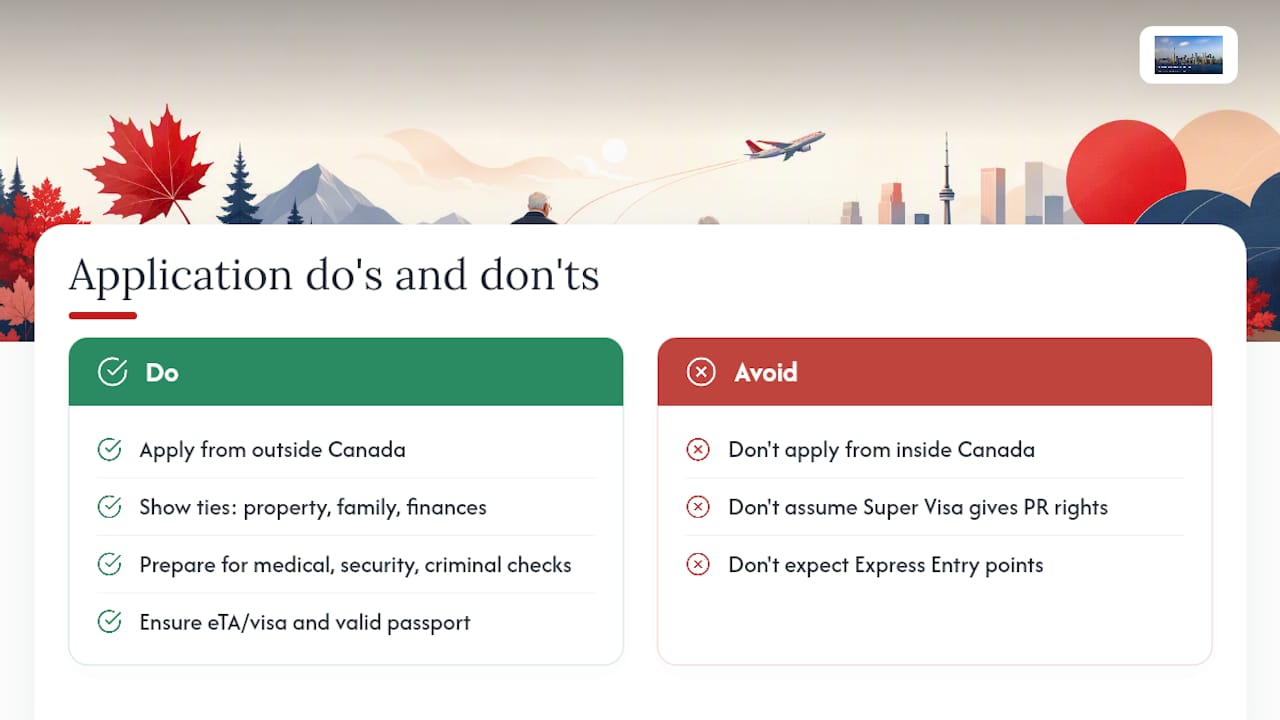
The applicant must be the parent or grandparent of a Canadian citizen, permanent resident, or registered Indian. The application must be submitted from outside Canada. Applying while inside Canada as a visitor is not permitted under the Super Visa stream.
IRCC also assesses admissibility on three fronts: medical, security, and criminality. A prior criminal record or a serious medical condition may require additional steps or waivers before the visa is approved. Applicants must also demonstrate genuine intent to leave Canada at the end of the authorized stay, typically through ties to their home country such as property ownership, family obligations, or financial accounts.
The Super Visa is a temporary resident document, not a pathway to permanent residence. Holding a Super Visa does not accumulate points toward Express Entry, does not count as residency for citizenship purposes, and does not create any right to remain in Canada beyond the authorized period.
Regarding travel documents: citizens of visa-exempt countries who travel to Canada by air need an Electronic Travel Authorization (eTA) in addition to the Super Visa. The visa itself is printed by the visa office and affixed to the passport, so the passport must be valid for the full intended period of stay.
How do you calculate the minimum income and what documents prove it?
Family size is the key variable. The count includes the host, the host’s spouse or common-law partner, all dependent children, any previously sponsored individuals still under the sponsorship undertaking, and the Super Visa applicant(s) being invited. Every person in the household counts, even if they are not listed on the tax return.
Minimum necessary income table
The figures below come from the IRCC and CRA-based income thresholds currently in effect:
Worked example 1: A host living with a spouse and one child (family of 3) inviting one parent = family size of 4. Minimum income required: $56,724.
Worked example 2: A single host with no dependents inviting both parents = family size of 3. Minimum income required: $46,720.
If the host’s income falls short, a co-signing spouse or common-law partner’s income is added. The combined total must meet or exceed the threshold for the full family size.
What must the letter of invitation include?
The letter of invitation is more than a formality. IRCC reviewers use it to verify the relationship, confirm the host’s status in Canada, and cross-check the income calculation. A weak or incomplete letter is one of the most common reasons for delays.
- Host’s full legal name, date of birth, address, and status in Canada (citizen, PR, or registered Indian), with a copy of the supporting document
- Applicant’s full legal name and relationship to the host (e.g., “my mother,” “my paternal grandfather”)
- Full list of all household members included in the family-size calculation, with names and dates of birth
- Commitment to financially support the applicant during the visit, including accommodation and living expenses
- Proof of income attached or referenced (NOA, T4, pay stubs, or other accepted documents)
- Dates of intended visit and confirmation the applicant will return home at the end of the authorized stay
If a co-signer is included, the letter should name both the host and co-signer, and the co-signer must provide their own income documents separately. Both parties sign the letter.
What are the Super Visa health insurance rules, and what trips people up at the border?
The insurance requirement is where most applications run into trouble, not at the IRCC stage, but at the port of entry. IRCC requires a private medical insurance policy with at least CAD $100,000 in emergency medical coverage, valid for a minimum of one year from the date of entry. The policy must cover health care, hospitalization, and repatriation.
Permitted insurers are Canadian companies licensed provincially or foreign insurers that are OSFI-authorized and doing insurance business in Canada at the time the policy is issued. This 2026 update made the Super Visa more accessible to applicants whose home-country insurers qualify under OSFI authorization.
Common pitfalls that cause entry-time problems:
- Effective date after arrival: The policy must be active on the day you land, not the day after.
- Coverage stated in foreign currency only: Border officers want to see a clear CAD amount. If using a foreign insurer, the policy should state the CAD equivalent explicitly.
- Policies that exclude pre-existing conditions without disclosure: Bring documentation of any exclusions so the officer understands the scope.
- Showing only a quote or payment receipt: You need the full policy certificate, not a booking confirmation.
Industry guidance from RBC Insurance notes that some applicants opt for CAD $150,000–$200,000 in coverage to get broader pre-existing-condition protection, even though $100,000 is the regulatory floor.
Pro Tip: When using a foreign insurer, confirm the policy certificate explicitly states the insurer was doing insurance business in Canada when the policy was issued. A certificate that omits this detail can create unnecessary delays at the border, even when the insurer is legitimately OSFI-authorized.
How do you complete the immigration medical exam for a Super Visa?
Every Super Visa applicant must complete an Immigration Medical Exam (IME) with an IRCC-designated panel physician. You cannot use your family doctor or a walk-in clinic. The panel physician submits results directly to IRCC electronically, and the applicant receives a copy of the upfront instructions and a confirmation of completion.
Steps to follow:
- Use the IRCC panel-physician locator to find an approved doctor in your country of residence.
- Book the appointment early, ideally before or at the same time as gathering other documents. Medical exams have a 12-month validity window, so timing matters.
- Bring your passport and any prior medical records the physician requests.
- After the exam, keep your copy of the IME instructions and any receipt or confirmation the physician provides.
- Include the IME proof in your visa application package. In most cases the physician transmits results directly, but confirm this with the clinic.
Do not delay the medical exam. If the exam expires before IRCC processes the application, you may need to repeat it.
What documents do you need for a complete Super Visa application?
A complete application package prevents the most common processing delays. Missing a translation or a certified copy is enough to trigger a request for additional documents, which can add weeks to the timeline.
- IRCC application forms: IMM 5257 (Application for Temporary Resident Visa), IMM 5645 (Family Information), and any visa-office-specific forms listed in the instructions for your country
- Valid passport with at least six months of validity beyond the intended stay
- Two recent passport-size photos meeting IRCC specifications
- Letter of invitation with all required content (see the invitation section above)
- Proof of host’s Canadian status (citizenship certificate, PR card, or Indian status card)
- Host income documents (NOA preferred, plus alternatives if needed)
- Private health insurance policy certificate meeting IRCC minimums
- IME proof or confirmation of submission by the panel physician
- Proof of relationship (birth certificate, adoption certificate, or equivalent)
- Proof of ties to home country (property documents, employment letter, bank statements)
Translation rules: Every document not in English or French must be accompanied by a certified translation and a translator’s affidavit confirming accuracy. A bilingual friend’s translation does not qualify. Use a certified translator, and attach both the original document and the translation.
Check the visa-office-specific instructions for your country on the IRCC website. Some offices require additional forms or have specific submission formats.
How do you apply, and how long does processing take?
Most applicants submit online through the IRCC secure portal. Paper applications are accepted in limited circumstances, typically when the applicant cannot apply online due to accessibility issues.
- Create or log into your IRCC secure account.
- Complete all required forms and upload supporting documents in the specified file formats.
- Pay the application fee and the biometrics fee when prompted. Do not skip the biometrics payment.
- Once IRCC issues a biometrics instruction letter, book your biometrics appointment immediately. Delays in booking extend overall processing time, sometimes by weeks.
- Attend the biometrics appointment at a Visa Application Centre (VAC) in your country.
- Track your application status through the IRCC online portal using your application number.
Processing times vary by visa office and application volume. Check the IRCC processing-times tool for current estimates for your country. The visa, once approved, is printed by the visa office and affixed to your passport.
Air travelers from visa-exempt countries also need an eTA, which is typically issued automatically when the visa is approved, but confirm this for your specific nationality.
What happens at the border, and how long can you stay?
The Canada Border Services Agency (CBSA) officer at the port of entry makes the final decision on admission and authorized length of stay. A valid Super Visa does not guarantee entry. Officers verify identity, check the insurance certificate, review the invitation letter, and may ask questions about the purpose and length of the visit.
The Super Visa allows up to five years per entry. The visa itself can be issued as a multiple-entry visa valid for up to 10 years, meaning you can travel back and forth without reapplying, as long as each entry is covered by qualifying one-year insurance.
Arrive with these documents in your carry-on, not checked luggage:
- Original letter of invitation from the host
- Proof of host’s Canadian status (copy of PR card or citizenship certificate)
- Full insurance policy certificate showing CAD coverage, effective date, and one-year validity
- Passport with the Super Visa affixed and eTA confirmation (if applicable)
- IME confirmation or proof of exam completion
- Evidence of ties to your home country
What are the most common reasons for refusal, and how do you avoid them?
Most refusals and shortened stays at the border come down to a short list of preventable problems.
- Insurance effective date is wrong: The policy must start on or before the date of entry, not after.
- Family-size calculation is off: Forgetting to count a dependent child or a previously sponsored individual is a frequent error that pushes income below the threshold.
- NOA is missing or too old: IRCC wants the NOA from one of the two preceding tax years. A 2020 NOA submitted in 2026 will not be accepted.
- Passport expires too soon: The passport must cover the full intended stay.
- Translations are missing or uncertified: Every non-English/French document needs a certified translation with an affidavit.
- Biometrics not completed on time: Late biometrics booking delays the entire application.
- Insurance policy is a quote, not a paid certificate: Bring the actual policy document, not a price estimate.
For entry-time problems, the most common fix is buying a compliant insurance policy before travel. If a CBSA officer finds the insurance insufficient, they may admit the applicant as a regular visitor for a shorter period rather than activating the full Super Visa stay. That shorter admission cannot easily be extended to the full five years without leaving Canada and re-entering with correct documentation.
Review the common application pitfalls before you submit.
How can a licensed RCIC help with your Super Visa application?
A licensed Regulated Canadian Immigration Consultant (RCIC) adds the most value in three situations: complex income arrangements (self-employment, multiple income sources, or co-signer situations), prior refusals, and cases involving medical inadmissibility concerns.
Canadanumberoneimmigration offers Super Visa support that covers:
- Eligibility assessment and family-size calculation review
- Letter-of-invitation drafting guidance and income document verification
- Insurance policy compliance checks against current IRCC rules
- IME coordination and panel-physician referrals
- Biometrics timing and application submission support
- Case management through visa office communications
For applicants with prior refusals or time-sensitive travel plans, having a licensed consultant review the file before submission is a straightforward way to reduce risk.
A practitioner’s perspective on what actually matters
The official IRCC pages tell you what to submit. What they don’t tell you is how small formatting choices affect processing speed and port-of-entry outcomes.
The NOA is the clearest income document IRCC reviewers see all day. Submit it first in the income section of the package, not buried behind pay stubs. Align the insurance effective date to the day before your planned entry, not the day of. That one-day buffer prevents a scenario where a flight delay pushes your arrival past the policy start date.
Book biometrics the same day the instruction letter arrives. Not the next week. The same day. Applicants who wait lose two to three weeks of processing time for no reason.
On insurance: the certificate needs to name the insured person, state the coverage in CAD, and show the exact effective and expiry dates on the first page. A policy that buries those details in a schedule on page 12 will slow down the border officer and may prompt additional questions. Clarity in the document is not a nicety; it is what gets you through the primary inspection line without being pulled aside.
Canada Number One Immigration can take the guesswork out of your Super Visa file
Getting the Super Visa right the first time saves months of waiting and the cost of a second application. Canadanumberoneimmigration’s immigration consulting services are built specifically for situations like this: a licensed RCIC reviews your income documents, verifies your insurance policy against current IRCC rules, and confirms your application package is complete before it leaves your hands.
The firm handles document package reviews, NOA verification, insurance compliance checks, biometrics coordination, and full submission support. Book a paid consultation at Canadanumberoneimmigration to get a clear picture of what your application needs and what it will cost to get it done right.
Sources
Always verify details directly with official sources, as thresholds and policies are updated periodically.
This article is general information, not a substitute for advice from a qualified lawyer. Consult a qualified legal professional about your own circumstances before acting on anything here.
Recommended
- Navigating Canada’s Revised Visitor Visa Guidelines | McBean Immigration
- Visitor Visas & Super Visas Canada | McBean Immigration
- Canadian Immigration Programs to Target in 2026 | McBean Immigration
- Major Ontario Immigration Changes Coming May 30, 2026: What This Means for Applicants | McBean Immigration
Stay Updated
Subscribe to our newsletter for the latest immigration news and tips.