
Work Permit Extension in Canada: Keep Working Legally

Apply online to extend or change your Canadian work permit before your current permit expires — that single action is what keeps you legally authorized to work. The moment IRCC receives your application, you gain maintained status, which lets you continue working under the same conditions while a decision is pending. Miss that deadline and you lose the right to work immediately.
Here is what to do in the next 72 hours:
- Check your permit expiry date on your current work permit and count back at least 30 days — that is the minimum IRCC recommends, but a safer approach is to apply well in advance, considering that processing times can often be longer than expected.
- Confirm your eligibility to apply from inside Canada (you must be physically present, in valid status, and hold a qualifying permit type).
- Start your online IRCC account and locate IMM 5710 (Application to Change Conditions, Extend my Stay or Remain in Canada as a Worker) — this is the form every inside-Canada extension or condition change runs through.
One critical timing detail: online submissions must be received by IRCC before midnight UTC on your expiry date. If you are in Vancouver and your permit expires at midnight local time, that is already 8:00 AM UTC the next day — you have more room. But if you are in Halifax, midnight UTC is 8:00 PM local time, which means you must submit before 8:00 PM Atlantic time on your expiry date. Do not cut it close.
Key Takeaways
Applying before your work permit expires is the single action that preserves your right to work in Canada under maintained status while IRCC processes your extension.
Table of Contents
- Who can apply for a work permit extension from inside Canada?
- Open vs. employer-specific permits: when do you need a new one?
- When should you apply to protect your right to work?
- What documents do you need for your application?
- What are the official fees and realistic processing times?
- How to complete and submit your application step by step
- Special cases: BOWP, PGWP holders, vulnerable workers, and Quebec
- When should you hire a licensed immigration consultant?
- Sources
Who can apply for a work permit extension from inside Canada?
Eligibility for an inside-Canada application comes down to four gates, and you need to clear all of them.
You must be physically in Canada at the time you submit. Applying from outside Canada is a different stream with different rules, and the two are not interchangeable.
Your current status must be valid when you submit. This means your work permit has not yet expired and you have not violated any conditions of your stay. If your status has already lapsed, you are in restoration territory — covered in the next section.
Your passport must be valid for at least as long as the permit you are requesting. IRCC will not issue a work permit that outlasts your travel document. If your passport expires in eight months and you want a two-year extension, renew the passport first.
Your permit category must qualify. Most employer-specific (closed) and open work permit holders can apply from inside Canada. Post-Graduation Work Permit (PGWP) holders, vulnerable workers, and applicants using the Bridging Open Work Permit (BOWP) route each have category-specific eligibility conditions layered on top of the general gates.
Eligibility trap to watch: Provincial Nominee Program (PNP) candidates often confuse a provincial nomination with an Acknowledgement of Receipt (AOR) from IRCC. A provincial nomination alone does not qualify you for a BOWP. You need an AOR from IRCC confirming your federal PR application is in the system. Applying for a BOWP with only a provincial nomination letter is one of the most common refusal triggers in this category.
Pro Tip: If you are a PNP candidate, check the updated IRCC work permit extension policy for PNP candidates before you file — the eligibility rules have specific nuances that differ from standard extension applications.
Open vs. employer-specific permits: when do you need a new one?
The type of work permit you hold determines what you can change without filing a new application.
An open work permit lets you work for almost any employer in Canada, in almost any occupation. You can switch jobs, change cities, or take on contract work without notifying IRCC, as long as your permit remains valid. Extending an open work permit means you are simply asking for more time under the same open conditions.
An employer-specific (closed) work permit ties you to a named employer, a specific job title, and often a specific location. The permit spells out exactly what you are authorized to do. Any meaningful deviation from those conditions requires a new permit, not just an extension.
Changes that always require a new permit application:
- Starting work with a different employer (even temporarily)
- A significant change in job duties or NOC code
- Moving to a different work location when the permit specifies a location
- Switching from an employer-specific permit to an open work permit (or vice versa)
The nuance that trips people up: extending and changing conditions both use the same form (IMM 5710) and the same application stream. But they are not the same thing. If you are extending with the same employer under the same conditions, you are extending. If you are changing employers, changing your job title, or switching permit types, you are changing conditions — and you will need supporting documentation that reflects the new arrangement, including a new job offer letter and potentially a new Labour Market Impact Assessment (LMIA) or employer portal offer number.
PGWP holders and BOWP applicants are exceptions to some of these rules. A PGWP is an open permit, so extending it is straightforward if you still qualify. BOWP applicants are moving from an employer-specific permit to an open permit as part of their PR pathway — that transition has its own eligibility gates, covered in the special cases section below.
When should you apply to protect your right to work?
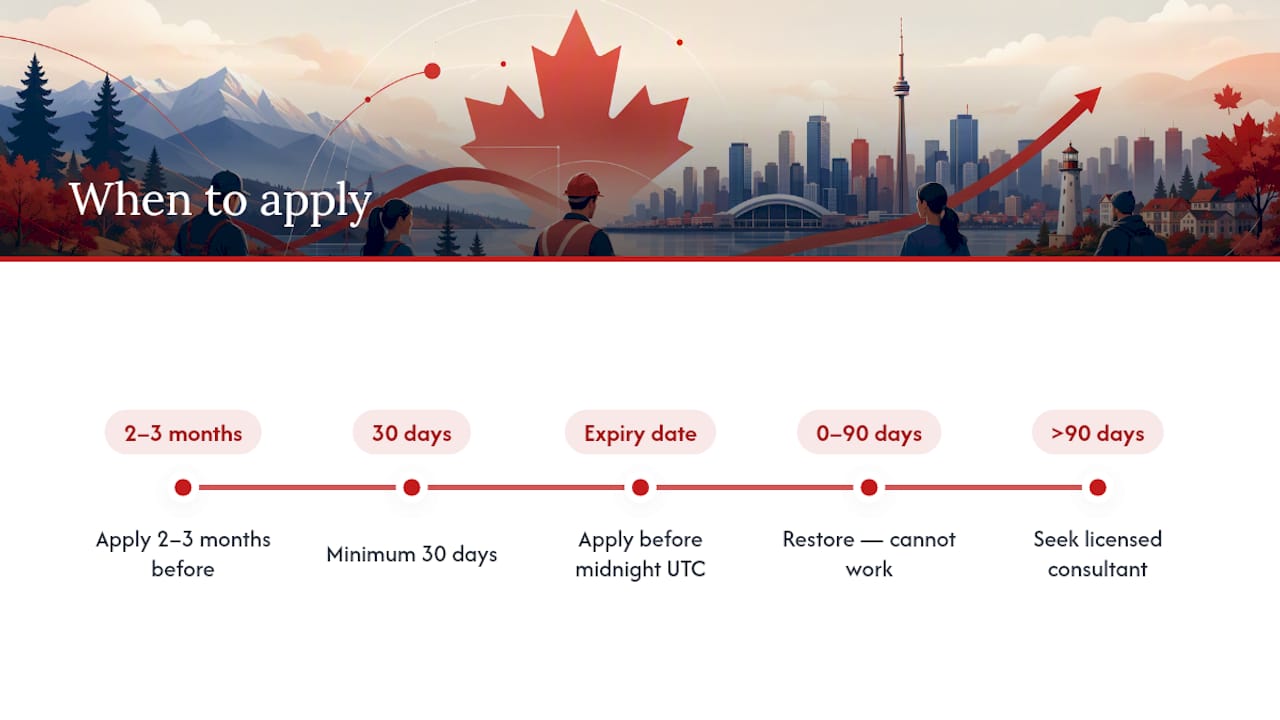
The core rule is simple: IRCC must receive your application before your work permit’s printed expiry date. Submit online before midnight UTC on that date and you are covered. Submit one minute after and you are not.
IRCC recommends applying at least 30 calendar days before expiry, but that is a floor, not a target. Processing times regularly exceed IRCC’s own service standards, and a 30-day buffer can evaporate quickly if your application is flagged for additional review or if biometrics are required.
The maintained-status rule: Once IRCC receives your application before your permit expires, you are automatically granted maintained status. You can keep working under the exact same conditions — same employer, same job, same hours — until IRCC issues a final decision. Your original permit may show an expired date, but your authorization to work continues. Online applicants receive a WP-EXT letter in their IRCC account immediately after submission; this letter is what you show your employer as proof that you are still authorized to work.
Maintained status does not give you new rights. You cannot change employers, change job duties, or travel outside Canada and expect to re-enter on maintained status alone. It preserves what you already had, nothing more.
What if you missed the deadline? If your status has already expired, you have a 90-day window to apply for restoration. Restoration is not the same as an extension. While your restoration application is pending, you cannot work. You also pay a separate restoration fee on top of the standard work permit fee. If the 90-day restoration window has also passed, restoration is no longer available and your options narrow significantly — that is when you need a licensed consultant immediately.
Pro Tip: Apply 2–3 months before your expiry date whenever possible. If your employer needs an LMIA or your situation involves a BOWP, the document-gathering alone can take weeks. Building in that buffer means a slow employer or a delayed LMIA decision does not cost you your maintained status.
What documents do you need for your application?
Guide 5553 is the authoritative document checklist for inside-Canada applications. Read it before you start gathering anything. The list below covers what most applicants need, but your specific situation may require additional items.
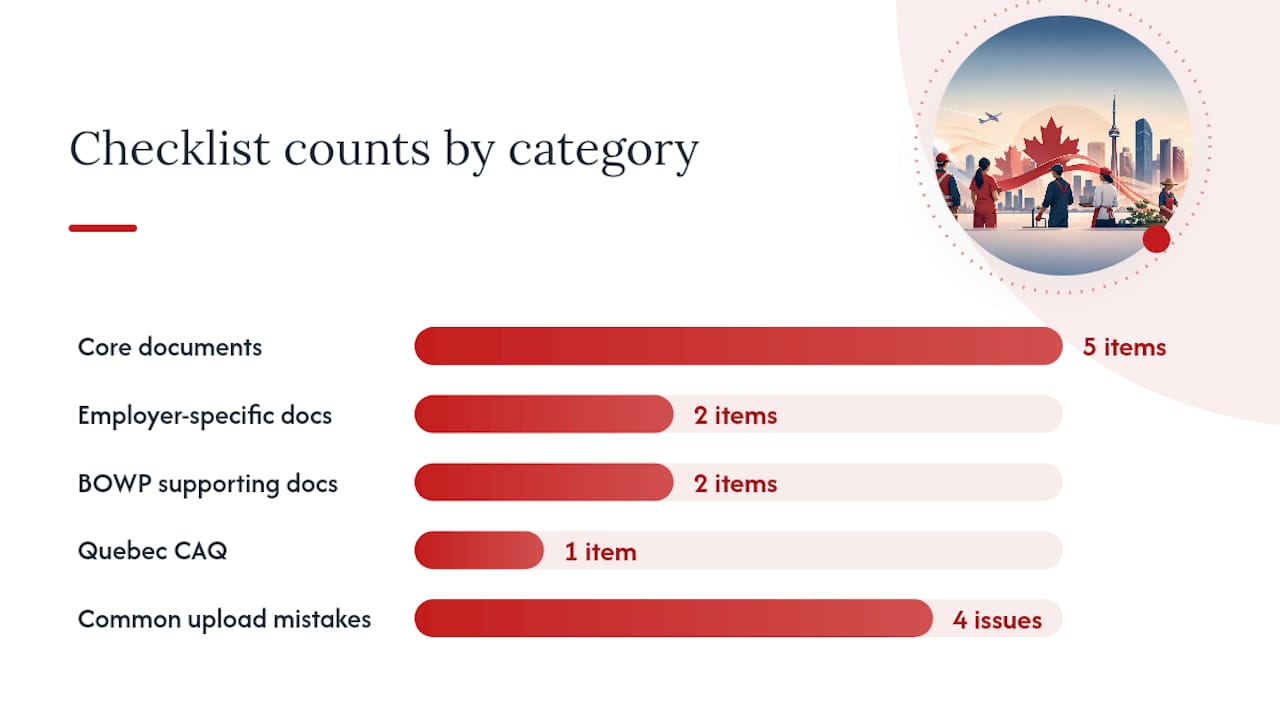
Core documents for most applicants:
- Copy of your current work permit (front and back)
- All valid passport pages (biographical page plus any entry stamps or visas)
- A detailed job offer letter or employment contract from your employer, on company letterhead, signed, and specifying your job title, NOC code, salary, hours, and start date
- Proof of your current immigration status in Canada (your most recent entry stamp or record of landing if applicable)
- Digital photos meeting IRCC specifications
Employer-specific permit applicants also need:
- LMIA approval letter and LMIA number, OR employer-specific offer number from the Employer Portal if your employer used that route
- Employer’s CRA business number
BOWP applicants additionally need:
- AOR from IRCC confirming your PR application is in the system
- Evidence of your qualifying PR stream (Express Entry profile, PNP nomination confirmation, etc.)
Quebec applicants: If you work in Quebec, you also need a Certificat d’acceptation du Québec (CAQ) from the Quebec government. IRCC will not approve a Quebec-based work permit without it. This is one of the most frequently missed documents in Quebec applications.
Biometrics: If you have not given biometrics to IRCC in the past 10 years, you will need to provide them as part of your application. After you submit online and pay the biometrics fee, IRCC sends a biometrics instruction letter (BIL). You then book an appointment at a Service Canada location or a designated collection point. Biometrics results are valid for 10 years, so many renewal applicants will not need to repeat this step.
Common upload mistakes that cause delays: file names with special characters, PDFs that exceed IRCC’s size limits, scanned documents that are too dark to read, and submitting only the front of a two-sided permit. Name your files clearly (e.g., “passport_biographical_page.pdf”) and check every scan before uploading.
What are the official fees and realistic processing times?
Fees are set by IRCC and do not change based on your province or permit type, with one exception: the open work permit holder fee applies only when you are applying for an open work permit.
The processing fee ($155) is generally non-refundable once IRCC begins reviewing your application. The open work permit holder fee ($100) may be refunded in specific circumstances — Guide 5553 outlines the conditions. Pay all fees through your IRCC online account using a credit card; IRCC does not accept cash or money orders for online applications.
On processing times: IRCC publishes service standards, but those numbers are averages and the actual time for your application can be longer. Demand fluctuates, and applications that require additional review, biometrics collection, or employer compliance checks take more time. The practical advice is consistent: do not plan around the published estimate. Apply early enough that even a significantly delayed decision does not create a gap in your work authorization. Check IRCC’s live processing time tool directly on Canada.ca before you file — the number changes regularly and any figure printed in a guide (including this one) may already be outdated by the time you read it.
How to complete and submit your application step by step
The entire process runs through your IRCC secure online account. Here is the sequence:
-
Create or log in to your IRCC online account at canada.ca. If you already have an account from a previous application, use the same login.
-
Start a new application and select “Extend my stay or change conditions as a worker.” The system will walk you through a series of eligibility questions before presenting the IMM 5710 form fields.
-
Complete the IMM 5710 fields carefully. The fields that most often cause problems:
- Type of permit requested: Be precise. “Open work permit” and “employer-specific work permit” are not interchangeable. Select the one that matches your situation.
- Employer details: Enter the exact legal name of your employer as it appears on their CRA registration, not a trade name or abbreviation.
- LMIA or offer number: If your employer used the Employer Portal, enter the offer number exactly as it appears in the portal confirmation. A single digit error causes a processing delay.
- Intended duration: Request a duration that does not exceed your passport validity.
-
Upload your supporting documents in the correct document slots. IRCC’s system labels each slot — do not upload a job letter into the passport slot. Double-check every file opens correctly before submitting.
-
Pay the applicable fees using a credit or prepaid card. The system calculates the total based on your answers. Review the fee summary before confirming payment.
-
Submit before your permit’s expiry date (before midnight UTC). After submission, your IRCC account will show a confirmation number and, for online applicants, the WP-EXT letter will appear in your account. Download it and share it with your employer immediately — it is your proof of continued work authorization.
-
Complete biometrics if required. If IRCC sends a biometrics instruction letter, book your appointment promptly. Delays in completing biometrics can stall your application.
-
Monitor your application status through your IRCC account. If IRCC sends a request for additional documents (an “additional document request” or ADR), respond within the timeframe stated in the request. Missing an ADR deadline can result in a refusal.
If your application is refused, IRCC will send a refusal letter explaining the reasons. You generally cannot appeal a work permit refusal directly, but you can reapply with a corrected application or request a judicial review through the Federal Court. A licensed consultant is particularly valuable at this stage.
Special cases: BOWP, PGWP holders, vulnerable workers, and Quebec
Bridging Open Work Permit (BOWP)
The BOWP is designed for foreign nationals who have applied for permanent residence and need to keep working while their PR application processes. It converts an employer-specific permit into an open work permit, giving you flexibility while you wait.
The eligibility gates are strict:
- You must hold a valid employer-specific work permit (not an open permit)
- Your current permit must expire within a limited time window before the date IRCC receives your BOWP application—applying too early may lead to refusal
- You must have an AOR from IRCC confirming your PR application is in the system (Express Entry, PNP federal stage, or another qualifying stream)
- You must be physically in Canada when you apply
The four-month window is the most common BOWP refusal trigger. Applicants who apply six months before expiry thinking they are being proactive get refused because they are outside the window. Set a calendar reminder for the date that falls four months before your permit expires — that is your earliest eligible BOWP application date.
Leaving Canada while your BOWP application is pending can end your maintained status and complicate re-entry. Stay in Canada until you have a decision in hand.
PGWP holders
PGWP holders hold an open work permit, so they are not BOWP-eligible (BOWP requires an employer-specific permit). If your PGWP is expiring and you have not yet applied for PR, your options are to apply for a different open work permit (if you qualify under another stream) or an employer-specific permit backed by an LMIA. PGWP extensions are not available — the PGWP is issued once and cannot be renewed.
Vulnerable workers
Workers in vulnerable situations (those experiencing abuse or at risk of abuse from an employer) may be eligible for an open work permit specifically for vulnerable workers. This route does not require an LMIA and has a reduced fee structure. IRCC’s guidance on this stream is specific about what constitutes a qualifying situation.
Quebec-specific rules
Quebec controls its own immigration selection for economic immigrants. Work permit applicants in Quebec generally need a CAQ from the Quebec government before IRCC will issue a federal work permit. The CAQ application runs through the Ministère de l’Immigration, de la Francisation et de l’Intégration (MIFI) and has its own processing time, which you need to factor into your overall timeline.
When should you hire a licensed immigration consultant?
Most straightforward extensions — same employer, same conditions, valid status, no complications — are manageable without professional help if you read Guide 5553 carefully and follow the steps above. But several situations genuinely call for a licensed Regulated Canadian Immigration Consultant (RCIC).
Hire a consultant when:
- Your permit expires in less than 30 days and you have not yet started the application
- Your employer’s LMIA is delayed, expired, or was refused
- You are applying for restoration (status already lapsed)
- Your previous application was refused and you are reapplying
- You need a BOWP and are unsure whether your AOR qualifies or whether the four-month window applies to your situation
- You are considering leaving Canada while an application is pending and need to understand the re-entry risk
- Your employer situation is complex (multiple employers, corporate restructuring, change in ownership)
An RCIC can review your IMM 5710 before submission, catch documentation gaps that cause refusals, handle BOWP timing calculations, prepare restoration submissions, and represent you if IRCC requests an interview or additional information. The value is not just in knowing the rules — it is in knowing which rules apply to your specific combination of permit type, employer situation, and PR pathway.
Canadanumberoneimmigration offers work permit services covering LMIA-based employer-specific permits, open work permits, BOWP applications, and restoration submissions. When you book a paid consultation, bring your current permit, your passport, your most recent job offer or employment contract, and your AOR if you have one.
What practitioners see applicants get wrong most often
The most common error is timing. Applicants wait until the 30-day mark, then discover their employer’s LMIA has expired or their job letter is missing the NOC code. By the time the corrected letter arrives, they are inside two weeks of expiry and filing in a panic. The application goes in incomplete, IRCC sends an ADR, and the back-and-forth eats up the maintained-status buffer.
The second most common error is the AOR/BOWP confusion described earlier. A provincial nomination is not an AOR. Applicants who file a BOWP with a PNP nomination letter instead of a federal AOR get refused, then have to scramble for a standard extension while their PR application continues processing.
Travel is the third trap. Once you are on maintained status, leaving Canada ends it. You cannot re-enter on a maintained-status basis — you need a valid permit or a valid visa to return. Applicants who travel for a family emergency while their extension is pending sometimes find themselves stuck outside Canada, unable to return to work, because their permit expired while they were abroad and maintained status ended the moment they crossed the border.
One-line corrective for each: apply 2–3 months early, confirm your AOR before filing a BOWP, and do not leave Canada while any work permit application is pending unless you have confirmed with a licensed consultant that re-entry is not at risk.
Canadanumberoneimmigration: RCIC-led work permit help in Toronto
Getting a work permit extension right the first time is cheaper than fixing a refusal. Canadanumberoneimmigration is a Toronto-based consultancy led by Minerva McCoon McBean, a licensed RCIC with a high success rate in handling work permit, PR, and sponsorship files.
For work permit extensions and changes, the firm handles IMM 5710 preparation, BOWP timing and eligibility assessment, restoration submissions, and employer document review. If your situation involves a complex LMIA, a recent refusal, or a tight expiry window, a paid consultation gives you a clear action plan before you file. Transparent fee information is available at McBean Immigration fees. To book an assessment and get your application reviewed by a licensed professional, visit McBean Immigration services.
Sources
These are the primary sources used throughout this guide. Check each one directly on Canada.ca for the most current version — IRCC updates these pages when policy changes.
- Canada
Before relying on any processing time figure, check IRCC’s live processing time tool on Canada.ca directly. Published estimates in guides and articles go stale quickly, and the live tool reflects current volumes.
This article is general information, not a substitute for advice from a qualified lawyer. Consult a qualified legal professional about your own circumstances before acting on anything here.
Recommended
- Updated 2024 IRCC Work Permit Extension Policy for PNP Candidates | McBean Immigration
- Canada Ends Visitor-to-Work Permit Policy Effective August 28 | McBean Immigration
- Manitoba to Offer Two-Year Work Permit Ext. for MPNP Candidates | McBean Immigration
- Canada Work Permits: LMIA & Open | McBean Immigration
Stay Updated
Subscribe to our newsletter for the latest immigration news and tips.