C11 Work Permit for Entrepreneurs: 2026 Guide

The C11 work permit is the fastest route into Canada for foreign entrepreneurs who want to own and actively run a business without waiting for a Labour Market Impact Assessment. Under IRPR R205(a), the C11 exemption sits inside the International Mobility Program and applies when your business activity will produce a measurable “significant benefit” to Canada, whether economic, social, or cultural. IRCC officers have wide discretion on these files, which means the strength of your evidence package matters far more than any checklist.
Your immediate next step: build a credibility-focused business plan and evidence package that ties every claim to something verifiable in Year 1 of operations. Here is what that looks like in practice:
- Who it’s for: Foreign nationals who will own and actively manage a Canadian business, not passive investors or minority shareholders.
- Legal basis: IRPR R205(a) under the Immigration and Refugee Protection Act, administered by IRCC through the International Mobility Program.
- What wins: A business plan grounded in Canadian market data, near-term hiring commitments, proof of capital already moved to Canada, and clear ownership/governance documents.
- Who can help: A licensed Regulated Canadian Immigration Consultant (RCIC) like those at Canadanumberoneimmigration can review your file before submission and catch structural weaknesses that lead to refusals.
Pro Tip: Before you draft a single page of your business plan, confirm your ownership structure gives you operational control. A minority stake with no management authority will not satisfy the owner-operator requirement, no matter how strong the rest of the file is.
Key Takeaways
The C11 work permit is approved or refused based on the quality of the evidence behind the significant benefit claim, not the ambition of the business plan.
| Point | Details |
|---|---|
| C11 legal basis | IRPR R205(a) under the IMP; LMIA-exempt for owner-operators who demonstrate significant benefit to Canada. |
| Owner-operator requirement | You must hold operational control and actively manage the business, not just hold shares. |
| Evidence beats projections | Executed leases, wire transfers, and signed offer letters outweigh forward-looking projections with no documents behind them. |
| Renewals require proof of activity | Updated financials, payroll records, and CRA filings are expected at renewal; file at least 30 days before expiry. |
| Canadanumberoneimmigration | A licensed RCIC firm offering C11 business plan review, evidence assembly, and regulated representation before IRCC. |
Table of Contents
- What the C11 work permit is and how it differs from LMIA-based routes
- Who qualifies: ownership, active management, and the eligibility contours
- What “significant benefit” actually means and the evidence IRCC expects
- Money: investments, personal funds, and the real application costs to plan for
- Exactly what to put in the business plan and which supporting documents to attach
- Step-by-step application options and the procedural route to choose
- Processing times, renewals, and how C11 can be used as a bridge to permanent residency
- Top reasons C11 applications fail and how to avoid them
- How Canadanumberoneimmigration helps with C11 applications
- What we see in successful C11 files
- Ready to file your C11 application? Here is how to get started
- Sources
What the C11 work permit is and how it differs from LMIA-based routes
The C11 is an LMIA-exempt work permit, meaning no Canadian employer needs to prove they could not find a local worker first. That distinction matters enormously for entrepreneurs because the standard LMIA process is designed for employment relationships, not ownership ones. When you are the business, the LMIA route simply does not fit.
The legal authority flows from IRPR R205(a), which allows IRCC to issue a work permit where the work would create a significant benefit to Canada. The International Mobility Program administers this exemption under the broader authority of the Immigration and Refugee Protection Act. Unlike the Intra-Company Transfer (ICT) stream, which requires a pre-existing corporate relationship, or the Start-Up Visa Program, which requires a designated organization’s endorsement, C11 is open to any entrepreneur who can demonstrate that benefit.
How C11 differs from other routes:
- vs. LMIA-based work permits: No employer-employee relationship required; you are the owner-operator. No recruitment advertising or prevailing wage requirements.
- vs. Intra-Company Transfer (ICT): ICT requires a qualifying relationship between a foreign parent and a Canadian entity. C11 does not.
- vs. Start-Up Visa: Start-Up Visa is a permanent residency pathway requiring endorsement from a designated venture capital fund, angel investor group, or business incubator. C11 is a temporary work permit with no such gatekeeping.
- vs. Provincial Entrepreneur Streams: Provincial streams often have published minimum net worth and investment thresholds and lead directly to PR. C11 is federal, discretionary, and temporary, though it can support a later PR application.
When entrepreneurs typically use C11: launching a new Canadian startup, acquiring an existing Canadian business, expanding an international company into Canada as the controlling owner, or operating as a self-employed professional in a field with demonstrable social or cultural benefit.
Statistic callout: IRCC’s operational instructions for C11 note that initial C11 permits are typically issued for a period of time that can vary, with renewals available when the applicant continues to demonstrate active management and ongoing significant benefit.
Who qualifies: ownership, active management, and the eligibility contours
C11 eligibility is not a pass/fail checklist. Officers weigh the totality of evidence, but three factors consistently determine whether a file holds up.
Ownership and control. IRCC expects you to hold a meaningful ownership stake and exercise genuine operational authority. Documents that prove this include a shareholder register, a shareholders’ agreement, corporate minute books, and a board resolution naming you as the managing director or equivalent.
Active management. Owning shares is not enough. Officers look for evidence that you will be physically present in Canada, making operational decisions, signing contracts, managing staff, and directing the business. A job description that reads like a CEO or general manager role, supported by an organizational chart, strengthens this claim considerably.
Other eligibility requirements:
- Admissibility: You must be admissible to Canada. Criminal history, prior immigration violations, or certain health conditions can affect eligibility.
- Medical examination: Required for applicants from certain countries or those working in occupations with public health implications. IRCC’s work permit guidance specifies when medicals apply.
- Police certificates: Required from every country where you have lived for six or more months in the past ten years.
- Biometrics: Required for most applicants; collected at a Visa Application Centre.
When C11 is not appropriate:
- Passive investment with no operational role (silent partner, portfolio investor).
- Minority shareholding with no management authority.
- A business concept with no operational steps taken yet and no capital committed.
- Situations where the applicant’s role is purely advisory or consulting without ownership.
Pro Tip: If your ownership structure involves a holding company, a trust, or a joint venture, document the chain of control explicitly. Officers need to trace the line from you to operational authority without ambiguity.
What “significant benefit” actually means and the evidence IRCC expects
“Significant benefit” is the heart of every C11 file. IRCC’s operational bulletin for R205 C11 identifies four primary benefit categories: economic, social, cultural, and scientific. For most entrepreneurs, the economic case is the strongest and the most straightforward to document.
Officer indicators IRCC uses to assess benefit:
- Job creation: Signed offer letters, an organizational chart showing planned hires, and a hiring timeline tied to revenue milestones.
- Capital investment: Wire transfer records showing funds moved to a Canadian business bank account, investor agreements, and a capitalization table.
- Tax and revenue contribution: Financial projections showing Canadian corporate tax obligations, GST/HST registration, and payroll remittances.
- Market development: Export contracts, letters of intent from Canadian customers or distributors, and evidence of filling a gap in the Canadian market.
- Innovation or service to underserved communities: R&D milestones, patents filed, or letters from community organizations confirming the service need.
The distinction officers draw is between demonstrable benefit and speculative benefit. Executed documents beat unsigned ones every time.
The strongest C11 files tie each benefit claim directly to verifiable near-term actions: an executed supplier contract, a signed lease, funds already wired to a Canadian bank account, and signed offer letters for Canadian hires. Distant future projections without these anchors are the single most common reason officers find the benefit claim unconvincing.
Federal Court rulings have reinforced this standard. Officers are entitled to weigh the credibility of projected benefits against the operational steps already taken. A business plan that front-loads Year 3 projections while showing minimal Year 1 activity signals to officers that the benefit is aspirational rather than real.
Money: investments, personal funds, and the real application costs to plan for
IRCC publishes no minimum investment threshold for C11. That flexibility is both an opportunity and a trap. Without a published floor, officers apply a credibility standard: does the capital committed match the scale of the business described?
Practitioners who prepare C11 files regularly report that files with meaningful near-term investments and two to five planned Canadian hires tend to perform well with officers. A business plan projecting a modest operation with no committed capital and no near-term hiring rarely satisfies the significant benefit test, regardless of how the projections look on paper.

Personal support funds. Separate from business capital, you need to show you can support yourself and any dependants for the duration of the permit without relying on Canadian social assistance. Bank statements covering three to six months, investment account statements, and a personal net worth summary are standard.
Application cost breakdown:
Documenting source of funds. Officers want to see a clear paper trail: bank statements showing the funds in your account, wire transfer confirmations to a Canadian business account, and, where funds come from investors, signed investment agreements or shareholder loan documents. Unexplained large deposits close to the application date raise credibility concerns.
Exactly what to put in the business plan and which supporting documents to attach
The business plan is not a formality. For a C11 file, it is the primary evidence document, and every section should map directly to an officer’s significant benefit assessment. A generic business plan template will not do this job.
Business plan sections that matter for C11:
| Business Plan Section | What IRCC Evaluates | Common Pitfall |
|---|---|---|
| Executive summary | Ties the business directly to a specific significant benefit claim | Vague benefit language (“will contribute to the economy”) |
| Market analysis | Uses Canadian data (Statistics Canada, industry reports) to show real demand | Relying on global or US market data |
| Operating model | Explains how the business will function in Canada, with your role central | Describes a business that could operate without you present |
| Hiring plan | Names roles, timelines, and salary ranges for Canadian hires | Lists hires without timelines or committed budget |
| 3-year financial projections | Includes assumptions tied to Canadian market conditions | Assumptions not explained or sourced |
| Applicant role and governance | Describes your day-to-day management responsibilities explicitly | Reads like a passive investor, not an owner-operator |
Supporting documents checklist:
- Certificate of incorporation (federal or provincial)
- CRA business number registration
- Shareholder register and shareholders’ agreement
- Corporate minute book or board resolution naming you as managing director
- Signed commercial lease or letter of intent for business premises
- Canadian business bank account statements or account opening confirmation
- Supplier letters of intent or executed agreements
- Customer contracts or letters of intent
- Signed offer letters for Canadian hires (or recruitment evidence)
- Personal bank statements (3–6 months)
- Source of funds documentation (wire records, investor agreements)
- Applicant’s resume and professional credentials
- Organizational chart
Each document should be tied explicitly to a benefit claim in your cover letter or evidence index. For example, a supplier letter of intent supports local spending, job creation downstream, and market development simultaneously. Make that connection explicit; do not leave it for the officer to infer.
Pro Tip: Build an evidence index as a separate document that lists every exhibit, its purpose, and the benefit claim it supports. Officers reviewing hundreds of files appreciate a clear map. It also forces you to audit whether every claim in the business plan actually has a document behind it.
Step-by-step application options and the procedural route to choose
IRCC offers three application pathways for work permits, and the right one depends on your current immigration status and where you are when you apply.
The three pathways:
-
Apply from outside Canada (online or paper): The most common route for C11 applicants. You submit your application before traveling to Canada and receive a work permit approval letter, which you present at the port of entry. This pathway gives you time to prepare a complete file without the pressure of an in-person interview.
-
Apply from inside Canada: Available if you are already in Canada with valid status (e.g., as a visitor or on another permit). You cannot begin working until the new permit is approved. This route suits entrepreneurs who entered Canada to explore the market and are now ready to commit.
-
Apply at a port of entry: Generally not recommended for C11 applications. The volume of evidence required for a significant benefit assessment is not practical to present at a border crossing, and officers there have limited time for discretionary reviews.
Recommended order of operations:
- Confirm your ownership structure and governance documents are in order.
- Complete the business plan and evidence package.
- Gather personal documents: passport, police certificates, biometrics appointment (book early, as wait times vary by location).
- Complete a medical examination if required for your country of origin or occupation.
- Complete the correct application form (IMM 1295 for applications outside Canada; IMM 5710 for applications inside Canada).
- Prepare a cover letter that maps each document to a specific benefit claim.
- Build the evidence index.
- Pay IRCC fees online and attach the receipt.
- Submit the complete package.
Filing tips that reduce delays:
- Label every document clearly (e.g., “Exhibit A: Certificate of Incorporation,” “Exhibit B: Shareholder Register”).
- Use a consistent naming convention for digital files if applying online.
- Submit biometrics before or immediately after filing, not weeks later, as IRCC will not process the application until biometrics are received.
- If a medical exam is required, complete it within 30 days of application submission to avoid expiry.
Pro Tip: Do not submit a partial file expecting to add documents later. IRCC does not routinely request additional evidence for C11 applications the way some other programs do. An incomplete file is more likely to result in a refusal than a request for more information.
Processing times, renewals, and how C11 can be used as a bridge to permanent residency
Processing times for C11 applications vary based on the volume of applications at the processing center, the completeness of the file, and whether additional security or medical checks are triggered. A well-organized, complete file consistently processes faster than one that requires officer follow-up.
IRCC’s work permit guidance notes that processing times are published on the IRCC website and updated regularly. As a general benchmark, outside-Canada applications have historically taken several weeks to a few months, though this fluctuates. Inside-Canada applications can take longer during peak periods.
Statistic callout: Practitioners consistently report that complete, well-documented C11 files with a clear evidence index and no missing documents process more predictably than files requiring officer follow-up, which can add weeks or months to the timeline.
Renewals. C11 permits are renewable when you can demonstrate continued operational activity and ongoing significant benefit. Officers reviewing a renewal expect to see that the business is actually operating: updated financial statements, payroll records, CRA filings, lease renewals, and evidence of the hires you committed to in the original application. File your renewal well before your current permit expires. Practitioners recommend filing at least 30 days before expiry to maintain implied status while the renewal is pending, though earlier is better given current processing volumes. For the latest extension policy details, the IRCC work permit extension guidance for PNP candidates offers useful context on how extension rules interact with provincial programs.
C11 as a bridge to permanent residency. C11 is not a PR pathway itself, but the operational history you build under a C11 permit is valuable evidence for several PR routes:
- Provincial Nominee Program (PNP) entrepreneur streams: Many provinces require applicants to demonstrate Canadian business experience. A C11 permit with documented operational activity satisfies this requirement.
- Express Entry (Federal Skilled Worker or Canadian Experience Class): If you or a key employee accumulates Canadian work experience under the C11 operation, that experience counts toward Express Entry eligibility.
- Post-approval obligations: Maintain your active management role, file Canadian taxes, keep CRA registrations current, and document operational milestones. These records become your renewal and PR evidence simultaneously.
Top reasons C11 applications fail and how to avoid them
Refusals cluster around a small set of recurring problems. Most are preventable with the right preparation.
Failure to demonstrate significant benefit. The most common refusal reason. Vague language like “will contribute to the Canadian economy” without supporting evidence gives officers nothing to evaluate. Fix: tie every benefit claim to a specific, verifiable document.
Insufficient ownership and control proof. An applicant who holds shares but cannot show operational authority will not satisfy the owner-operator requirement. Fix: include a shareholders’ agreement, board resolution, and a job description that explicitly describes management responsibilities.
Unrealistic financial projections. Projections that assume aggressive revenue growth without explaining the assumptions, or that show a business scaling to dozens of employees in Year 1 without committed capital, read as wishful thinking. Fix: ground every assumption in Canadian market data, cite your sources, and show conservative and base-case scenarios.
Passive investment structures. A file that reads like a portfolio investment rather than an owner-operator business will be refused. Fix: restructure the governance documents to show active management, or reconsider whether C11 is the right stream.
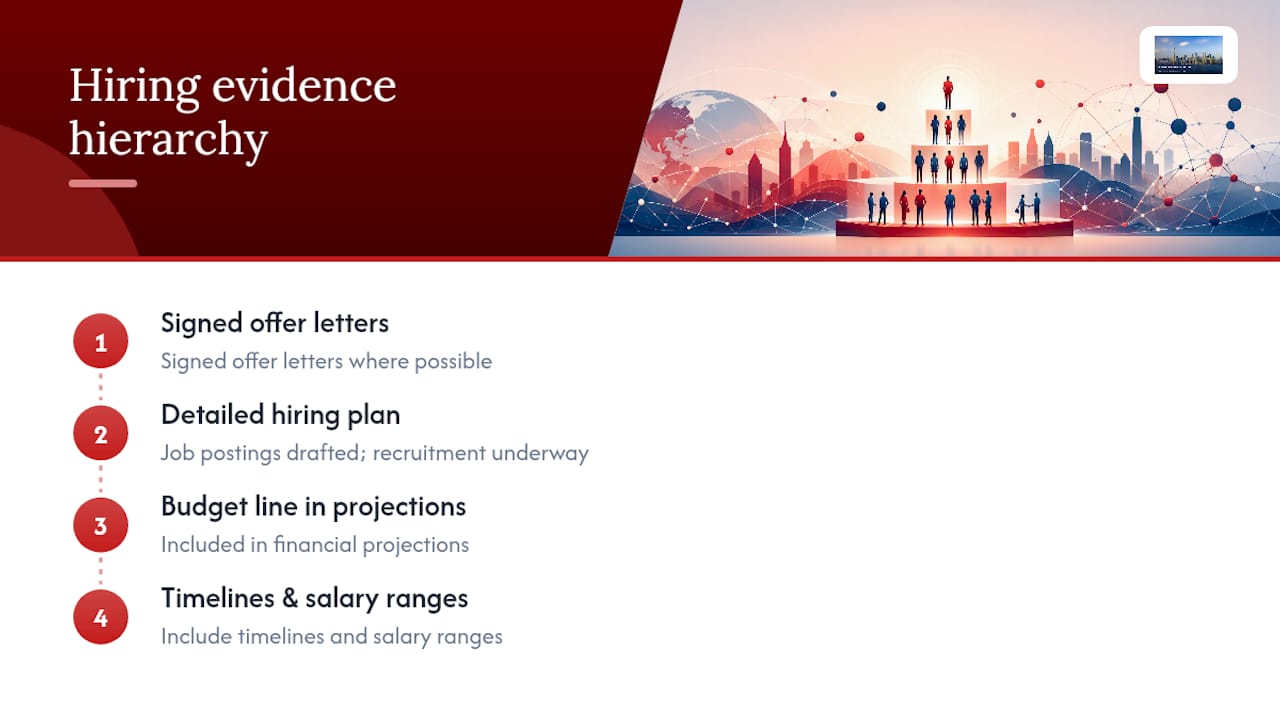
Weak hiring evidence. Listing planned hires without timelines, salary ranges, or any recruitment activity already underway is a common gap. Fix: include signed offer letters where possible, or at minimum a detailed hiring plan with job postings already drafted and a budget line in the financial projections.
Speculative language without evidence. Phrases like “we intend to,” “we plan to,” and “we expect to” without any executed documents to back them up are red flags. Officers have seen thousands of business plans with identical language. Fix: replace intent with action. An executed lease beats a letter saying you plan to sign one.
Pro Tip: Before you submit, have a licensed RCIC review your file specifically for structural weaknesses in the significant benefit argument. An experienced RCIC has seen refusal letters and knows exactly which gaps officers flag. That review is far cheaper than a refusal and a reapplication.
How Canadanumberoneimmigration helps with C11 applications
C11 is one of the most discretionary work permit categories IRCC administers. There is no published checklist that guarantees approval, which means the quality of the evidence package and the way it is framed for an officer matters more than in almost any other permit type. That is where a licensed RCIC earns their fee.
Canadanumberoneimmigration is led by Minerva McCoon McBean, a licensed Regulated Canadian Immigration Consultant based in Toronto.
What the firm does for C11 clients:
- Drafts or reviews the business plan with the significant benefit test as the organizing framework, not a generic business template.
- Reviews ownership and governance documents to confirm the owner-operator requirement is clearly satisfied.
- Assembles the evidence package and builds the evidence index.
- Prepares the cover letter that maps each document to a specific benefit claim.
- Advises on the application pathway (outside Canada vs. inside Canada) based on the client’s current status.
- Develops a renewal strategy from Day 1, so the operational records you keep during the permit period become your renewal evidence automatically.
Why “licensed RCIC” matters for C11. An RCIC is regulated by the College of Immigration and Citizenship Consultants (CICC) and is legally authorized to represent clients before IRCC. For a discretionary exemption like C11, where the framing of evidence can be the difference between approval and refusal, regulated representation provides both legal protection and practical expertise. An unlicensed consultant or a generic business plan writer cannot represent you if IRCC requests additional information or issues a procedural fairness letter.
For complex ownership structures, cross-border investments, or files where the significant benefit argument requires careful construction, self-filing a C11 application carries real risk. A single structural weakness in the evidence package can result in a refusal that is difficult to overcome on reapplication. Regulated representation from a licensed RCIC is not a luxury on these files; it is a practical risk management decision.
When to hire an RCIC vs. self-filing: If your ownership structure is straightforward, your business plan is already strong, and you have clear executed documents for every benefit claim, a self-filed application is possible. If you have a complex holding structure, cross-border capital flows, a joint venture, or any prior immigration history that requires explanation, professional representation is the more defensible choice. The firm’s work permit services page outlines the specific support available.
What we see in successful C11 files
The files that get approved share a pattern that has nothing to do with the size of the business or the ambition of the projections. They share one quality: every claim has a document behind it before the application is submitted.
The files that struggle are almost always the ones where the business plan describes a compelling vision but the evidence package is thin. An officer reading a 40-page business plan with no executed lease, no wire transfer confirmation, and no signed offer letters has no way to distinguish a serious entrepreneur from someone who wrote a persuasive document. The plan itself is not evidence. The documents behind it are.
One pattern that consistently strengthens files: clients who, before filing, take three concrete steps in Canada, signing a lease, opening a business bank account, and wiring an initial capital contribution, give officers something real to evaluate. Those three documents alone shift the file from “applicant intends to operate a business” to “applicant has already begun operating a business.” That distinction is often the difference between approval and a refusal citing insufficient evidence of benefit.
The advice to every C11 client: do not file until you can show at least two or three executed documents that prove the business is already in motion. A business plan is a roadmap. Officers want to see that you have already started driving.
Ready to file your C11 application? Here is how to get started
A C11 application is only as strong as the evidence behind it, and the evidence is only as strong as the strategy behind the evidence. Canadanumberoneimmigration offers paid initial consultations that cover document review, eligibility assessment, and a gap analysis of your current evidence package against the significant benefit test.
The initial consultation with Minerva McCoon McBean or her team covers your ownership structure, the strength of your business plan, and the specific documents you still need before filing. You will leave with a clear picture of where your file stands and what it needs. Fee information is available on the firm’s fees page, and the full range of business immigration services is listed on the services page.
To prepare for the consultation, bring your corporate documents (certificate of incorporation, shareholder register, minute book), personal bank statements covering three to six months, a draft business plan or executive summary, any executed contracts or letters of intent, and a one-page summary of your ownership structure and planned role in the business.
Canadanumberoneimmigration is a licensed RCIC firm, which means every client receives regulated representation before IRCC. Book your consultation at Canadanumberoneimmigration and get a clear assessment of your C11 file before you file it.
Sources
These are the primary sources to use when drafting your evidence and verifying current requirements:
- S.C. 2001, c. 27 - Immigration and Refugee Protection Act - CanLII
This article is general information, not a substitute for advice from a qualified lawyer. Consult a qualified legal professional about your own circumstances before acting on anything here.
Recommended
Stay Updated
Subscribe to our newsletter for the latest immigration news and tips.