20 Question, 45 Minute Canadian Citizenship Test: 4 Week Study Plan

The Canadian citizenship test is 20 questions, split between multiple-choice and true-or-false, and you get 45 minutes to finish. Every question comes from the official Discover Canada study guide, and most applicants now take it online with webcam monitoring.
TL;DR:
- Most applicants aged 18 to 54 must pass the test, which covers six broad areas including Canadian history, government, law, and geography.
- The test is based solely on the Discover Canada guide, and multiple attempts are allowed with waiting periods of weeks or months between tests.
- Four weeks of focused study using flashcards, practice quizzes, and full simulations increase success chances, especially for history and government sections.
- Online practice tests that track progress and explain answers are more effective than unstructured quizzes, provided they cite Discover Canada content.
- Candidates must have a webcam-enabled device, valid photo ID, and sit alone in a well-lit room during monitored online sessions, with accommodations available upon request.
Table of Contents
- Who Actually Has to Take the Citizenship Test in Canada
- How to Prepare Using Discover Canada: A 4-Week Study Plan
- Practice Tests and Simulations Worth Your Time
- How the Online Citizenship Test Actually Works
- When Studying Alone Isn’t Enough
- Official Pages and Trusted Practice Resources
- Sources
Who Actually Has to Take the Citizenship Test in Canada
Not everyone applying for citizenship sits this exam. Immigration, Refugees and Citizenship Canada requires it mainly from applicants who are between 18 and 54 years old on the day they sign their application. Fall outside that range and you’re typically exempt, though officers occasionally waive the requirement for other reasons tied to a specific applicant’s circumstances.
The content itself pulls from six broad areas, and knowing them helps you organize your study time instead of rereading the guide cover to cover with no plan.
- Rights and responsibilities of citizenship
- Canadian history
- Geography of Canada
- How the government works, federally and provincially
- The economy and how Canadians earn a living
- Canadian laws, symbols, and national institutions
Here’s a detail that surprises a lot of applicants: you don’t get just one shot. Canada gives you several chances to pass. Miss the mark once, and you’ll typically be scheduled for another attempt rather than sent back to square one. Timing varies by case, but most applicants wait weeks to a few months after applying before receiving an invitation to test, and results usually follow shortly after the session ends.
How to Prepare Using Discover Canada: A 4-Week Study Plan
Discover Canada is not one option among many. IRCC has confirmed it’s the sole authoritative source for every test question, which means skimming random online summaries is a waste of your time. Grab it as a PDF, an eBook, or an audio file, whichever format matches how you actually retain information. Some people absorb history better listening during a commute than staring at a screen after work.
A simple four-week rhythm works well for most applicants:
- Week 1: Foundations. Read the sections on rights, responsibilities, and government structure. Build your first batch of flashcards from anything you had to reread twice.
- Week 2: History and geography. Cover Confederation, major historical events, and the provinces and territories. Take your first untimed practice quiz to see where you stand.
- Week 3: Economy, laws, and symbols. Finish the remaining chapters, then start timing your practice quizzes at 45 minutes for 20 questions to match real conditions.
- Week 4: Full simulation and review. Run at least two full timed simulations, then spend remaining days only on topics you’re still missing.
Language ability isn’t what’s being tested here. IRCC has stated that the test measures knowledge of Canada, not English or French fluency, that gets assessed separately during an interview if needed. So don’t burn study hours polishing vocabulary; spend them on facts and dates.
Pro Tip: Build flashcards around numbers and dates specifically, since true-or-false questions love to swap a single figure (like a year or a percentage) to make a true statement false.
Spaced repetition beats cramming for this material, particularly for history dates and government structure, which tend to blur together otherwise. If you keep failing the same section of practice quizzes, stop retaking full simulations and go back to that chapter directly. Studying with a partner or in a small group also helps, especially if your interview readiness matters too. Talking through answers out loud mimics what an officer might ask if your case requires a follow-up conversation. For a more detailed breakdown week by week, Canadanumberoneimmigration’s citizenship test study plan walks through the checklist version of this same approach.
Practice Tests and Simulations Worth Your Time
Free resources go a long way here, and you don’t need to pay for most of what actually helps. Public libraries have stepped up in a real way: the Richmond Public Library citizenship practice test offers a question bank built from Discover Canada content, at no cost, hosted right here in Canada.
Beyond library resources, a few things separate a genuinely useful practice tool from a time sink:
- It runs a timed 20-question mode that mirrors the real 45-minute window, not an open-ended quiz with no clock.
- It explains why an answer is right or wrong, rather than just flashing a score at the end.
- It tracks your progress across sessions so you can see which content areas are actually improving.
- It states clearly that its questions are drawn from Discover Canada, and updates when the guide changes.
Online quizzes like CitizenshipCounts give quick, informal practice for reviewing individual topics. For timing practice specifically, simulations such as CitizenshipSupport’s timed test replicate the 20-question, 45-minute format with instant feedback, useful for building pacing instincts. Just double-check that any commercial app or site you use has been updated recently and attributes its questions to Discover Canada. A quiz built on outdated material can teach you the wrong facts with total confidence.
How the Online Citizenship Test Actually Works
Most applicants complete the test online rather than in person, and the process has a few hard requirements you don’t want to discover at the last minute. Once you receive your invitation, you have 30 days to complete the test, and the 45-minute timer cannot be paused once it starts.
Before test day, confirm the basics:
- You’ll need a desktop, laptop, or tablet with a working webcam, and a browser like Chrome or Safari.
- Valid photo ID (your PR card or another accepted photo ID) has to be ready for verification.
- You must sit alone in a well-lit room, since the session is monitored by webcam throughout.
- Blurry or poorly lit ID and selfie photos can invalidate the entire session, which may cost you one of your three attempts.
That last point deserves real attention. IRCC’s own guidance confirms that failed identity verification can burn an official attempt, not just delay your test. Test your webcam and lighting the day before, not five minutes before your session starts.
If you need accommodations, whether an in-person sitting, an oral test conducted over Microsoft Teams, or another alternate format, you can request one even after receiving your invitation. IRCC will follow up to arrange the details, though it may shift your timeline slightly.
When Studying Alone Isn’t Enough
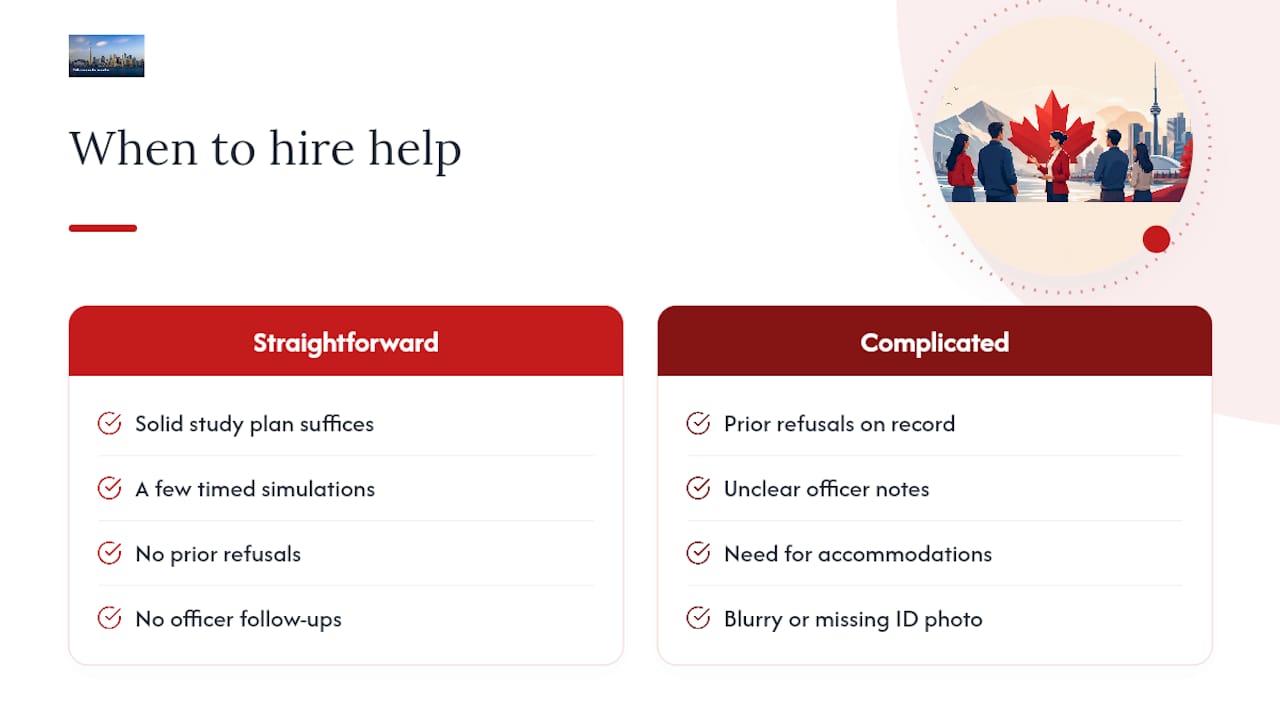
Most applicants can pass this test with a solid study plan and a couple of timed simulations. That’s the honest truth, and no consultant should tell you otherwise. Where things get complicated is everything around the test: cases with prior refusals, unclear officer notes from a previous application, or applicants who need accommodations but aren’t sure how to request them without delaying their file.
That’s where a licensed consultant earns their fee rather than just collecting one. A single blurry ID photo or a missed accommodation request can cost someone an attempt they didn’t need to lose. Reviewing your documents before test day, running a mock interview if your case involves a follow-up conversation with an officer, or interpreting what went wrong after a failed attempt, these are the moments where guidance actually changes outcomes. If your situation is straightforward, our citizenship application checklist may be all you need. If it’s not, that’s a different conversation.
— Micah
Official Pages and Trusted Practice Resources
Start with the primary sources: Discover Canada for study content, and the IRCC test pages for rules and format. For practice, the Richmond Public Library test bank is free and Canada-based. Before using any other quiz site, confirm it cites Discover Canada and was updated recently, since outdated questions teach outdated facts.
If your citizenship application involves document translation, CertiTranslate’s guide to the translation process walks through what certified translation typically requires before submission.
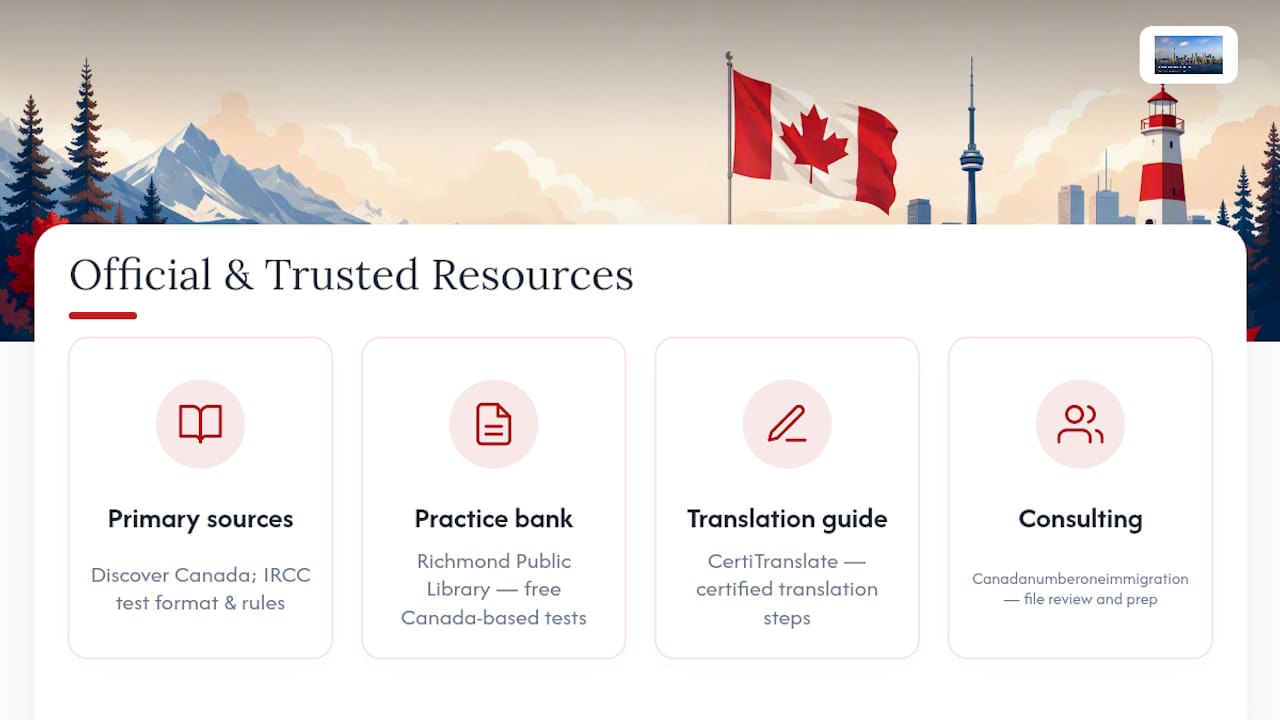
Ready for support beyond self-study? Canadanumberoneimmigration’s immigration consulting services can help you review your file, prepare for an interview, or sort out a prior refusal before you book your next test attempt.
Recommended
Stay Updated
Subscribe to our newsletter for the latest immigration news and tips.