What an ECA Report Canada Applicants Need Actually Involves

An Educational Credential Assessment is the report IRCC requires to confirm your foreign degree, diploma, or certificate equals a Canadian credential. If you’re claiming education points in Express Entry, you need one, it must be less than five years old when you use it, and the process starts with picking the right designated organization and pulling together your official transcripts. Everything else in your application depends on getting this piece right first.
TL;DR:
- An ECA must be less than five years old when used to ensure the credential’s validity for immigration purposes.
- Only designated assessment organizations like WES, CES, ICAS, IQAS, and ICER are accepted for general credentials, with regulated professions requiring specific bodies such as MCC or PEBC.
- The ECA report confirms both the authenticity of your credential and its Canadian equivalency, which directly impacts your CRS score in Express Entry.
- Processing typically takes four to six weeks and requires official transcripts, certification, and payment; ordering transcripts early helps avoid delays.
- Incorrectly entering the report number or choosing the wrong assessor can cost months and points, making professional review advisable for complex or regulated credentials.
Table of Contents
- What Is an ECA and Why Does IRCC Require It?
- Who Needs an ECA and When Should You Get One?
- Which Organizations Can Issue an ECA?
- How to Get an ECA: Documents, Costs, and Processing Time
- How Do You Use Your ECA to Claim CRS Points?
- What if the Result Looks Wrong or Is About to Expire?
- Practical Tips From Canada Number One Immigration for a Stronger ECA Outcome
- What I’d Tell an Applicant Starting This Process Today
- Let Canada Number One Immigration Handle the ECA Details
- Official Pages Worth Bookmarking Before You Apply
- Sources
What Is an ECA and Why Does IRCC Require It?
An ECA does two things at once, and mixing them up causes most of the confusion applicants run into. First, it authenticates: the assessing body confirms your degree or diploma is genuine and came from a legitimate, recognized institution. Second, it evaluates equivalency: it states what your credential would be worth if earned in Canada, whether that’s a bachelor’s degree, a two-year diploma, or something closer to a trade certificate.
The report itself is required for many Canadian immigration pathways, including Express Entry, and it’s mandatory for Federal Skilled Worker principal applicants who want to claim points for foreign education under the Comprehensive Ranking System. Without it, IRCC simply won’t count your foreign schooling toward your score, no matter how impressive that schooling actually was.
An ECA typically covers:
- The name of the institution and the credential awarded
- Confirmation the institution was recognized in that country’s education system at the time you attended
- The Canadian equivalency, expressed in familiar terms (high school diploma, one to two year diploma, three year diploma, bachelor’s degree, and so on)
- The assessing organization’s reference number, which you’ll need later
Here’s the part people miss: an immigration ECA has nothing to do with professional licensing. If you’re a nurse, engineer, or teacher, this report tells IRCC your education level for point-scoring purposes only. It does not grant you the right to practice in Canada. That’s a separate process run by provincial regulators, and conflating the two is one of the most common and costly mistakes applicants make.
Who Needs an ECA and When Should You Get One?
If you’re planning to claim points for foreign education in Express Entry, you need an ECA before your application reaches the point of no return. Here’s how to think through timing:
- Principal applicants under Federal Skilled Worker must submit an ECA to be eligible at all, not just to boost their score. No ECA means no education points, and for FSW that can mean falling short of the minimum threshold entirely.
- Express Entry candidates under other programs (Canadian Experience Class, Provincial Nominee Program streams routed through Express Entry) generally don’t need one to qualify, but skipping it means leaving education points on the table, and those points often decide who gets an invitation.
- Time your application around the five-year clock. The report is valid for five years from its issue date, and it needs to still be valid both when you create your Express Entry profile and when you submit your permanent residence application. Applicants sometimes get an ECA early, sit in the pool for a year or two, then get invited only to find their report expired mid-process.
There are a few scenarios where you can skip it. If your only credential is Canadian, or if you’re applying through a stream that doesn’t score education at all, an ECA adds nothing. Spouses or common-law partners can also get one to boost the principal applicant’s CRS score, though it’s optional rather than required.
Pro Tip: Order your ECA as close as possible to the point you expect to submit your profile, not the moment you start planning your move. A report that’s fresh when you apply avoids the awkward scramble of re-ordering one right before an invitation deadline.
Which Organizations Can Issue an ECA?
IRCC doesn’t accept assessments from just anyone. The organization has to be on its designated list, and picking the wrong one means starting over.
Five general-purpose bodies handle the vast majority of immigration ECAs:
- World Education Services (WES) — the most widely used provider, handling credentials from nearly every country
- Comparative Education Service, University of Toronto (CES) — often preferred by applicants whose credentials come from specific regions CES specializes in
- International Credential Assessment Service of Canada (ICAS) — based in Alberta and used across a wide range of source countries
- International Qualifications Assessment Service (IQAS) — run by the Alberta government, also broadly accepted for general immigration ECAs
- International Credential Evaluation Service (ICER) — based in British Columbia, another accepted general assessor
For regulated professions, the rules shift. Physicians need an assessment through the Medical Council of Canada (MCC). Pharmacists go through the Pharmacy Examining Board of Canada (PEBC). Architects use the Canadian Architectural Certification Board (CACB). These bodies serve a dual purpose: they verify your education for immigration and start you down the path toward professional licensing in that field.
The stakes here are real. Submit a general ECA from WES when your occupation actually requires MCC or PEBC assessment, and IRCC can reject it outright, forcing you to restart the process months later, often after your original report has already expired. Before you pay a cent, confirm on the designated organizations page that the body you’re considering actually covers your credential and, if relevant, your regulated occupation.
How to Get an ECA: Documents, Costs, and Processing Time
The mechanics are similar across every designated organization, even though the portals and forms look different. Here’s the general flow:
- Create an account with your chosen assessing body and select “immigration” as the purpose of your assessment (as opposed to employment or licensing, which sometimes have separate tracks).
- Submit your highest completed credential. You don’t need every diploma you’ve ever earned, just the one that best reflects your education level, though including additional credentials can sometimes help if your case is unusual.
- Request official transcripts and proof of credential sent directly from your institution, or send certified copies yourself depending on the provider’s rules. Most assessors require documents in the original language plus a certified English or French translation.
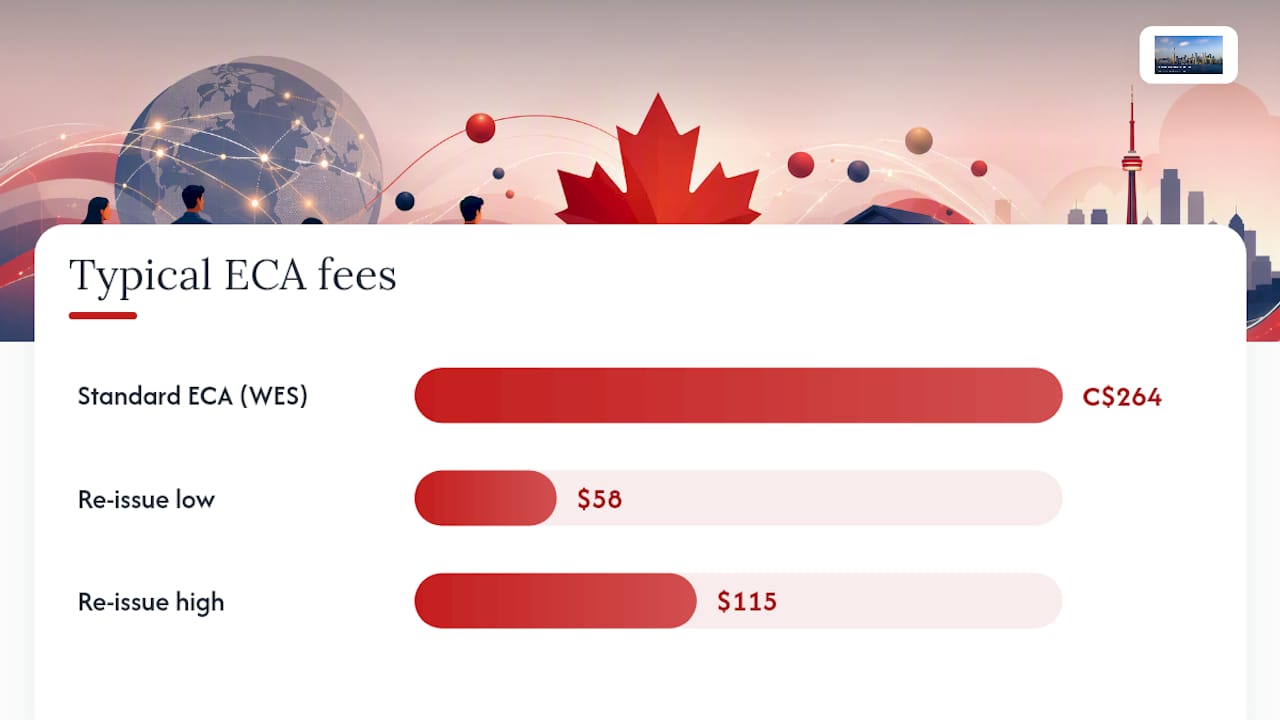
- Pay the evaluation fee. A standard ECA runs roughly C$264 through WES, with other designated bodies charging similarly in that range. Courier fees for document delivery can add an additional charge for next-day service within Canada, and international shipping runs higher.
- Wait for processing, which typically takes four to six weeks once your assessor has received everything they need, though incomplete files or documents requiring extra verification can push that timeline out considerably.
- Receive your report and reference number, which you’ll enter into your Express Entry profile later.
A few practical habits separate a smooth application from a frustrating one. Order transcripts the moment you decide to pursue an ECA. Some institutions, particularly ones dealing with high international demand, take weeks to process a records request, and that delay sits entirely outside your assessor’s control. If your country requires notarization or an apostille for foreign document use, sort that out early too. Many providers, including WES, publish country-specific document checklists and sample reports that show exactly what applicants from your country typically need, and reading one before you start saves a round of rejected submissions.
Pro Tip: Keep a scanned digital folder of every original document, translation, and receipt tied to your ECA application. If you ever need to request a remark, re-issue, or professional assessment down the line, having that paperwork ready cuts weeks off the follow-up process.
Re-issue and update fees vary but generally run in the range of $58 to $115 depending on the provider and whether you need a full re-evaluation or just an updated copy sent to a new address.
How Do You Use Your ECA to Claim CRS Points?
Once your report arrives, the work isn’t quite done. You still need to get it into your Express Entry profile correctly, or it won’t count.
- Enter the ECA reference number in the education section of your Express Entry profile exactly as it appears on the report. A typo here can flag your profile for extra scrutiny or cause IRCC to disregard the credential entirely.
- Match the equivalency stated on your report to the corresponding education level in the CRS grid. A one-year diploma and a three-year advanced diploma score very differently: the gap between them can be worth dozens of CRS points, which is often the difference between getting an invitation and watching the cutoff pass you by.
- Keep your original documents on hand. IRCC doesn’t require you to upload them when you first apply, but if you’re invited to apply for permanent residence, you’ll need to submit copies of the same documents your assessor used.
The CRS impact is where this whole process pays off or falls flat. A bachelor’s degree properly assessed and entered correctly can be worth a significant number of points on its own, factoring into both the education criteria and the combined education plus language or work experience factors. Applicants who skip the ECA, delay it, or enter it incorrectly routinely lose points they didn’t realize were available, sometimes finding out only after a round of invitations has already passed them by.
What if the Result Looks Wrong or Is About to Expire?
Assessment reports aren’t infallible, and assessors do make errors, particularly around how they group credentials. A common issue: if your education included what looks like several short certificate programs rather than one continuous degree, an assessor may undervalue it, awarding a lower equivalency than the credential deserves.
If that happens to you:
- Request a remark through your assessing organization rather than immediately reapplying from scratch. Most providers, including CES, offer a formal process for flagging assessment errors, and it’s typically faster and cheaper than starting over.
- Gather supporting evidence. A full course syllabus, an official transcript showing continuous enrollment dates, and a letter from the institution clarifying the program structure all strengthen a remark request.
- Watch your expiry date like a hard deadline, not a suggestion. If your ECA will turn five years old before you expect to submit your permanent residence application, order a re-issue or a fresh assessment well ahead of time rather than after your invitation arrives.
Pro Tip: If you suspect your credentials were mis-grouped, write out a simple timeline of your studies before contacting your assessor. A one-page continuous-enrollment summary often does more to support a remark request than a stack of loose transcripts.
Practical Tips From Canada Number One Immigration for a Stronger ECA Outcome
Consultants see the same avoidable mistakes over and over. Applicants order transcripts too late, submit documents in the wrong format, or pick a general assessor when their occupation actually calls for a profession-specific body like MCC or PEBC. Each one costs weeks, sometimes months, and occasionally an entire cycle of Express Entry draws.

A tight document checklist helps: official transcripts requested directly from the institution, complete course syllabi for any program that might look fragmented, and certified translations done by a recognized translator rather than a friend who happens to speak the language. Small inconsistencies between a transcript and a translation are a frequent cause of assessor pushback.
This is where a licensed RCIC earns their fee. For complex credential histories, regulated occupations, or a report that needs to be appealed, professional review before submission catches problems an applicant working alone often can’t see coming, since it’s rarely obvious from the outside which grouping or wording choice will trip up an assessor.
What I’d Tell an Applicant Starting This Process Today
Confirm your assessor before you spend a dollar. That single step prevents the single most expensive mistake in this whole process: paying for a general ECA when your occupation quietly required MCC, PEBC, or CACB instead. It’s a five-minute check against the designated organizations list that saves months.
After that, documentation is everything. Applicants who over-prepare, meaning full transcripts, syllabi, and certified translations gathered before they even submit, rarely need a remark. Applicants who submit the bare minimum often do.
If your credential history is unusual, if you’re in a regulated profession, or if a report has already come back lower than expected, that’s the moment to bring in a licensed RCIC rather than troubleshoot alone. And whatever you do, treat the five-year validity window as a real deadline. Mark it on a calendar the day your report arrives, not the week before your invitation.
— Minerva McBean
Let Canada Number One Immigration Handle the ECA Details
Canada Number One Immigration works through the ECA process with clients every week, and the recurring problem is always the same: applicants choose the wrong assessor, submit incomplete documents, or enter their reference number incorrectly, and only discover it after points are already lost. Working with a licensed RCIC-led firm means someone checks your assessor choice, your document set, and your Express Entry entries before any of it becomes a costly delay.

A consultation typically starts with a review of your credentials, your target program, and whether your occupation requires a profession-specific assessor rather than a general one. From there, the team helps you build your document checklist, review your ECA once it arrives, and get your Express Entry profile set up correctly the first time. If a report comes back looking off, that’s also where a remark request or appeal gets handled properly instead of guessed at.
Browse the firm’s immigration services to see what’s covered, check the fee schedule for consultation pricing, and book a session before you submit your ECA application, not after something goes wrong.
Official Pages Worth Bookmarking Before You Apply
Keep these on hand while you work through your application:
- IRCC’s ECA guidance page, covering validity rules and Express Entry requirements
- The designated organizations and service providers list, where you confirm your assessor is accepted
- WES’s evaluation and fee page for cost and processing time specifics
- CES’s help center for remark and appeal procedures
- IRCC’s clarification on ECAs and professional licensing, useful if you’re in a regulated occupation
For applicants in healthcare fields specifically, it’s worth reading how Express Entry draws have prioritized physicians and the related healthcare Express Entry update for guidance specific to that credential path.
Sources
- Educational credential assessment
- Educational Credential Assessment – Service Providers
- ECA - Evaluations and Fees | WES
- What do I do if there is an issue with my assessment report - CES Help
Recommended
- Canada issues 3,300 ITAs to Canadian Experience Class candidates | McBean Immigration
- Canada Invites 6000 Candidates in Major Canadian Experience Class | McBean Immigration
- Canadian Citizenship Applications | McBean Immigration
- IRCC Issues 4,000 ITAs to CEC Candidates in Latest Express Entry | McBean Immigration
Stay Updated
Subscribe to our newsletter for the latest immigration news and tips.