Express Entry Processing Time: What to Expect in 2026

Federal Skilled Worker files are running slightly behind. Provincial Nominee Program cases sit somewhere in between, largely because of the extra steps a province adds before your file ever reaches IRCC’s desk.
Here’s the practical breakdown for 2026:
- Canadian Experience Class (CEC): often close to the six-month service standard for many straightforward files
- Federal Skilled Worker (FSW): typically takes slightly longer than six months
- Provincial Nominee Program (PNP): processing time varies by province and can be longer than for other streams
The clock starts the moment IRCC receives your complete electronic application for permanent residence (eAPR), not when you submit your profile to the pool. It stops the day a final decision is made.
Everything else, the pool wait, the ITA window, the paperwork you gather before you even apply, happens outside that six-month window. Understanding where that boundary sits changes how you plan the whole process.
Key Takeaways
| Point | Details |
|---|---|
| Official standard | IRCC aims to process 80% of complete Express Entry applications within six months. |
| Clock starts at completeness | Processing time begins when your eAPR is marked complete, not when you enter the pool. |
| Stream speed varies | CEC often finishes fastest, FSW tends to run longest due to overseas verification needs. |
| The 60-day deadline is fixed | Missing the ITA submission window typically voids your invitation entirely. |
| Get expert help when stalled | Canadanumberoneimmigration, led by RCIC Minerva McCoon McBean, reviews complex or delayed files to identify what’s slowing things down. |
Table of Contents
- How IRCC Defines Express Entry Processing Time
- What Actually Happens Between Applying and Approval
- Which Express Entry Stream Moves Fastest?
- What Slows Down or Speeds Up Your Application
- How to Stay Inside the Six-Month Window
- What Happens After Your Application Is Approved
- Real Timelines from Recent Express Entry Draws
- Why the Six-Month Number Gets Misread So Often
- Get a Clear Read on Your Own Timeline
- Frequently Asked Questions
- Sources
How IRCC Defines Express Entry Processing Time
It means four out of five complete applications get a decision inside six months. The remaining fifth, often files with complicated travel histories, inconsistent documentation, or pending security checks, can run well past that mark. If your case sits in that slower group, it does not necessarily mean something went wrong.
IRCC’s own processing times tool states plainly that the timer starts when a complete application arrives and ends at decision. The tool also lists what actually moves that number: application type, how easy your documents are to verify, and how fast you respond if IRCC asks for more information.
Here’s how to use the tool correctly:
- Go to the IRCC processing times page and select “Express Entry” as your application type.
- Choose the correct stream (CEC, FSW, or PNP) since each reports a different estimate.
- Read the result as a historical average, not a countdown clock for your specific file.
- Screenshot or save the result with today’s date, so you have a record to compare against later.
- Log the exact date your eAPR was marked complete. That date, not your ITA date, is your real starting line.
Pro Tip: Check the tool no more than once a month. Checking daily won’t change your outcome, and IRCC updates the published averages periodically rather than in real time.
What Actually Happens Between Applying and Approval
The six-month standard covers only one slice of a much longer road. Applicants who feel blindsided by how long “Express Entry” takes are usually measuring from the wrong starting point. There are five distinct phases, and only one of them is bound by IRCC’s official target.
Phase 1: Getting your documents ready
Before you can even enter the pool with a competitive profile, you typically need language test results (IELTS or CELPIP for English, TEF for French), an Educational Credential Assessment (ECA), and, for many applicants, police certificates from every country you’ve lived in for six months or more. Budget 2 to 4 months for this stage. Language test booking slots fill up fast in major cities, and ECAs alone can take several weeks once submitted to an approved body.
Phase 2: Waiting in the pool
This is the least predictable part of the entire journey. Your Comprehensive Ranking System (CRS) score determines whether you get an Invitation to Apply (ITA), and draw thresholds shift by round. Some applicants with strong scores receive an ITA within weeks. Others wait 12 months or longer while they build additional points through a language retest, more work experience, or a provincial nomination.
Phase 3: The 60-day ITA deadline
Once you receive an ITA, the clock on a separate, unforgiving deadline starts: you have 60 calendar days to submit a complete eAPR. This window is fixed by regulation, and extensions are rare enough that you shouldn’t count on one. Miss it, and your ITA is typically voided, sending you back into the pool to wait for another invitation. This is exactly why document prep in Phase 1 matters so much: applicants who scramble to gather police certificates or medical exam results after receiving an ITA are the ones most likely to run out of time, as detailed in Visa - Fewa Consultancy’s guidance on document readiness.
Phase 4: IRCC’s official review
This is the phase the six-month standard actually measures. Once your complete eAPR is logged, IRCC begins background verification, security and criminality checks, and a final eligibility review. Simple files with clean travel histories and easily verified employment often clear faster than the six-month benchmark.
Phase 5: After the decision
Approval brings a Confirmation of Permanent Residence (eCoPR), then, for most, a PR card mailed within a few months afterward. Add it all up, and a realistic end-to-end timeline from starting your document prep to holding a PR card commonly runs 12 to 24 months, not the six months many applicants assume from headlines alone.
Which Express Entry Stream Moves Fastest?
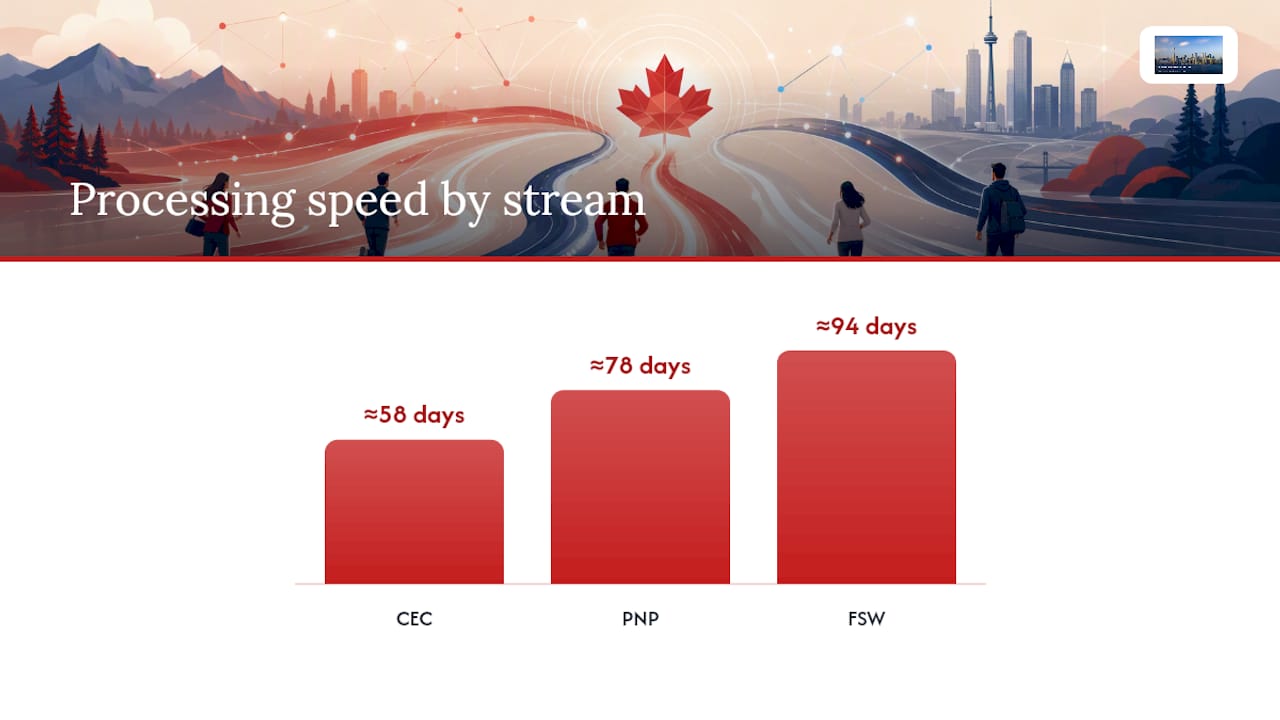
Not all Express Entry streams process at the same speed, and the gap comes down to how much verification each file requires. Community-tracked data from applicants who’ve gone through the process recently shows a clear pattern once you look past the official six-month ceiling.
Median timelines from AOR to eCoPR, based on recent applicant-reported tracking:
- CEC: median around 58 days
- PNP: median around 78 days
- FSW: median around 94 days
- Outliers in any stream can stretch toward 198 days, particularly when a file triggers extra review
These are medians, not guarantees, and IRCC’s own six-month figure still describes the 80th percentile, the point where four out of five files are done. A file landing at the 75th percentile or beyond for its stream is not unusual, but it’s worth flagging if there’s been no correspondence from IRCC in that time.
Why FSW often runs longer: Federal Skilled Worker applicants frequently have overseas employment history that needs verification, foreign police certificates that take time to arrive by mail, and credential assessments spanning multiple countries. Each of those adds a checkpoint.
Why CEC often moves faster: Canadian Experience Class applicants typically have Canadian work history that officers can verify domestically, often through direct employer records or Canada Revenue Agency data, which cuts out a layer of international back-and-forth. Recent CEC-specific draws reflect that steady processing pattern.
Why PNP sits in the middle: Provincial Nominee Program timelines depend on the province’s own review before the file even reaches federal processing. A province with a backlog in its nomination stream will push your overall timeline out, even if IRCC’s federal review itself is quick.
What Slows Down or Speeds Up Your Application
Some delays are entirely within your control. Others aren’t, and knowing the difference saves you from wasted stress. The single biggest controllable factor is document completeness: mismatched dates, an expired police certificate, or an inconsistent employment reference between your resume and your reference letter can all trigger a request for more information, and each request restarts a portion of the review.
Common causes of delay, roughly in order of how often they show up:
- Missing or expired supporting documents, especially police certificates and medical exam results that lapsed while waiting in the pool
- Inconsistent information across forms, where job titles, dates, or addresses don’t match between your profile and your application
- Complex travel or immigration history, which can trigger deeper security screening regardless of stream
- Slow response to IRCC requests, since every additional-document request pauses the file until you reply
- Outdated contact information, which means you might miss a request entirely if IRCC can’t reach you
Some pressures sit outside any individual’s control. Reporting in 2026 pointed to rising inventory across Express Entry and PNP streams, a systemic backlog that stretches timelines even for applicants who did everything right. Seasonal spikes tied to major draw rounds can have a similar effect, simply because more files arrive in a shorter window.
Pro Tip: Respond to any IRCC request the same week you receive it, even if you only have partial documents ready. A short, honest update to IRCC’s webform showing you’re actively gathering the remaining item is far better than silence.
How to Stay Inside the Six-Month Window
You cannot control your CRS draw date, but you have real control over how fast your file moves once it’s submitted. The applicants who land closest to the six-month standard almost always did the same thing: they finished the boring paperwork long before they needed it.
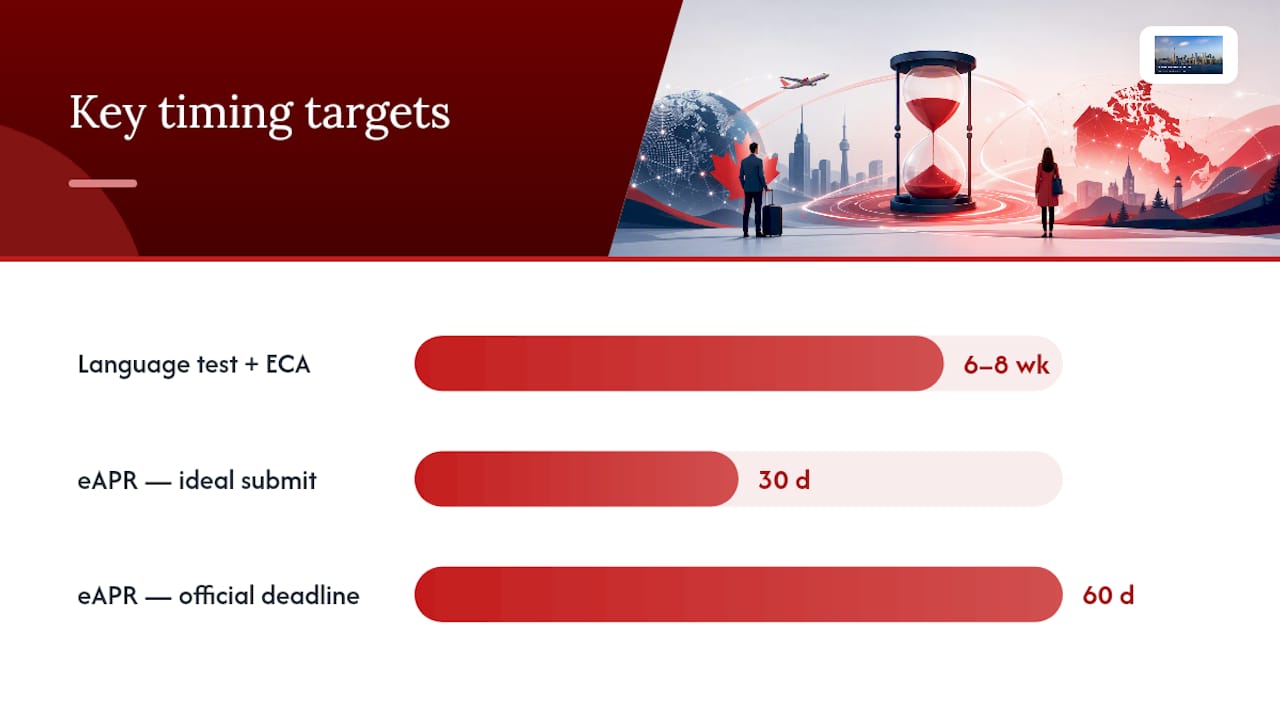
- Book your language test and ECA immediately, even before you enter the pool. These two items alone can take 6 to 8 weeks combined, and they’re required regardless of which stream you use.
- Request police certificates for every country of residence over six months as early as possible. Some countries take months to issue these by mail, and this single document causes more ITA deadline scrambles than any other.
- Schedule your medical exam only after you’re in the pool, since results expire, but don’t wait until after your ITA to book the appointment slot.
- Submit your eAPR well before the 60-day deadline, ideally within the first 30 days, so you have a buffer if you discover a missing document.
- Verify every upload before you hit submit. A blurry scan or the wrong page order is a common, avoidable reason for a follow-up request.
- Keep timestamped copies of everything you mail or upload, including courier tracking numbers for anything sent physically.
- Update your contact information the moment anything changes. A missed request because of an old email address can cost weeks.
Pro Tip: Create a single folder, digital or physical, the day you start your ECA. Label every document with the date it was issued and its expiry date. This one habit prevents the most common last-minute panic: realizing a police certificate expired while you were still waiting in the pool.
If your file passes the median for your stream by a wide margin with no request for more information, or if you’re dealing with a refusal, a complex travel history, or a prior visa denial, that’s the point to bring in a licensed Regulatory Canadian Immigration Consultant (RCIC). An RCIC can review your file for the kind of inconsistency that triggers extra screening before you submit, not after.
What Happens After Your Application Is Approved
Getting approved isn’t the finish line. Once IRCC issues your eCoPR, you’ll need to complete landing, either at a port of entry if you’re outside Canada or through a confirmation of permanent residence process if you’re already here.
After landing, your physical PR card typically arrives by mail within 30 to 90 days. Where you’re living affects that window: mail to a fixed home address moves faster and more reliably than mail routed through a temporary or shared address, so update your mailing details with IRCC as soon as you know where you’ll be living.
A few practical notes for this final stretch:
- Track your PR card status through your IRCC online account rather than guessing based on the mail date alone.
- If your card hasn’t arrived after 90 days, submit a webform inquiry rather than waiting indefinitely.
- Keep your eCoPR document itself accessible. You can use it to prove permanent resident status while your physical card is still in transit.
- A lost or stolen card in transit requires a formal replacement request, which adds its own processing time on top of the original wait.
Real Timelines from Recent Express Entry Draws
Numbers on a government page are useful, but seeing how they play out in actual draw rounds makes the pattern concrete. Canada Number One Immigration, the Toronto consultancy led by licensed RCIC Minerva McCoon McBean, tracks Express Entry draws as they happen, publishing analysis on category-based rounds and stream-specific patterns as they occur.
Its coverage of the March 4, 2026 French-language draw, which issued 5,500 invitations at a CRS score of 397, illustrates how category-based rounds can move applicants with strong French skills through the pool faster than the general draw pace would suggest.
That kind of tracking matters because draw context shapes expectations for what comes next. A lower CRS threshold in a given round often means a larger, more varied applicant pool entering IRCC’s processing pipeline at once, which can affect how quickly files clear.
RCIC involvement tends to matter most in a few recurring situations:
- Applicants with multi-country work or travel history that could trigger extended security screening
- Files where a prior refusal or misrepresentation flag needs careful explanation before resubmission
- Cases stalled well past the median for their stream with no clear reason on file
Why the Six-Month Number Gets Misread So Often
The conventional advice treats “six months” as a countdown that starts the moment you enter the pool, and that’s the single biggest source of frustrated applicants checking the processing times tool every day expecting movement. The standard was never designed that way. It measures a completely different window than the one most people are watching.
What actually predicts your outcome isn’t luck or which officer gets your file. It’s how clean your paperwork was on day one. The applicants who avoid trouble are the ones who treat document prep as the real first phase of the process, not an afterthought squeezed into a 60-day scramble after an ITA lands.
If there’s one place conventional wisdom falls short, it’s underselling how much a messy travel history or a mismatched date across two forms can cost you. That’s not a paperwork technicality. It’s the difference between a file that clears in ten weeks and one that sits for a year waiting on a security check nobody explained to you. Prioritize getting that right before you worry about anything else.
Get a Clear Read on Your Own Timeline
Reading about medians and service standards only gets you so far when it’s your own file sitting in queue. Canadanumberoneimmigration offers something the processing times tool can’t: a licensed RCIC who actually reviews your specific documents, travel history, and eligibility before you submit, catching the inconsistencies that turn a six-month file into a twelve-month one.
Led by Minerva McCoon McBean, the Toronto-based team has built a 98% success rate by focusing on the part of the process applicants control least well on their own: making sure the file IRCC receives is complete, consistent, and ready for fast verification the first time. If your Express Entry profile is active, your CRS score is competitive, or you’ve already hit an ITA deadline crunch, a paid consultation can walk through your exact document readiness before you submit. Check current consultation fees or reach out directly through Canadanumberoneimmigration’s homepage to book a review before your next deadline arrives.
Frequently Asked Questions
How long does Express Entry processing time actually take in 2026? IRCC’s service standard targets six months for 80% of complete applications. CEC files often finish close to that mark, FSW commonly runs six to seven months, and PNP falls in a similar range depending on the province.
When does the processing clock start for Express Entry? It starts the day IRCC receives your complete electronic application for permanent residence, not the day you submit your Express Entry profile or receive an ITA.
What happens if I miss the 60-day ITA deadline? Your invitation is typically voided, and you’d need to re-enter the pool and wait for a new ITA, which can add months to your overall timeline.
Why is my Express Entry application taking longer than six months? Common causes include incomplete or inconsistent documents, complex travel or immigration history requiring extra security screening, or slow responses to an IRCC document request. Systemic backlogs reported through 2026 have also stretched some timelines.
How soon does the PR card arrive after approval? Most applicants receive their PR card by mail within 30 to 90 days of landing, though delivery location and mailing address accuracy both affect timing.
This article is general information, not a substitute for advice from a qualified lawyer. Consult a qualified legal professional about your own circumstances before acting on anything here.
Sources
- Check our current processing times
- How Long Does Express Entry Take in 2026? Real Data | Soon To Be Canadian
- Express Entry Processing Time 2026: How Long Does It Take? | Immigration Start Guide
Recommended
Stay Updated
Subscribe to our newsletter for the latest immigration news and tips.