Prevent LMIA Refusals: Hire a Foreign Worker in Canada

Yes, a Canadian employer can hire a foreign worker, and the process runs on three steps: decide whether the role needs a Labour Market Impact Assessment (LMIA) or qualifies for an LMIA-exempt offer, get the worker approved for a work permit, then meet your ongoing compliance duties. You will submit paperwork through LMIA Online or the Employer Portal, pay the $230 employer compliance fee, and generate the offer number your worker needs to apply. Some provinces add a registration step before you can move forward.
TL;DR:
- Employers must submit thorough documentation, including job ads, wage details, and provincial certificates, to avoid refusals due to weak evidence.
- Most LMIA applications require early preparation, such as confirming job codes, creating accounts, and collecting recruitment logs before filing.
- LMIA-exempt roles include intra-company transfers, trade agreement workers, and certain PR candidates; provinces like BC and Nova Scotia require prior registration.
- The process involves two portals: LMIA Online for labor market tests and Employer Portal for exempt offers, each with specific fees and deadlines.
- Ongoing compliance requires keeping detailed records of wages, hours, and job duties for at least six years, with violations risking penalties or bans.
Table of Contents
- Quick Employer Checklist: What To Do First
- Step 1: Do You Need an LMIA or an LMIA-Exempt Offer?
- Step 2: LMIA Online vs. Employer Portal, Fees, and Deadlines
- Step 3: What Your Worker Needs From You To Apply
- Permanent Hiring Routes You Can Support
- Employer Obligations and Ongoing Compliance
- When To Bring In a Licensed Consultant
- What Employers Consistently Get Wrong
- How Canada Number One Immigration Supports Your Hire
- Sources
Quick Employer Checklist: What To Do First
Before touching a federal portal, get your paperwork in order. Employers who scramble mid-application lose weeks waiting on documents they could have gathered up front.
- Confirm the job’s National Occupational Classification (NOC) code, its TEER category, the wage you plan to offer, and a realistic start date.
- Create a Job Bank employer account and register for LMIA Online access through Service Canada.
- Decide whether the position falls under an LMIA stream or an LMIA-exempt category, and calendar your job advertising accordingly.
- Start collecting recruitment evidence now (job postings, applicant logs, screening notes) even if you have not filed anything yet.
Rushing straight to a job offer without this groundwork is the most common way employers end up refiling.
Step 1: Do You Need an LMIA or an LMIA-Exempt Offer?
An LMIA is a document from Employment and Social Development Canada confirming there is a genuine need for a foreign worker and that no Canadian citizen or permanent resident is reasonably available to fill the role. Most positions under the Temporary Foreign Worker Program (TFWP) require one. The International Mobility Program (IMP), by contrast, covers roles exempt from that labor market test, usually because of a trade agreement, intra-company transfer, or reciprocal arrangement.
Common LMIA-exempt categories worth checking first:
- Intra-company transferees moving to a Canadian branch, subsidiary, or affiliate
- Workers covered under CUSMA or other trade agreements
- Certain PR-track candidates already holding a valid work permit
- Recent LMIA exemptions IRCC introduced for specific cases, effective March 13, 2026
Employers in British Columbia, Manitoba, Saskatchewan, and Nova Scotia must register with their province before submitting an LMIA. Skipping this makes your federal application incomplete, since the required provincial certificate has to be uploaded alongside it. Keep every job ad, its posting dates, and your screening notes on file. This is the documentation reviewers ask for most often when they question whether the role was genuinely open to Canadians.
Step 2: LMIA Online vs. Employer Portal, Fees, and Deadlines
These are two separate systems, and mixing them up costs employers time. LMIA Online is where you file with Service Canada when the job requires a labor market test. The Employer Portal is where you submit an offer of employment for IMP roles and pay the associated fee.
- LMIA Online: File your application here, including your job advertising proof, wage details, and any provincial certificates. Applications can go in up to six months before the expected start date, and filing early gives Service Canada room to process without pushing back your hire.
- Employer Portal: For LMIA-exempt offers, you build the offer here, pay the $230 employer compliance fee, and the system generates a 7-digit offer number. Without that number, your worker cannot submit a work permit application tied to your job offer.
Most refusals trace back to thin advertising evidence or vague job descriptions that don’t match the wage or NOC code claimed.
Pro Tip: Screenshot your Job Bank posting the day it goes live, not weeks later when you finally file. Officers want dated proof, and a late screenshot looks worse than no screenshot at all.
Step 3: What Your Worker Needs From You To Apply
Once you have an LMIA number or an offer number, the ball moves to your worker’s side, but they still need specific inputs from you before they can file.
- The LMIA number or offer number tied to their specific position
- A copy of the job offer detailing duties, wage, hours, and location
- Any supporting LMIA documents if the role went through that stream
Workers applying from outside Canada typically receive a port-of-entry letter of introduction, which they present at the border alongside a valid visa or eTA if applicable. Some occupations trigger a medical exam requirement before a permit is finalized, and admissibility issues (criminal or medical) can stall things if not addressed early. If there’s a gap between your job’s start date and when the worker’s permit clears, be upfront about it. Dual intent, meaning a worker who is simultaneously applying for permanent residence, does not disqualify someone from a temporary work permit, but it does mean extra scrutiny on both files.
Permanent Hiring Routes You Can Support
Not every foreign hire has to stay temporary. Employers who want to back a worker’s path to permanent residence have a few structured options:
- Express Entry: A valid job offer can add Comprehensive Ranking System points, though it is no longer mandatory for most candidates, and LMIA-backed offers carry more weight than exempt ones.
- Provincial Nominee Programs (PNPs): Many provinces run employer-specific streams requiring the business to be designated or registered before nominating a worker.
- Atlantic Immigration Program: Employers in Atlantic Canada must hold formal designation and commit to settlement support obligations for the worker and their family.
A temporary LMIA-backed hire can transition into one of these streams once the employer and worker both meet the program’s specific criteria, but that transition needs planning well before the work permit expires.
Employer Obligations and Ongoing Compliance
Getting a worker into Canada is not the finish line. IRCC and Service Canada expect ongoing compliance, and inspections happen without much warning.
- Keep records of wages paid, hours worked, and job duties matching what you promised in the offer.
- Never charge a worker recruitment fees. Federal rules prohibit passing those costs onto the employee.
- Maintain your provincial registration paperwork in BC, Manitoba, Saskatchewan, or Nova Scotia and renew it before it lapses.
- Store copies of pay stubs, schedules, and any correspondence with the worker for at least six years.
Auditors flag mismatches between the job offer and actual working conditions more than almost anything else. If the wage on paper does not match the wage on the pay stub, that discrepancy alone can trigger penalties ranging from warnings to program bans.
Pro Tip: Set a calendar reminder for provincial registration renewal dates the same day you register. Employers lose LMIA eligibility more often from an expired provincial certificate than from an actual compliance violation.
When To Bring In a Licensed Consultant
Some hiring scenarios are straightforward. Others are not, and knowing which is which saves you from a refusal that costs more time than a consultation would have.
- You’re navigating a less common LMIA-exempt category and aren’t sure the paperwork supports your claim.
- Your business operates in a province with its own registration requirement and you’ve never filed one before.
- Your start date is tight and a delay at any stage would cost you the hire.
- You need your advertising evidence and wage assessment audit-ready before submission, not after a refusal.
A licensed RCIC reviews your job offer, wage benchmarking, and recruitment file against what officers actually look for, then manages the LMIA or Employer Portal submission on your behalf. Canada Number One Immigration, led by RCIC Minerva McCoon McBean, reports a 98% success rate across client files, built on catching the gaps before Service Canada does.
What Employers Consistently Get Wrong
The biggest misconception I run into is employers treating the LMIA as a formality rather than a genuine labor market test. It isn’t. Officers are looking for real evidence that you tried to hire a Canadian first, and a thin job posting or a wage that doesn’t match your regional rate is enough to sink an otherwise legitimate application.
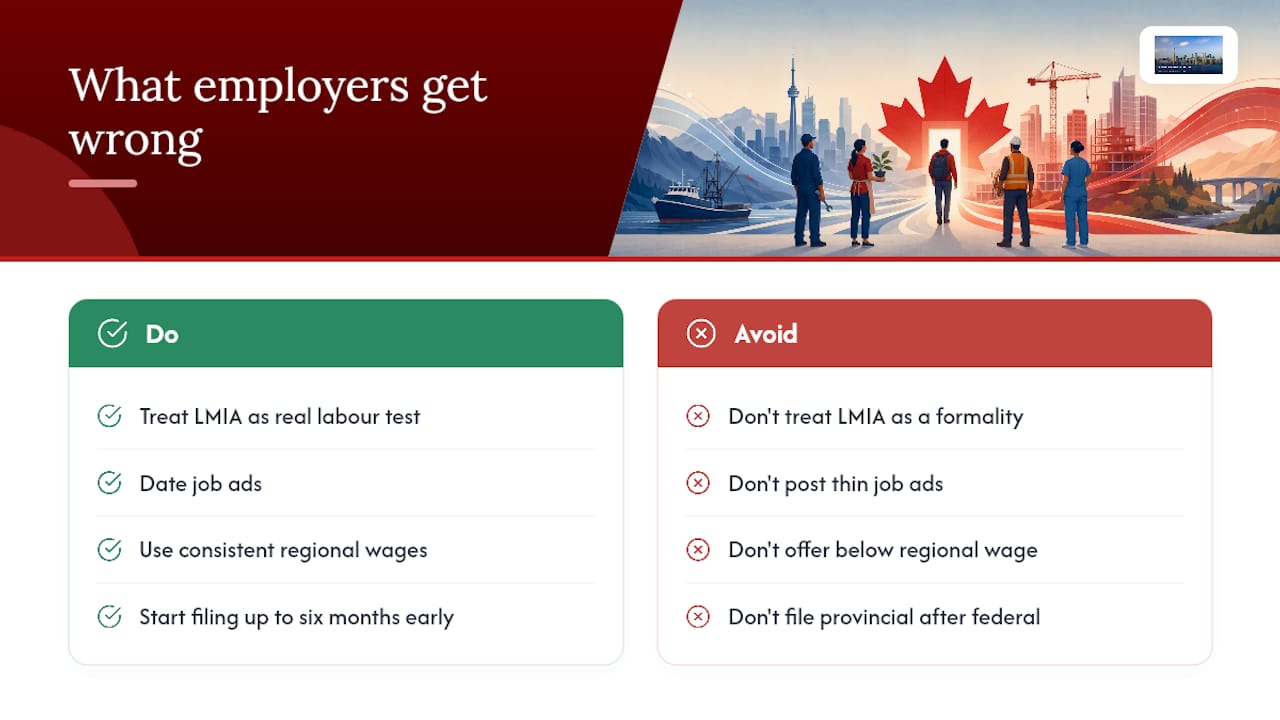
The second issue is timing. Employers often start the process weeks before they need someone, then act surprised when LMIA Online processing and provincial registration eat into that window. Filing up to six months ahead isn’t a suggestion, it’s the buffer that keeps a hire from falling apart over a documentation gap nobody caught in time.
What actually matters, based on where refusals happen most, is documentation discipline: dated job ads, consistent wage figures, and a provincial certificate filed before the federal one if your province requires it. Employers who treat these as boxes to check after the fact are the ones who refile. Employers who build the file correctly the first time rarely hear from Service Canada again until the next hire.
— Minerva McBean
How Canada Number One Immigration Supports Your Hire
Filing an LMIA or building an Employer Portal offer without guidance means you’re absorbing every risk on your own timeline, with no second set of eyes on the advertising evidence or wage numbers before they go in. Canada Number One Immigration reviews your job offer, benchmarks your wage against regional standards, and manages your submission through LMIA Online or the Employer Portal so the file is complete the first time.
The firm’s employer services cover LMIA applications, provincial registration guidance for BC, Manitoba, Saskatchewan, and Nova Scotia, and corporate immigration support for businesses hiring across multiple roles. Most employer files move to submission within a few weeks of a document review, once the wage assessment and advertising evidence are confirmed. If you’re planning a hire and want your file checked before it goes to Service Canada, book a consultation through the services page and start with a document review.
This article is general information, not a substitute for advice from a qualified lawyer. Consult a qualified legal professional about your own circumstances before acting on anything here.
Sources
- Canada
- LMIA Online — Employment and Social Development Canada
- How do I hire a temporary foreign worker? — IRCC Help Centre
Recommended
Stay Updated
Subscribe to our newsletter for the latest immigration news and tips.