Avoid Refusal: Prove These 3 Costs for a Canada Study Permit (2026)

Yes, IRCC requires proof of funds for every Canada study permit application. You need to document three separate costs: tuition, living expenses, and return travel. As of September 1, 2026, the baseline living-amount for a single applicant outside Quebec is set by IRCC, and that figure is separate from whatever your tuition and airfare actually cost.
TL;DR:
- Proof of funds must include tuition, living expenses based on family size, and return airfare, with the living amount increasing for each additional family member.
- Acceptable proof documents include GICs purchased through Canadian banks, bank statements showing steady balances, and official payment receipts, with translations and certifications where needed.
- Large, unexplained deposits or inadequate sponsor documentation are common reasons for visa refusals, especially if the applicant’s source of funds cannot be clearly demonstrated.
- Applicants should plan to gather and prepare all documents three to four months before applying, paying particular attention to multi-year funding needs and provincial requirements for Quebec.
- For complex financial situations or previous refusals, consulting a licensed professional can help strengthen the proof of funds package before submission.
Table of Contents
- How Much Money Do You Need for a Study Permit?
- What Documents Count as Proof of Funds?
- Building Your Proof of Funds Package: A Step-by-Step Checklist
- Why Do Proof of Funds Applications Get Flagged?
- Special Cases: Families, Multi-Year Programs, and Quebec
- What Do Visa Officers Actually Check?
- When Does It Make Sense to Get Help With Your Application?
- Get Your Study Permit Documents Reviewed Before You Submit
- Where to Verify These Numbers Yourself
- Sources
How Much Money Do You Need for a Study Permit?
The living-amount you must prove depends on how many people are coming with you to Canada, and it climbs fast once dependents enter the picture. IRCC’s official guidance sets these figures per year, and they apply on top of whatever your tuition and travel actually cost, not instead of them.
| Family Size | Annual Living-Amount (Outside Quebec) |
|---|---|
| 1 person | the IRCC-set minimum for living expenses |
| 2 people | an increased amount based on IRCC guidance |
| 3 people | a further increased amount per official guidelines |
| 4 people | a further increased amount per official guidelines |
| 5 people | a further increased amount per official guidelines |
| 6 people | a further increased amount per official guidelines |
| 7 people | a further increased amount per official guidelines |
| Each additional person | an incremental increase as per IRCC standards |
Quebec runs its own financial assessment tied to its Certificat d’acceptation du Québec (CAQ) process, and applicants heading to a Quebec institution need to follow that provincial pathway before IRCC will process the federal application. These amounts are indexed annually against 75% of Statistics Canada’s Low Income Cut-Off, which is why the number jumped again for the September 2026 cycle. Budget tuition and airfare as separate line items on top of whichever row applies to you.
What Documents Count as Proof of Funds?
IRCC does not ask you to guess at what counts. The official list names specific document types, and some carry far more weight with a visa officer than others.
- Guaranteed Investment Certificates (GICs): A GIC purchased through a major Canadian bank is one of the strongest pieces of evidence you can submit, because the funds sit inside Canada, the institution verifies the deposit, and the money releases to you in installments after arrival rather than all at once.
- Bank statements: Officers generally want several months of statements showing a steady, unremarkable balance, not a single lump deposit the week before you applied. Non-English or non-French statements need certified translations and, ideally, the bank’s official stamp.
- Tuition and housing receipts: Proof of payment or a deposit made to your Designated Learning Institution (DLI) strengthens your file, though it does not replace the living-expense evidence.
- Scholarship letters: An official letter on institutional letterhead confirming the amount, duration, and conditions of the award.
- Student loan approval letters: These need to state the approved amount and disbursement schedule clearly.
- Sponsor letters: Anyone sponsoring you (usually a parent) needs to back their letter with employment letters, recent payslips, and tax filings, since notarized letters alone rarely satisfy an officer.
Building Your Proof of Funds Package: A Step-by-Step Checklist
Treat this as an assembly project, not a scavenger hunt. Work through it in order and you avoid the last-minute scramble that produces the exact “large unexplained deposit” pattern officers flag most often.
- Add up your total need. Combine one year of tuition, the living-amount for your family size, and a realistic return airfare. This total is the number every document you gather needs to collectively support.
- Lock in tuition first. Pay your deposit or full tuition to your DLI where your budget allows, and save the official receipt. It is often the easiest piece of the file to finalize early.
- Set up your GIC or transfer funds. If you’re going the GIC route, purchase it through a Canadian bank as early as your visa office timeline allows; processing can take a few weeks.
- Gather 4 to 6 months of bank statements. Pull statements for every account you’re citing, and collect a short paper trail (a sale agreement, an inheritance letter, a business ledger) for any deposit that isn’t obviously your salary.
- Build the sponsor dossier. Pair the sponsor letter with an employment letter, recent payslips, and the last one to two years of tax returns.
- Translate, label, and order everything. Certify any document not in English or French, name your files clearly, and upload tuition proof, then funds evidence, then sponsor documentation, in that sequence.
Pro Tip: Keep a one-page summary listing each document, what it proves, and the dollar amount it covers. Visa officers move through hundreds of files a week, and a package that’s easy to verify at a glance gets less scrutiny than one that makes them dig.
Why Do Proof of Funds Applications Get Flagged?
Most refusals trace back to a handful of repeat mistakes, and nearly all of them are fixable if you catch them before submission.
- Sudden large deposits with no paper trail. A $20,000 transfer that appears two weeks before you apply reads as a red flag unless you attach a source document, such as a property sale contract or a gift letter with the giver’s bank records.
- Thin sponsor letters. A notarized letter stating “I will support my child” means little without an employment letter, payslips, and tax filings proving the sponsor can actually afford it.
- Prepaid tuition mistaken for full proof. Paying your first year’s tuition upfront covers exactly that line item; it does nothing to prove you can cover living costs, and officers still expect that evidence separately.
- Underestimating 2026 scrutiny on source of funds. IRCC’s updated officer instructions push visa officers to trace where money originated in every file, not just the unusual-looking ones, so even a clean-looking bank balance needs a plausible backstory.
Special Cases: Families, Multi-Year Programs, and Quebec
A few situations change the math, and missing the adjustment is a common reason otherwise strong files stall out.
- Accompanying family members: Use the family-size row that includes every dependent traveling with you, not just yourself, and total the funds accordingly.
- Multi-year programs: A two- or three-year degree needs a credible funding plan for every year, not just year one. A multi-year scholarship letter or a parent’s stable, documented employment carries far more weight than a vague promise that “funds will be arranged later.”
- Quebec applicants: Quebec sets its own financial thresholds through the CAQ process, and you generally need that certificate approved before IRCC processes the federal study permit.
What Do Visa Officers Actually Check?
Officers aren’t scanning for a specific document; they’re applying a legal test. Under section 220 of the Immigration and Refugee Protection Regulations, an officer cannot issue a study permit unless satisfied the applicant has sufficient, available funds to cover tuition, living costs for themselves and any accompanying family, and return transportation.
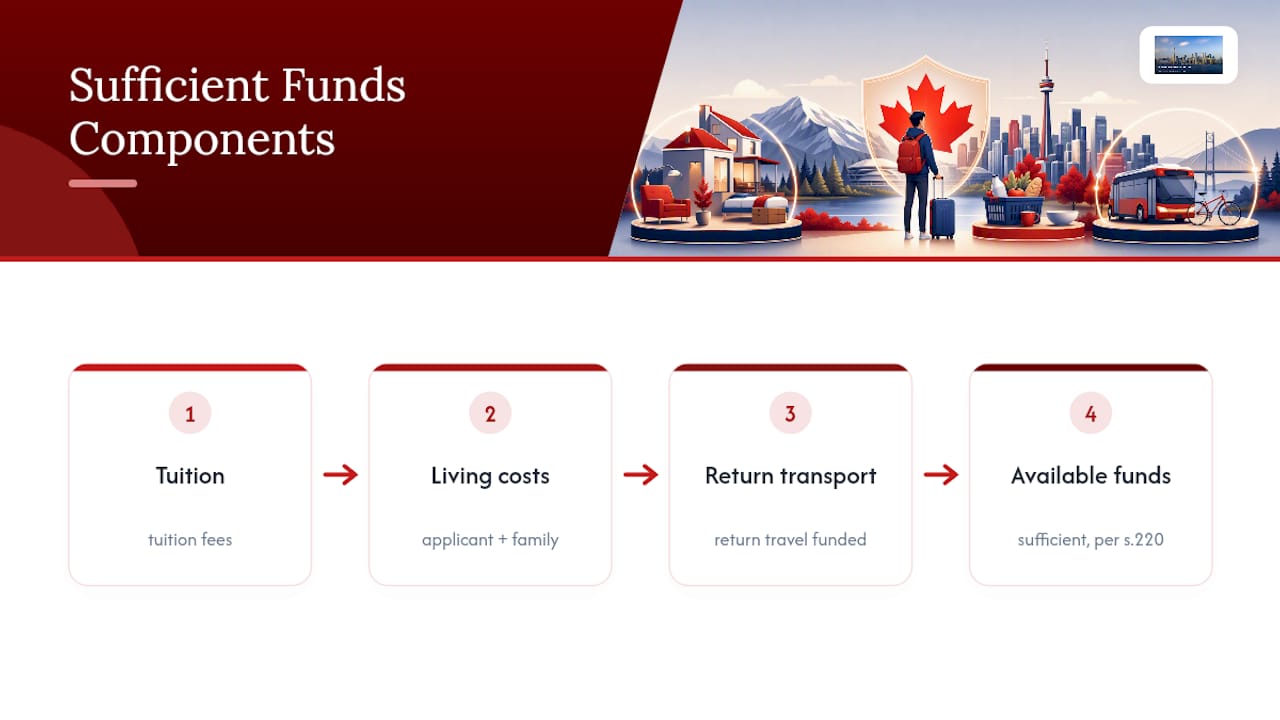
That “available” word matters. It’s why a 4 to 6 month bank statement history, the timeframe most university international offices recommend, carries more weight than a single-day snapshot. A steady balance across half a year is harder to fake and easier to verify than a number that appeared overnight. Officers also cross-reference sponsor claims against employment and tax documents, so a mismatch between claimed income and lifestyle tends to trigger a request for more evidence rather than an outright refusal.
Give yourself real lead time. Start gathering statements and setting up a GIC at least two to three months before your intended application date, since GIC processing and translation work both take time you don’t want to lose in the final week.
When Does It Make Sense to Get Help With Your Application?
Most straightforward files don’t need a consultant. Where applicants commonly run into trouble is complex source-of-funds situations, family businesses, mixed sponsor income, or a previous refusal on record. In those cases, a second set of trained eyes on your document package before submission can catch the gap an officer would otherwise flag. A licensed RCIC consultant can review these files and advise you before submission whether your evidence supports your claims.
— Micah
Get Your Study Permit Documents Reviewed Before You Submit
Some services offer a licensed consultant to review your bank statements, sponsor letters, and GIC paperwork before IRCC does.
That review matters most when your money story is complicated, a mix of sponsor income, a recent property sale, a multi-year funding plan that needs to look credible on paper rather than just true in principle. Canadanumberoneimmigration’s study permit and PGWP service covers document review, sponsor dossier preparation, and full application submission support, and if you’ve already been refused once, the firm also breaks down what the officer’s notes actually mean so your next attempt doesn’t repeat the same mistake. This is paid consulting work, not a free eligibility check, and pricing is listed upfront on the fees page. If you want a second opinion on your proof-of-funds package before you upload it, book a consultation and get your documents checked while there’s still time to fix what’s missing.
Where to Verify These Numbers Yourself
Every figure and rule in this guide traces back to a small set of primary sources worth bookmarking before you finalize your application.
- IRCC’s proof of financial support page for the current living-amounts and accepted document examples.
- Section 220 of the Immigration and Refugee Protection Regulations for the legal standard officers apply.
- UBC Student Services’ document guide for practical examples of what a strong file looks like in practice.
- Canadanumberoneimmigration’s breakdown of recent policy changes affecting international students, and a partner resource on immigration document preparation services for a broader look at professional document support.
This article is general information, not a substitute for advice from a qualified lawyer. Consult a qualified legal professional about your own circumstances before acting on anything here.
Sources
- Canada
- Immigration and Refugee Protection Regulations — Financial resources (s.220)
- Gather required documents for your initial study permit application - UBC Student Services
- Canada hikes funds needed by study permit applicants | CIC News
Recommended
Stay Updated
Subscribe to our newsletter for the latest immigration news and tips.