UTC Deadline and WP-EXT: Maintained (Implied) Status in Canada

If you applied to extend or change your work or study permit before it expired and you stayed in Canada, you have maintained status. You can generally continue under your original permit’s conditions until IRCC decides. The exceptions: temporary resident permit holders don’t get this protection, and leaving Canada can end your work or study authorization on re-entry.
TL;DR:
- Maintaining status requires submitting a timely application to extend or change your permit before it expires, with no new document issued during processing.
- You qualify for maintained status only if your original permit was valid, the application was received before expiry, and you remained in Canada.
- Working, studying, or traveling while on maintained status depends on your original permit’s permissions, with leaving Canada risking the loss of re-entry rights.
- Applications submitted after permit expiry can still be restored within 90 days, but work or study rights are not granted during restoration.
- Precise proof of application receipt, including timestamps and confirmation screenshots, is crucial for verifying maintained status to employers and authorities.
Table of Contents
- What Does Implied Status Mean in Canada Today?
- Do You Qualify for Maintained Status?
- Can You Work, Study, or Travel on Maintained Status?
- How Do You Prove Maintained Status to an Employer?
- What Happens If You Missed the Deadline?
- Your Immediate Checklist and When to Call in Help
- A Practitioner’s Note on Timing Mistakes
- Book a Consultation Before Your Deadline Closes In
- Where to Verify These Rules Yourself
- Sources
What Does Implied Status Mean in Canada Today?
The term “implied status” is outdated. IRCC now calls it maintained status, and the rename wasn’t cosmetic. Officials wanted a term that better reflects what’s actually happening: your existing conditions carry forward automatically, they aren’t “implied” from anywhere.
The legal foundation is Immigration and Refugee Protection Regulations section 183(5). It states that a temporary resident who applies to extend their status before it expires stays authorized under the same conditions while IRCC processes the request.
Here’s the part that trips people up: no new document gets issued. You won’t receive a fresh permit with new dates. What you actually hold is an expired permit plus proof that you applied on time. That combination, not a piece of paper, is your legal status. It’s why keeping your application receipt matters more than almost anything else in this process.

Do You Qualify for Maintained Status?
Three conditions have to line up for maintained status to kick in:
- You held a valid permit at the time you submitted your new application.
- IRCC received the application before your existing permit expired.
- You remained physically in Canada.
Miss any one of these and you fall into restoration territory instead, which comes with tighter rules and no automatic work or study rights.
Inside-Canada applications for extensions or changes typically trigger maintained status. Applications filed from outside Canada, or first-time temporary resident permit requests, do not. TRP holders never qualify for maintained status, since TRPs are discretionary and governed by their own set of rules.
One more wrinkle worth knowing: if you file a second application while your first is still pending and that first one gets refused, updated IRCC policy can affect the second application too. Filing multiple applications back to back isn’t automatically a problem, but it’s not risk free either.
Can You Work, Study, or Travel on Maintained Status?
Maintained status doesn’t hand you new permissions. It extends the ones you already had, which means the boundaries depend entirely on what your original permit allowed.
- Workers continue under their existing permit’s terms. If you had an employer-specific work permit, you keep working for that same employer only. Open work permit holders keep the same flexibility they had before.
- Students can keep studying and working under the same conditions their study permit allowed, including off-campus work limits. Maintained status doesn’t unlock a program change or a new work entitlement you didn’t already have.
- Visitors can stay in the country while their application is processed, but filing paperwork doesn’t create work or study rights out of nothing.
- Travelers face the biggest risk. Leaving Canada while on maintained status usually ends your right to resume working or studying on re-entry, even if your application is still pending.
Pro Tip: If you’re mid-application and considering a trip home, call it off unless you have a compelling reason. Border officers see maintained status cases regularly, and re-entry isn’t guaranteed just because your paperwork is still in the system.
How Do You Prove Maintained Status to an Employer?
Timing here is unforgiving, and it runs on a clock most applicants have never heard of. Online applications must reach IRCC before 11:59 PM Coordinated Universal Time (UTC) on the day your permit expires, not 11:59 PM in your local time zone. Someone in Vancouver submitting at 9 PM Pacific might think they have three hours to spare. They don’t. UTC has already moved past midnight by then. Paper applications get a narrower exception tied to the postmark date.
Once your application is in, IRCC typically issues a WP-EXT code or an account message confirming receipt. This is your proof. Employers and immigration officers both recognize it.
Here’s where confusion often creeps in: the letter sometimes shows a 365-day validity window, but that date is not a hard cutoff. Work can continue past it as long as a final decision is still pending.
- Screenshot your submission confirmation the moment you file.
- Save the IRCC account message or WP-EXT letter as a PDF.
- Keep courier tracking numbers if you filed on paper.
- Hand your employer or school a copy of the confirmation directly, not just a verbal explanation.
What Happens If You Missed the Deadline?
If your application arrived after your permit expired, you’re not automatically out of options, but you are on a shorter clock. IRPR section 182 allows you to apply for restoration within 90 days of your permit’s expiry date, provided you meet the conditions your original status required.
A few things to know going in:
- You generally cannot work or study while a restoration application is pending, unlike maintained status.
- Restoration involves separate fees layered on top of your permit fee, plus biometrics if required.
- IRCC has full discretion here. Meeting the 90-day window doesn’t guarantee approval.
If restoration gets refused, you typically need to stop working immediately and plan your departure, or explore whether an appeal or a fresh application makes sense for your situation. Waiting it out rarely helps at that point.
Your Immediate Checklist and When to Call in Help
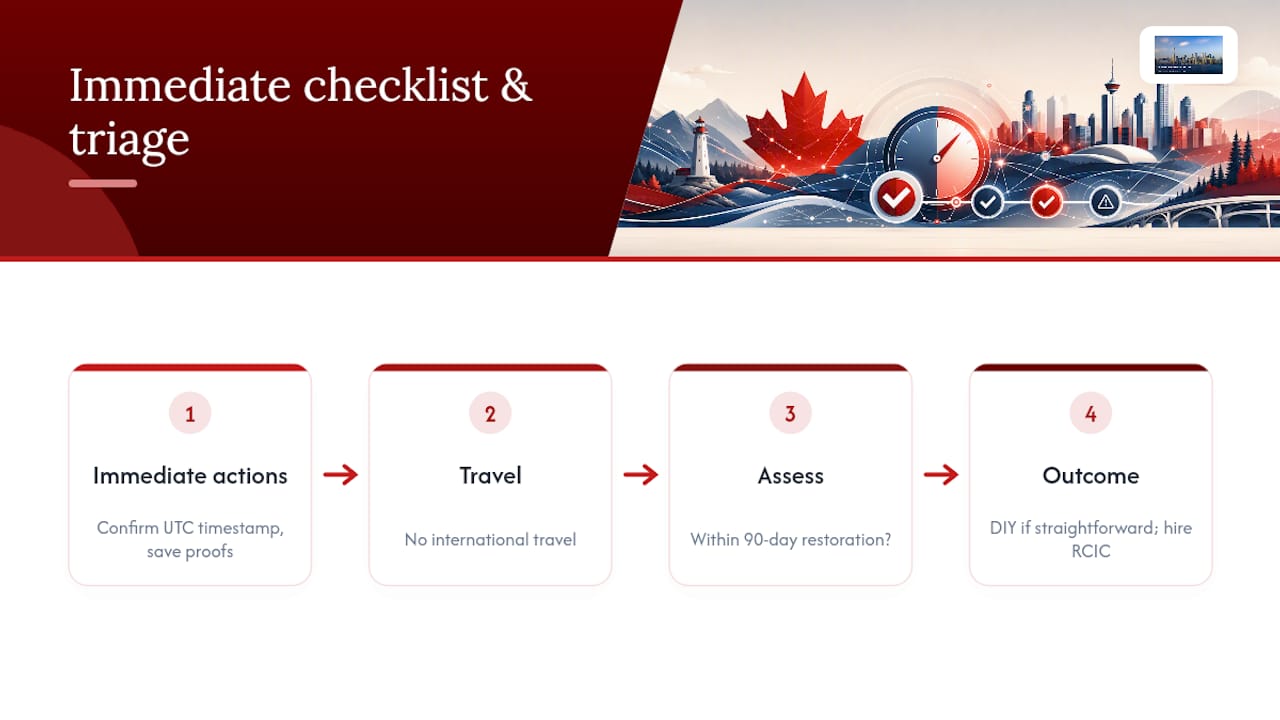
Right now, before anything else: confirm your submission timestamp in UTC, not local time. Save your IRCC acknowledgement and screenshot the confirmation page. Hand your employer or school that proof directly. Skip international travel until you have a decision in hand.
From there, it’s a judgment call. If your timeline is straightforward and you’re inside the 90-day restoration window, waiting or filing restoration yourself might be enough. If you’re facing a refusal, a TRP complication, an employer who won’t accept your documentation, or a restoration filing you’re not confident about, that’s when a licensed consultant earns their fee. A work permit extension filed incorrectly the first time often costs more to fix later than it would have cost to get right upfront.
Canadanumberoneimmigration has built its practice around exactly this kind of timing-sensitive case, led by licensed RCIC Minerva McCoon McBean.
A Practitioner’s Note on Timing Mistakes
Most maintained status problems trace back to one thing: applicants trusting their local clock instead of UTC. I’ve seen submissions land four minutes past the cutoff, pushing someone straight into restoration when a slightly earlier click would have avoided it entirely.
Employers ask for WP-EXT confirmation because they’ve been burned before by workers who assumed they were covered and weren’t. A consultant’s real job in these cases is translating IRCC’s confirmation language into something HR will actually accept without a second phone call.
— Minerva McBean
Book a Consultation Before Your Deadline Closes In
Canadanumberoneimmigration handles the exact situations covered above: application timing reviews, restoration filings, and employer letters that actually satisfy HR departments instead of raising more questions. If you’re unsure whether your submission cleared the UTC deadline or your employer is pushing back on your WP-EXT confirmation, a licensed consultant can review your file and tell you where you actually stand.
A consultation works best when you bring your IRCC submission receipt, copies of your current and expired permits, and your employer’s contact information if a letter needs drafting. Minerva McCoon McBean’s team has built its practice around exactly this kind of timing-sensitive case, and for readers dealing with a work permit renewal or a restoration filing, that experience is the difference between guessing and knowing. Book a consultation and get a straight answer on where your application stands before the 90-day restoration window narrows any further.
Where to Verify These Rules Yourself
For primary confirmation, check IRCC’s help centre answer on work permit renewals, the official extension guidance, the TRP program page, and the IRPR legislative text itself.
Sources
- I applied for a new work permit. Can I stay in Canada if my work permit expires? — IRCC help centre
- Canada
- Maintained status — UBC Student Services
Recommended
Stay Updated
Subscribe to our newsletter for the latest immigration news and tips.