Employers: IRCC Oct 2026 Evidence for Canada Intra Company Transfers

Intra-company transfers let multinational employers bring executives, senior managers, and narrowly defined specialized-knowledge workers to Canada without an LMIA, provided the corporate relationship and the evidence behind it hold up. Since October 2024, that’s the hard part: IRCC now expects ownership charts, proof both entities are actively doing business, and clear documentation of physical premises before it will sign off. If your file has that, the next move is straightforward: the employer logs into the Employer Portal, completes the Offer of Employment, and gets the A-number that starts the process.
TL;DR:
- Confirm ownership and active operation evidence no later than four weeks before filing, including leases, payroll, and client contracts, to avoid refusals.
- Gather detailed organizational charts, clear job descriptions, and proprietary system documentation to substantiate specialized knowledge claims.
- Ensure the applicant has at least one year of continuous full-time employment with the foreign entity within the past three years, verified through official records.
- When filing from inside Canada, expect initial permits of one to three years for executives and senior managers, while start-up transferees receive only a one-year initial permit.
- Engaging a licensed immigration professional is recommended when establishing new Canadian operations or building complex, proprietary knowledge cases to meet IRCC’s tougher evidence standards.
Table of Contents
- Who Qualifies for a Canada Intra-Company Transfer?
- What Counts as a Qualifying Company Relationship?
- What Documents Do You Need for an Employer Portal Filing?
- How Do You Prove Specialized Knowledge?
- How Long Does an ICT Work Permit Last, and How Do You Apply?
- Why Do ICT Applications Get Refused?
- How Should Employers Plan an ICT Filing Timeline?
- When Should a Company Bring in a Licensed RCIC?
- Get Help Filing Your Intra-Company Transfer
- Where to Verify the Rules Yourself
- Sources
Who Qualifies for a Canada Intra-Company Transfer?
Intra-company transferees fall into three main buckets, and IRCC scrutinizes each one differently. Getting the category wrong is one of the fastest ways to stall a file before it even reaches an officer’s desk.
- Executives direct the organization or a major function, with broad decision-making authority and minimal day-to-day oversight from above.
- Senior managers oversee a department, subdivision, or function, and typically supervise other managers or professional staff.
- Specialized-knowledge workers hold expertise that is both advanced and proprietary to the company, not just skill that any competitor could hire off the street.
- Start-up transferees (C61) are executives or managers establishing a new Canadian branch, subsidiary, or affiliate that doesn’t yet have active operations here.
Every category shares one baseline test: the applicant generally needs at least one year of continuous full-time employment with the foreign entity within the past three years, with some variation under specific free trade agreements. Officers verify role level using an organizational chart showing where the person sits, a detailed duty description that matches the claimed title, and payroll records confirming the salary lines up with seniority. A “senior manager” earning an entry-level wage raises questions fast.
What Counts as a Qualifying Company Relationship?
IRCC needs to see two things clearly: that the foreign and Canadian entities are actually connected, and that both are genuinely operating businesses, not paper shells.
A qualifying relationship means the Canadian entity is a parent, subsidiary, branch, or affiliate of the foreign company, with ownership or control documented through share registries, corporate filings, or an annotated ownership chart. Franchise and license arrangements do not qualify, no matter how tightly the brand controls operations, because there’s no equity or corporate control link between the two businesses.
Beyond ownership, officers now look for proof of active operations on both sides:
- A signed commercial lease or proof of physical premises in Canada, not a virtual office address.
- Payroll records showing employees are actually being paid in Canada.
- Client contracts, invoices, or bank statements showing revenue movement.
- Corporate registration documents current with the relevant provincial or federal registry.
Pro Tip: Build your evidence package as if a skeptical stranger will read it with zero context. Label every exhibit, date every document, and connect the dots explicitly rather than assuming an officer will infer the relationship from a stack of unlabeled PDFs.
What Documents Do You Need for an Employer Portal Filing?
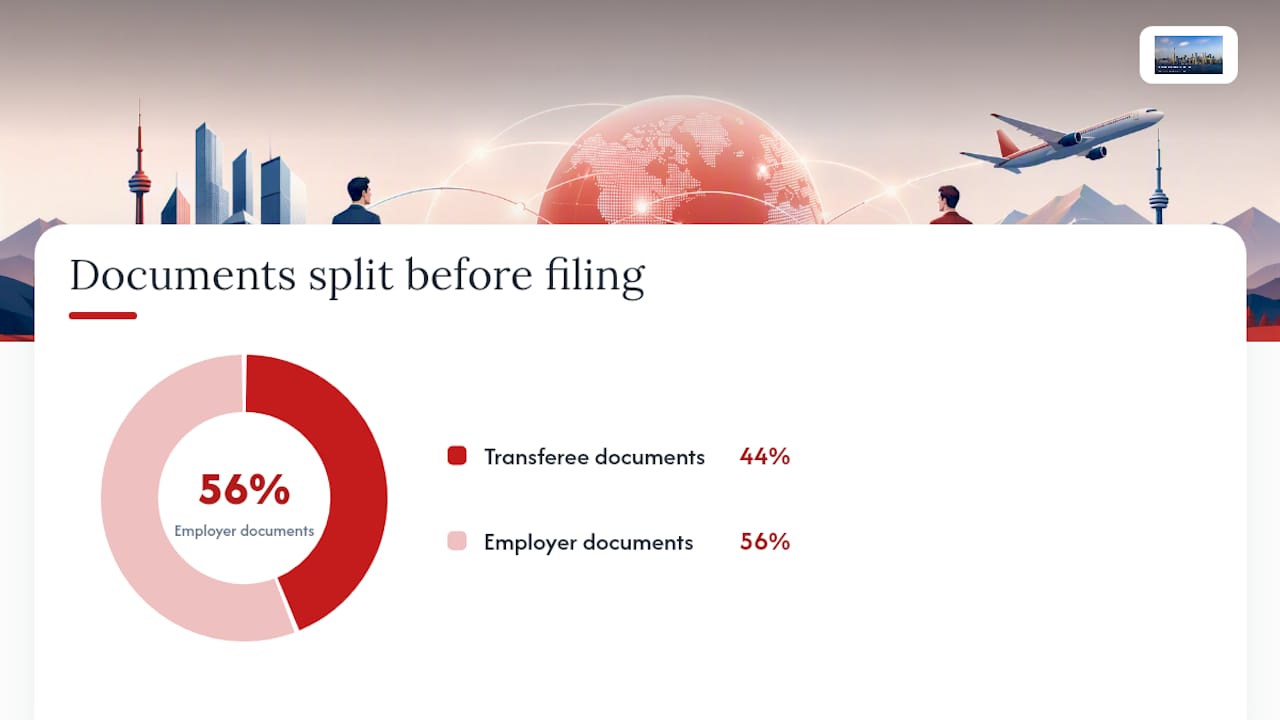
Two separate document sets need to come together before you file: what the worker provides, and what the employer produces. Missing either half stalls the case.
For the transferee, gather:
- A valid passport and proof of citizenship or permanent status in the home country.
- Employment records proving the one-year continuous employment threshold, including offer letters and role history.
- Recent pay stubs and tax documents from the foreign employer.
- A signed employment contract for the Canadian position, with salary, title, and duties spelled out.
For the employer, assemble ownership and organizational charts, corporate registration documents for both entities, a signed lease or proof of premises, recent bank statements, and contracts or invoices demonstrating ongoing Canadian business activity.
Once the paperwork is ready, the employer logs into the Employer Portal to submit the Offer of Employment and pay the compliance fee. IRCC issues an Offer of Employment number, often called the A-number, which the worker then enters into their own work permit application. Without that number, the application can’t be linked to a valid LMIA-exempt offer, and it will be returned as incomplete.
How Do You Prove Specialized Knowledge?
Specialized knowledge is the category officers scrutinize hardest, because “specialized” is subjective until you make it concrete. IRCC applies a two-part test: the knowledge must be advanced relative to the industry, and it must be proprietary to the company, meaning it isn’t something a competitor’s employee could plausibly replicate.
Generic expertise fails this test every time. “Ten years of experience in manufacturing” doesn’t cut it. What works is evidence tying the person directly to systems only their company uses:
- Patents or invention disclosures naming the transferee as an inventor or contributor.
- Confidential technical manuals or process documentation, with sensitive sections redacted but the connection to the role intact.
- Internal training records showing the person was trained on proprietary systems, not public-domain tools.
- A signed statement from a senior executive explaining, in plain terms, why this specific person’s knowledge transfer is necessary for the Canadian operation.
Pro Tip: Write a one-page mapping statement that lines up each proprietary skill against a specific operational need in the Canadian office. Officers respond better to “she built and maintains our order-routing algorithm, which the Canadian branch needs to launch its logistics platform” than to “she has advanced technical skills.”
How Long Does an ICT Work Permit Last, and How Do You Apply?
Where you apply depends on where the applicant is sitting when the offer comes through. Options include applying from outside Canada at a visa post, applying from inside Canada for an extension, or in limited cases presenting at a port of entry. Whichever route you choose, IRCC expects a complete submission through a secure account on the first attempt.
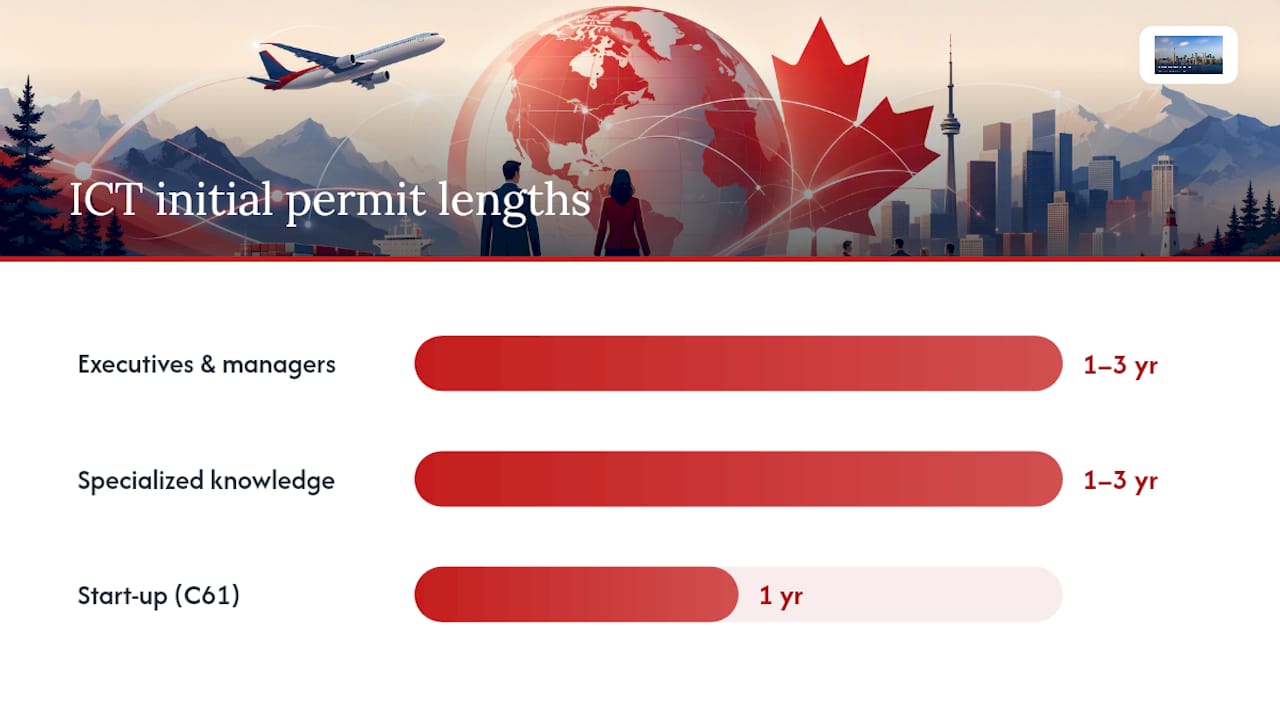
Permit lengths vary by category:
- Executives and senior managers typically receive initial permits of one to three years, renewable as long as the qualifying relationship and role continue.
- Specialized-knowledge workers usually see similar initial terms, tied closely to the strength of the documented evidence.
- Start-up (C61) transferees get a one-year initial permit only, reflecting the higher risk IRCC assigns to unproven Canadian operations, and it’s generally renewable once before the file needs to show a maturing business.
Renewal applications need continuity: the same ownership structure, consistent payroll, and evidence that the Canadian operation has grown, not stalled. Processing timelines shift, and some categories still route through legacy processing centers, so building in a buffer before a permit expires avoids gaps in work authorization.
Why Do ICT Applications Get Refused?
Refusals cluster around a small number of predictable weaknesses, and nearly all of them trace back to the tighter evidence standard IRCC adopted starting in October 2024.
- Unclear corporate ownership. A share registry that doesn’t match the ownership chart, or a missing link between the two entities, is an automatic red flag.
- Weak proof of active Canadian operations. A virtual office, no payroll history, or no client contracts signals a shell rather than a functioning business.
- Vague job descriptions. “Manager, Operations” with a duty list copied from a template doesn’t establish seniority or scope.
- Thin specialized-knowledge mapping. Broad claims of expertise without a direct line to proprietary systems rarely survive review.
Most of these are fixable before filing, not after refusal. Label exhibits clearly, get the commercial lease executed rather than pending, and produce payroll and bank records in Canadian dollars where the operation actually runs in Canada. If the evidence isn’t there yet, delaying the filing by a few weeks to assemble it properly beats submitting early and absorbing a refusal on record.
Pro Tip: A refusal creates a paper trail that follows the file into future applications. It’s almost always cheaper, in time and legal cost, to wait three weeks for a signed lease than to file today and fight a refusal for three months.
How Should Employers Plan an ICT Filing Timeline?
A rushed ICT file is usually a refused one. Working backward from a target start date gives HR and legal teams enough runway to build a case that holds up.
- Weeks 1 to 2: Confirm the qualifying relationship. Pull corporate registration documents, ownership charts, and share registries for both entities.
- Weeks 2 to 4: Assemble operational evidence: execute the lease, confirm payroll is running, and gather client contracts or bank statements showing revenue.
- Week 4: Draft the role narrative and, for specialized-knowledge cases, the proprietary-skills mapping statement.
- Week 5: Employer submits the Offer of Employment through the Employer Portal and receives the A-number.
- Week 5 to 6: Worker files the work permit application using the A-number, through whichever route fits their location.
- After filing: Track the case number, respond quickly to any request for information, and start renewal preparation at least three months before the permit expires.
Pro Tip: Assign one person, not a committee, to own the evidence file from day one. ICT filings die more often from documents sitting in five different inboxes than from a genuinely weak case.
When Should a Company Bring in a Licensed RCIC?
I’ve seen enough of these files to know the pattern: companies that try to self-file an ICT case usually underestimate how much documentary weight IRCC now expects since the October 2024 tightening. If you’re establishing a brand-new Canadian branch under the C61 start-up rules, or building a specialized-knowledge case that depends on proprietary systems most officers have never heard of, that’s exactly when a second set of trained eyes pays for itself.
The work that moves the needle most is rarely the application form itself. It’s the evidence architecture behind it: mapping ownership charts to officer expectations, structuring a business plan that survives scrutiny, and getting the Employer Portal submission right the first time so the A-number isn’t delayed by avoidable errors.
— Micah
Get Help Filing Your Intra-Company Transfer
Preparing an ICT file on your own means absorbing every hour of document collection, chart annotation, and narrative drafting internally, on top of your regular HR or legal workload. Immigration consultancies exist to take that weight off your team’s plate. Approaches center on building the exact evidence package IRCC has been demanding since the 2024 tightening: ownership documentation, business-plan drafting for start-up filings, and precise Employer Portal submissions that get the A-number issued without unnecessary back-and-forth.
Our services cover corporate ICT preparation, C61 start-up filings, and general work permit support for LMIA-exempt streams. Engagements typically start with a document audit, move into evidence assembly and narrative drafting, and end with a filed application and a monitoring plan through to approval. If your company is planning a transfer and wants the evidence built right the first time, visit our immigration services page to see what’s involved, or book a consultation to walk through your specific corporate structure before you file.
Where to Verify the Rules Yourself
Always confirm current requirements directly with IRCC before filing, since guidance updates regularly:
- IRCC exemption codes for intra-company transferees (R205/C12)
- Employer Portal and Offer of Employment guidance
- Immigration and Refugee Protection Regulations (IRPR)
- Applying for a work permit inside Canada
This article is general information, not a substitute for advice from a qualified lawyer. Consult a qualified legal professional about your own circumstances before acting on anything here.
Sources
Recommended
Stay Updated
Subscribe to our newsletter for the latest immigration news and tips.