Do You Need an Invitation Letter for a Canada Visa?

A letter of invitation can strengthen a visitor visa application, but it does not guarantee approval. Immigration, Refugees and Citizenship Canada (IRCC) states plainly that visa officers weigh the letter alongside everything else in the file, and a well-written letter with no proof behind it carries little weight. The host in Canada writes the letter, not the visitor, and it needs to reflect real facts in good faith rather than a copy-paste template.
Before you draft anything, get these six fields locked down:
- Visitor’s full name, date of birth, and passport number
- Purpose of the trip and exact travel dates
- Where the visitor will stay during the visit
- Who is paying for what (flights, lodging, meals)
- Host’s full name, address, and proof of Canadian status
- Host’s signature, date, and a phone number or email for verification
Every application also carries a fee. Visitor visa fees, which start at CAN$100, are detailed comprehensively on the Visitor Visa - Fewa Consultancy site, along with biometric fees of CAN$85 per person or CAN$170 for a family, applying to most applicants between 14 and 79. The letter itself costs nothing to write. It’s the surrounding paperwork that adds up.
Key Takeaways
An invitation letter strengthens a Canadian visitor visa application only when its claims about dates, finances, and host status are backed by matching documents attached to the file.
| Point | Details |
|---|---|
| Letter helps, doesn’t guarantee | IRCC confirms a letter supports the file but officers still assess the full application under immigration law. |
| Match every claim to proof | Any financial promise needs bank statements or pay stubs attached, not just a sentence in the letter. |
| Use the right template for the case | Super Visa letters need a signed financial support promise and proof of medical insurance; business letters need letterhead and two originals. |
| Update the letter after delays | Revise travel dates and refresh financial documents if processing runs long before the trip. |
| Get a licensed review for complex cases | Canada Number One Immigration offers letter review and application support for Super Visa, high-value, or previously refused files. |
Where to Verify These Requirements Directly
Check IRCC’s official invitation letter guidance, the IRCC help centre on assisting a visitor, and Travel for current entry requirements and advisories.
Table of Contents
- What Information Belongs in an Invitation Letter for a Canada Visa?
- Which Supporting Documents Should Accompany the Letter?
- How Do Super Visa and Business Invitation Letters Differ?
- Sample Invitation Letter Templates You Can Adapt
- How Officers Review the Letter and What Mistakes to Avoid
- What If the Visitor Has a Previous Visa Refusal?
- Should You Update the Invitation Letter If Processing Takes Longer Than Planned?
- Sources
What Information Belongs in an Invitation Letter for a Canada Visa?
IRCC’s checklist is specific, and skipping a field is one of the fastest ways to make a letter look incomplete. The letter needs two clear halves: who is visiting, and who is hosting.
For the visitor, include:
- Full legal name and date of birth
- Passport number and home address
- Relationship to the host (cousin, friend, business colleague)
- Purpose of the visit, stated in plain language
- Planned arrival and departure dates
- Where they will stay while in Canada
- Who covers which costs, spelled out rather than implied
For the host, include full name, date of birth, Canadian address and phone number, job title and employer, and status in Canada, whether that’s citizenship, permanent residency, or a valid permit. Attach proof of that status. IRCC’s own guidance notes that if the visit involves parents or grandparents, the host must include a written promise of financial support, not a vague gesture toward it.
If you’re covering costs, say so in a sentence an officer can actually verify: “I will pay for my cousin’s accommodation and meals for the duration of her stay, from March 3 to March 20, 2026.” Vague language like “I will help out financially” invites questions.

The letter needs a signature and a date at the bottom, along with a phone number where the host can be reached if an officer wants to confirm details.
Pro Tip: Write the letter yourself instead of downloading boilerplate text off a random website. Officers read hundreds of these letters a week, and generic phrasing is easy to spot.
Which Supporting Documents Should Accompany the Letter?
An invitation letter without backup documents is just a claim. IRCC’s guidance is consistent on this point: if the letter makes a promise, something in the file needs to prove the host can keep it.
From the host, attach:
- A copy of the passport, PR card, or citizenship certificate
- Proof of address, such as a utility bill or lease agreement
- Recent pay stubs or bank statements, if the host is covering costs
From the visitor, include a passport copy, a record of prior travel history, and proof of ties to their home country, like an employment letter or school enrollment confirmation. If the trip involves a business meeting or a specific event, attach the itinerary or the formal event invitation.
Business invitations sometimes need extra formality. Two original signed copies and notarization may be required depending on the visa office handling the application, so check that office’s specific instructions before assuming a scanned copy will do.
How Do Super Visa and Business Invitation Letters Differ?
Not every invitation letter follows the same script. Three situations call for extra language or extra paperwork.
- Super Visa applications: The host must sign a formal promise of financial support, calculated against household size, and the visitor needs private medical insurance valid for at least one year. This requirement is specific to Super Visa rules and does not apply to standard visitor visa letters.
- Business visitors: Use official company letterhead, state the purpose of the visit and any scheduled meetings, and prepare two original signed copies in case the visa office or border officer asks for one.
- Student hosts: If the host is studying in Canada, attach the study permit pages and mention how long the program runs. A longer, established stay reads as more stable than a host who just arrived.
Sample Invitation Letter Templates You Can Adapt
Two structures cover most situations: a personal visit and a business visit. Both follow the same IRCC fields, just with a different tone.
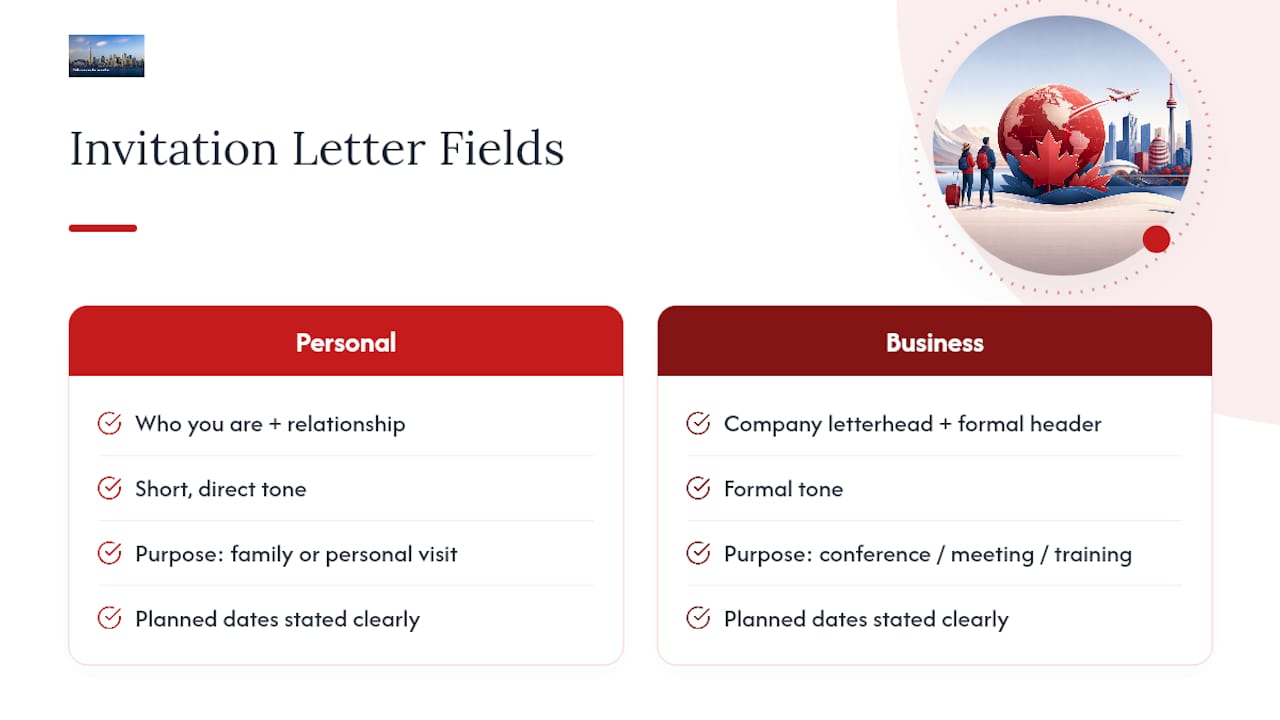
A family or personal template stays short and direct. Open with who you are and your relationship to the visitor, state the purpose and dates clearly, and if you’re paying for anything, say it plainly: “I will cover my sister’s hotel costs for her ten-day stay in Toronto, from June 5 to June 15, 2026.” Close with your signature, the date, and your contact information.
A business template needs a formal header on company letterhead, a clear statement of the trip’s purpose (a conference, a client meeting, a training session), the planned dates, and a line noting who’s covering travel costs. Prepare two originals since some border officers ask for a second copy on arrival.
Whichever template you start from, customize it. Avoid generic phrases like “we would love to have them visit,” and instead match every date and dollar figure in the letter to the documents attached to the file. An official sample letter from the University of Waterloo shows how the format looks when every field lines up cleanly.
Pro Tip: Read your draft letter out loud before sending it. If a sentence sounds like it was written for a form letter rather than an actual person, an officer will notice the same thing.
How Officers Review the Letter and What Mistakes to Avoid
Officers use the letter mainly as a cross-check. They read it against the rest of the file to see if the story holds together, not as a standalone document that decides anything on its own.
The most common mistakes that raise flags:
- Promising to cover costs with no bank statements or pay stubs attached
- Listing travel dates in the letter that don’t match the itinerary or application form
- Using generic template language that reads the same as a thousand other letters
- Failing to attach proof of the host’s status in Canada
Before submitting, check that every date matches across documents, every financial promise has paperwork behind it, and the host’s contact information is current and reachable.
What If the Visitor Has a Previous Visa Refusal?
A prior refusal doesn’t disqualify someone from applying again, but it does raise the bar for consistency. Officers reviewing a new application often pull up the applicant’s history, and if the new file contradicts something from an earlier one, that discrepancy gets noticed fast.
The invitation letter can help here, but only if it’s honest about the situation. Don’t pretend the refusal didn’t happen. Instead, focus on what’s different this time: stronger proof of ties to the home country, a clearer financial picture, or a more specific and verifiable travel plan. If the earlier refusal cited weak home-country ties, the new letter and supporting documents need to address that directly rather than repeating the same thin evidence.
Vague reassurances make this worse, not better. A letter that says “this time will be different” without new documentation reads as wishful thinking to an officer who has seen the pattern before. What actually helps is a letter that ties every claim to something concrete: a signed employment letter confirming the applicant still holds a stable job at home, a lease or property document showing ongoing ties, or a bank statement showing consistent income.
Cases involving a previous refusal, an overstay, or any other immigration flag are exactly where getting a second set of eyes on the file matters. A licensed consultant can review the refusal letter’s stated reasons and help build a response that actually closes the gap, rather than guessing at what went wrong the first time.
Should You Update the Invitation Letter If Processing Takes Longer Than Planned?
Processing times shift, and a letter written six months before a trip can go stale fast. If the visit dates in the original letter no longer match reality, that mismatch becomes a red flag exactly like the ones officers are trained to catch.
Update the letter whenever any of its stated facts change: new travel dates, a change in who’s paying for what, or a shift in where the visitor will stay. If processing drags on and the original planned dates have already passed, don’t leave the outdated letter sitting in the file. Submit a revised version through the application portal or in response to any request for additional information from IRCC.
The same rule applies to supporting documents. If the letter promises financial support based on bank statements that are now several months old, refresh them. Officers reviewing a delayed file want to see that the numbers still hold up, not a snapshot from half a year earlier.
A short cover note explaining what changed and why helps too. Something like: “Due to processing delays, our planned travel dates have shifted from March to July 2026; updated financial documents are attached” gives the officer context instead of leaving them to guess whether the discrepancy is a red flag or just a timing issue.
Why a Licensed Consultant’s Perspective Matters Here
Most invitation letter problems aren’t about wording. They’re about mismatches between what the letter claims and what the paperwork actually shows, and catching those gaps before submission is exactly where experience pays off. Canada Number One Immigration is a Toronto-based consultancy led by Minerva McCoon McBean, a licensed RCIC, whose firm reports a 98% success rate on the files it handles. That track record comes from catching the small inconsistencies that generic templates miss.
— Minerva McBean
Get a Professional Review Before You Submit
A well-built letter still needs the numbers, dates, and documents behind it to line up, and that’s the part most applicants get wrong on their own. Canada Number One Immigration reviews invitation letters line by line against the supporting evidence in your file, something a free template can’t do for you.
The firm’s visitor visa and Super Visa services cover letter review, a document checklist tailored to your situation, and full application submission support. If you’re dealing with a Super Visa’s financial support promise, a large financial commitment from the host, a previous refusal, or you simply want a licensed RCIC to check the file before it goes in, that’s when paid review earns its cost. You can also see what consultant fees typically look like before booking. For readers weighing longer-term options beyond a single visit, the firm’s family and spousal sponsorship services cover the pathway for permanent reunification. Start by requesting a review of your visitor visa services and invitation letter through the full services page.
Sources
- Canada
- How do I help a family member or friend apply to visit Canada? - IRCC help centre
- Letter of invitation sample (University of Waterloo) - PDF
Recommended
Stay Updated
Subscribe to our newsletter for the latest immigration news and tips.