Low-Wage LMIA for Canadian Employers: 2026 Guide

Most Canadian employers can apply for a low-wage LMIA today — but two checks decide whether your application will even be processed. First, compare your offered hourly wage to the current provincial or territorial median wage. If it falls below that median, you are in the low-wage stream. Second, confirm that your worksite is not inside a census metropolitan area (CMA) currently blocked for low-wage applications. ESDC refuses to process applications for positions in CMAs with unemployment rates of 6% or higher, and that list changes every quarter. Run both checks before you spend a dollar on advertising.
Three constraints will shape everything that follows:
- 8-week advertising window: You must run at least 8 consecutive weeks of recruitment before filing.
- 10% workforce cap: Low-wage temporary foreign workers (TFWs) generally cannot exceed 10% of your total workforce at a single work location (20% in specified sectors).
- Employer-paid obligations: You must cover round-trip transportation, suitable housing, and temporary private health insurance for every low-wage TFW you hire.
Stat to know: ESDC’s August 2026 processing-time data puts the average low-wage LMIA at 73 business days from submission to decision — and that clock does not start until after your 8-week advertising window closes.
Key Takeaways
A low-wage LMIA application lives or dies on three checks run before advertising starts: wage classification against the current provincial median, CMA eligibility status, and cap math at the work location.
| Point | Details |
|---|---|
| Classify the wage first | Compare your offered hourly rate to the current Job Bank provincial median before doing anything else. |
| Verify CMA status on submission day | The ineligible CMA list updates quarterly; confirm status the morning you file, not the week before. |
| Cap math includes vacancies | Vacant positions and pending TFW approvals count toward your 10% or 20% cap calculation. |
| 8-week advertising is a hard floor | Advertising must run for 8 consecutive weeks within 3 months of filing; starting too early voids the window. |
| Processing runs 73 business days | ESDC’s August 2026 average excludes the advertising window; total timeline is roughly 5–6 months. |
| Canadanumberoneimmigration | A licensed RCIC readiness audit before advertising catches classification and cap errors before they cost you. |
Table of Contents
- Low-wage LMIA eligibility: who qualifies and which jobs are blocked
- How wage thresholds work and where to find the current figures
- Recruitment and advertising requirements you must meet
- How to prepare and submit a low-wage LMIA application
- Fees, processing times, and what affects your timeline
- What Service Canada checks on working conditions and employer obligations
- Rules for using paid recruiters, RCICs, and third-party representatives
- When to hire an RCIC or corporate immigration adviser
- What employers consistently get wrong on low-wage LMIAs
- Canada Number One Immigration helps HR teams get low-wage LMIAs right
- Sources
Low-wage LMIA eligibility: who qualifies and which jobs are blocked
Stream classification: low-wage vs. high-wage
The split between streams is purely mathematical. If the hourly wage you plan to offer is below the provincial or territorial median hourly wage, the position is low-wage. If it is at or above that median, it is high-wage. The threshold is not a fixed national number — it varies by province and territory and is reset periodically (most recently July 17, 2026). Check the current figures on Job Bank before classifying anything.
The CMA refusal-to-process rule
This is the gate that catches employers off guard most often. ESDC will not process a low-wage LMIA application when the worksite sits inside a CMA where the unemployment rate is at or above 6%. The list of ineligible CMAs is updated quarterly, which means a CMA that was eligible when you started advertising can become ineligible by the time you file. Check the ESDC low-wage program page on the morning you plan to submit — not the week before.
To confirm whether your worksite falls inside a CMA at all, use Statistics Canada’s census resources. CMA boundaries are not always intuitive; a suburban industrial park can sit inside a large CMA even when it feels geographically separate from the urban core.
Workforce cap rules
The program requirements for low-wage positions set a hard cap on how many low-wage TFWs you can employ at a single work location:
- Standard cap: 10% of total workforce at that location.
- Elevated cap (20%): Available in specified sectors such as food manufacturing, construction, and some accommodation and food services roles — confirm your NOC code qualifies before relying on this.
- Small employers (fewer than 10 employees nationally): Limited to 1 low-wage TFW under the 10% cap, or 2 under the 20% cap. Vacant positions you are actively trying to fill and previously approved TFWs who have not yet started both count toward your headcount in this calculation.
Exemptions worth knowing
Certain sectors and situations are exempt from the low-wage stream restrictions entirely. Primary agriculture, some construction roles, food manufacturing, hospitals, and nursing or residential care facilities may qualify. Very short-term positions (generally under 120 days) can also be exempt. Confirm your exemption status directly with ESDC before assuming it applies — the exemption categories have specific conditions attached.
Pro Tip: Temporary measures under the TFWP can adjust cap percentages or regional rules on short notice. Check the temporary measures page each time you start a new application cycle, not just once a year.
Cap math matters: Vacant positions and pending TFW approvals count in your headcount. Small employers routinely miscalculate this without a precise payroll reconciliation.
How wage thresholds work and where to find the current figures
The July 2026 threshold reset
The low-wage classification uses a single rule: your offered wage versus the provincial or territorial median hourly wage. As of the July 17, 2026 reset, those medians shifted across most provinces. A position that was high-wage under the previous thresholds may now fall into the low-wage stream, which changes your advertising obligations, cap exposure, and employer-paid benefit requirements. Running a fresh wage audit before every new application is not optional — it is how you avoid a misclassification that cascades into a refusal.
How to look up the median wage on Job Bank
Job Bank’s wage data is the source ESDC expects you to use. Here is the practical sequence:
- Go to Job Bank and search by NOC code and province or territory.
- Pull the median hourly wage for that occupation and location.
- Compare it to your offered hourly wage.
- Document the comparison with a screenshot dated the day you ran it — include the NOC code, province, median figure, and your offered rate.
Keep that screenshot in your application file. If ESDC questions your stream classification, this is your first line of evidence.
Common pitfalls in wage classification
- Annual vs. hourly: ESDC compares hourly rates. If you are thinking in annual salary terms, divide by 2,080 hours (52 weeks × 40 hours) to get the hourly equivalent before comparing.
- What counts toward the offered wage: Base hourly pay counts. Most bonuses, commissions, tips, and non-cash benefits do not. Overtime pay does not count toward the base offered wage for classification purposes.
- Shift differentials: A night-shift premium does not raise your base wage for classification. The classification is based on the regular hourly rate.
Recruitment and advertising requirements you must meet
Service Canada treats hiring a TFW as a last resort. The burden of proof is on you to show that no qualified Canadian citizen or permanent resident was available for the role. The 8-week advertising rule and the youth-outreach requirement are the mechanisms that enforce that standard.
The 8-week advertising window
Advertising must run for at least 8 consecutive weeks within the 3 months immediately before you file your LMIA application. Starting the clock too early is a common mistake — if your advertising ends more than 3 months before your filing date, it does not count.
Required advertising channels
- Job Bank posting (mandatory): Post the position on Job Bank at Employer for the full 8-week period. This is non-negotiable.
- At least two additional methods: These can include national job boards (Indeed, LinkedIn), local newspapers, community employment centers, or sector-specific job boards. The methods must be appropriate for the occupation and the local labour market.
- Youth-targeting requirement (April 2026 update): At least one of your additional recruitment methods must specifically target youth, such as posting at a college or university career center, a youth employment program, or a youth-focused job board.
- Underrepresented groups: ESDC expects evidence that you made efforts to reach Indigenous peoples, persons with disabilities, and newcomers to Canada.
Records you must keep
- Screenshots of every job posting with the URL, date posted, and date closed.
- Invoices or receipts for paid advertising.
- A log of every applicant: name, contact information, date applied, interview outcome, and the specific reason for rejection.
- Copies of Job Match invitations received through Job Bank and your responses to each one. Failing to respond to Job Match invitations is treated as inadequate recruitment effort.
- Any direct-apply responses and follow-up communications.
Pro Tip: Build your applicant log in a spreadsheet from day one of advertising. Reconstructing it after the fact from memory or email threads is how employers end up with gaps that trigger a negative assessment.
What counts as “reasonable efforts” is assessed holistically. Posting on one job board and interviewing two candidates will not pass. ESDC looks for genuine engagement: multiple channels, documented follow-up, and rejection reasons tied to specific qualifications — not vague phrases like “not a good fit.”
How to prepare and submit a low-wage LMIA application
Step-by-step submission workflow
- Classify the stream. Run the wage comparison against the current Job Bank median for your NOC code and province. Document it.
- Verify CMA eligibility. Check the ESDC ineligible CMA list and confirm your worksite’s CMA status using Statistics Canada boundaries. Do this the day you plan to submit.
- Run cap math. Count your current workforce at the work location, including vacant positions being filled and pending TFW approvals. Confirm you are under the applicable cap.
- Complete the 8-week advertising window. Do not file until the full 8 weeks are done and you have all records compiled.
- Gather business legitimacy documents. You will need your CRA business number, provincial business license, recent payroll records, and proof of an established business (financial statements or a business registration document).
- Prepare housing and transportation plans. For low-wage positions, you must document how you will provide or assist with suitable affordable housing and round-trip transportation.
- Set up your LMIA Online account. Access the LMIA Online employer portal and connect your Job Bank posting to your application. The system links your Job Bank posting directly to the LMIA file.
- Attach all required documents. Upload recruitment records, wage calculations, payroll runs, housing and transport plans, and business legitimacy documents.
- Pay the processing fee. The current fee is a specified amount per position. Payment is made through the portal at time of submission.
- Submit and note your file number. After submission, ESDC sends an acknowledgment. Keep the file number — you will need it for any follow-up.
Fee exemptions
The $1,000 fee is waived for positions offering a wage at or above the provincial or territorial median (high-wage stream), for certain agricultural positions, and for some positions covered by international agreements. Low-wage stream applications almost never qualify for a fee exemption, but confirm with ESDC if you believe your situation is unusual.
What happens immediately after submission
ESDC performs a completeness check. If documents are missing or the application is incomplete, it will be returned without a refund of the processing fee. A complete application enters the processing queue, and the 73-business-day clock begins.
Fees, processing times, and what affects your timeline
The $1,000 fee and what it does not cover
The standard LMIA processing fee is a specified amount per position. That covers ESDC’s assessment — nothing else. Budget separately for:
Processing time: 73 business days
ESDC’s August 2026 data puts the average low-wage LMIA at 73 business days from the date a complete application is received. That figure does not include the 8-week advertising window, which must be completed before you file. In practice, from the day you post your first ad to the day you receive a decision, you are looking at roughly 5–6 months under normal conditions.
Processing times edged up from 71 to 73 business days in mid-2026, a modest increase that reflects higher application volumes. Regional variation is real: applications for worksites in provinces with higher TFW volumes or more complex labour-market conditions tend to sit longer in the queue.
Factors that lengthen your timeline
- Incomplete applications returned for correction (restarts the clock after resubmission).
- CMA status changes that require you to wait for the next quarterly update.
- ESDC requests for additional information mid-review.
- Seasonal spikes in application volumes, particularly in agriculture and hospitality.
What Service Canada checks on working conditions and employer obligations
Low-wage TFWs are considered a higher-risk population for exploitation, so the employer obligations in this stream are more demanding than in the high-wage stream.

Mandatory employer-paid items
Every employer hiring a low-wage TFW must cover, at no cost to the worker:
- Round-trip transportation: Economy-class airfare or equivalent ground transport from the worker’s country of origin to the worksite and back at the end of employment.
- Suitable affordable housing: Either employer-provided accommodations or documented assistance securing housing that meets provincial standards. You must show the housing is appropriate and affordable relative to the worker’s wage.
- Temporary private health insurance: Coverage from the worker’s arrival until they are eligible for provincial health coverage. In most provinces, that waiting period is up to 3 months.
- Workplace safety insurance: Workers’ compensation coverage as required by provincial law.
None of these costs can be recovered from the worker, directly or indirectly. Deducting housing or transportation costs from a worker’s wages is a compliance violation that can result in a ban from the TFWP.
How ESDC assesses working conditions
ESDC compares the wages and working conditions you offer the TFW to those of Canadian employees in comparable roles at the same location. If your TFW is being offered materially worse conditions than local hires, that is a red flag. Collective agreements in the sector also set a floor — if a collective agreement covers the occupation, the TFW’s conditions must meet or exceed it.
Pro Tip: Keep payroll records for all employees in comparable roles at the same location, not just the TFW. If ESDC conducts a compliance review, they will ask for exactly this comparison.
Common compliance red flags
- Recovering any cost from the worker (housing, transport, recruitment fees paid to a third party).
- Housing documentation that is vague, undated, or inconsistent with the wage being paid.
- Payroll records that do not match the wages stated in the LMIA application.
- Failure to maintain records for the required retention period — keep all recruitment and employment records for at least 6 years and be prepared to produce them on request during a compliance review.
Rules for using paid recruiters, RCICs, and third-party representatives
Paid recruiters vs. licensed RCICs
A paid recruiter helps you find candidates. A licensed Regulated Canadian Immigration Consultant (RCIC) is authorized to prepare and submit immigration documents on your behalf. These are distinct roles with different legal standing. To verify that an RCIC holds a current license, check the CICC public register. Using an unlicensed representative to prepare LMIA documents is a compliance risk for the employer, not just the representative.
Required disclosure in the LMIA application
If any third party — a recruiter, consultant, or RCIC — helped prepare or will submit your application, you must disclose this in the application. The disclosure field asks for the representative’s name, contact information, and the nature of their involvement. Here is sample language HR can use:
“[Name], [title], of [firm name], [address], [phone], [email], assisted in preparing this application and will communicate with ESDC on behalf of the employer. The employer retains full responsibility for the accuracy of all information submitted.”
Adjust the specifics to match your representative’s actual role. Do not overstate their involvement (e.g., do not say they “submitted” the application if the employer clicked submit).
Employer responsibility is non-delegable
Using an RCIC or recruiter does not transfer your legal obligations. If the application contains errors, if recruitment records are incomplete, or if working conditions fall short of what was promised, the employer is liable — not the consultant. ESDC’s compliance reviews target the employer of record, regardless of who prepared the paperwork.
Key point: Employers who pay a recruiter to find TFW candidates cannot pass those recruitment fees on to the worker. That prohibition applies whether the recruiter is domestic or international.
When to hire an RCIC or corporate immigration adviser
Most straightforward low-wage LMIA applications — single location, clear NOC code, no prior compliance issues — can be managed in-house by an experienced HR professional who has read the program requirements carefully. The cases that genuinely benefit from professional help share a few common characteristics.
Clear triggers for professional help
- Cap math complexity: Multiple work locations, recent workforce changes, or a mix of TFW streams that makes the 10%/20% calculation unclear.
- Cross-jurisdictional worksites: Operations in multiple provinces with different median wages and different CMA eligibility statuses.
- Reclassification risk after the July 2026 threshold reset: If a position that was previously high-wage is now borderline low-wage, a documented wage audit by an RCIC can protect against a misclassification refusal.
- Prior LMIA refusals or compliance flags: A previous refusal or a compliance review on your employer record changes how ESDC scrutinizes your next application. Professional help is not optional in this situation.
- Tight timelines: If you need a worker in place by a specific date, an RCIC can identify the fastest compliant path and flag risks before they become delays.
What a licensed RCIC typically does for employers
- Conducts a readiness audit before advertising begins, checking wage classification, CMA status, cap math, and business legitimacy documents.
- Prepares the full LMIA application package, including recruitment records organization and housing/transport documentation.
- Responds to ESDC requests for additional information during the review period.
- Advises on compliance obligations after the LMIA is approved and the worker arrives.
What to bring to a paid consultation
Arriving prepared cuts your consultation time in half and reduces the risk of a follow-up meeting. Bring your NOC code and job description, the offered hourly wage, your worksite address (to confirm CMA status), your current workforce headcount at that location broken down by employment type, any prior LMIA history, and a summary of advertising you have already run or plan to run.
Pro Tip: A readiness audit before you start advertising is worth more than a review after the fact. Catching a cap or classification problem on day one costs nothing compared to discovering it after 8 weeks of advertising and a $1,000 filing fee.
What employers consistently get wrong on low-wage LMIAs
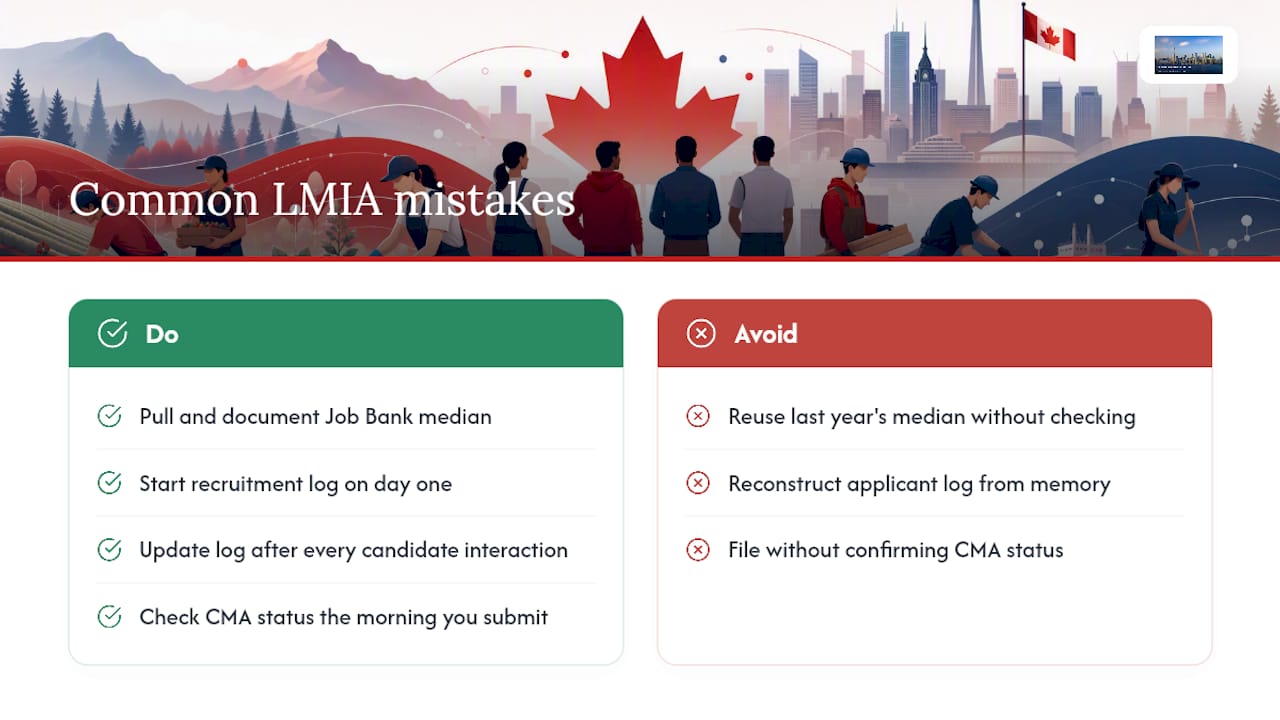
Wage misclassification is the error I see most often, and the July 2026 threshold reset made it worse. Employers who ran a high-wage application last year are filing the same position as high-wage again this year without checking whether the median shifted. It has shifted in most provinces. The fix is simple: pull the current Job Bank median the day you start the application, document it, and classify from there. Skipping that step has cost employers their $1,000 fee and 8 weeks of advertising.
The second mistake is treating the recruitment log as an afterthought. HR teams run the advertising, conduct interviews, and then try to reconstruct the applicant log from memory or scattered emails when it is time to file. ESDC does not want a summary — they want a contemporaneous record. Start the log on day one of advertising and update it after every candidate interaction.
The third mistake is filing without confirming CMA status on the submission date. I have seen applications refused because the CMA moved from eligible to ineligible between the start of advertising and the filing date. The quarterly update is not announced with fanfare. Check the list the morning you submit, every time.
Canada Number One Immigration helps HR teams get low-wage LMIAs right
Filing a compliant low-wage LMIA is a documentation-heavy process where a single missed step — a misclassified wage, an incomplete applicant log, a CMA status check done a week too early — can cost months and a non-refundable $1,000 fee. Canadanumberoneimmigration, led by licensed RCIC Minerva McCoon McBean, offers a direct alternative to navigating that process alone.
The firm’s LMIA services cover the full application cycle: a pre-advertising readiness audit that catches classification and cap problems before you spend a dollar on job boards, full application preparation and document organization, and ESDC correspondence management through to decision.
For HR teams managing multiple locations, cross-provincial worksites, or a prior compliance flag, the time savings alone justify the engagement. Review consultant fees and book a readiness audit to get a clear picture of your application’s risk profile before advertising begins.
Sources
Bookmark these pages and check them at the start of every new application cycle — program rules, wage thresholds, and CMA eligibility lists change more often than most HR teams expect.
This article provides general information about the low-wage LMIA process and does not constitute legal or immigration advice. Program rules, wage thresholds, and CMA eligibility lists change regularly. Confirm current requirements with ESDC directly or consult a licensed RCIC before filing.
This article is general information, not a substitute for advice from a qualified lawyer. Consult a qualified legal professional about your own circumstances before acting on anything here.
Recommended
Stay Updated
Subscribe to our newsletter for the latest immigration news and tips.