CAD $144,390: How Canada Decides Medical Inadmissibility

A health condition does not automatically bar you from Canada. Under IRPA s.38, you’re inadmissible only if a condition is a danger to public health, a danger to public safety, or would likely cause excessive demand on health or social services. An immigration medical exam (IME) starts the process, but the actual determination rests on an officer weighing your prognosis, projected costs, and wait-list impact. If you’re worried about a diagnosis affecting your application, save your medical records now and talk to a licensed RCIC or immigration lawyer before you file anything.
TL;DR:
- Most applicants with manageable chronic conditions are unlikely to face inadmissibility unless their treatment costs or care needs are high and resource-intensive.
- An immigration medical exam reports only clinical facts; the final decision depends on doctors’ findings, prognosis, projected costs, and system impact assessed by officers.
- Exempt categories like family sponsors or refugees are not subject to the excessive demand test, but they can still face scrutiny based on public health or safety concerns.
- Valuable evidence such as detailed specialist reports, cost estimates, and proof of private insurance can influence the outcome of inadmissibility cases or appeals.
- It is advisable to consult licensed immigration professionals before submitting medical documentation or appealing if concerns arise during the process.
Table of Contents
- What Makes Someone Medically Inadmissible to Canada?
- Which Medical Conditions Actually Trigger Scrutiny?
- How Does the Immigration Medical Exam Work?
- Who Is Exempt From the Excessive-Demand Test?
- What Can You Do After a Medical Refusal or Concern?
- Your Pre-IME and Post-Refusal Checklist
- When Does Professional Help Actually Change the Outcome?
- Get Help Building a Medical Inadmissibility Case That Holds Up
- Sources
What Makes Someone Medically Inadmissible to Canada?
The law gives officers three narrow grounds, not a checklist of diseases. IRPA Section 38 covers danger to public health, danger to public safety, and excessive demand on health or social services. That third category causes almost all the confusion, and almost all the refusals.
“Excessive demand” has a dollar figure attached to it. IRCC calculates a threshold from average Canadian per capita health and social spending, projected over five to ten years, and updates it periodically. Legal commentary places the illustrative 2026 five-year threshold near CAD 144,390, or roughly CAD 28,878 a year. Confirm the exact current figure on canada.ca before assuming it applies to your case.
Statistic Callout: IRCC’s own guidance is explicit that there’s no automatic-condition list. Officers assess your current health status, prognosis, expected publicly funded treatment costs, and whether your care would add to an existing wait list, according to IRCC’s own explanation of the excessive-demand test.
Officers weigh four things in every case:
- Your current clinical condition, based on the panel physician’s findings
- The medical prognosis, meaning whether the condition is stable, worsening, or treatable
- The projected public cost of care over five to ten years
- Whether your treatment would extend wait times for other Canadians needing the same service
Which Medical Conditions Actually Trigger Scrutiny?
Some diagnoses draw closer review because the associated care is expensive, ongoing, or resource intensive. Active tuberculosis requiring extended treatment, conditions that need long-term institutional or residential care, dialysis, and high-cost cancer treatment regimens tend to attract the most attention from officers weighing excessive demand.
Most applicants never come close to that line. Well-managed chronic conditions like controlled diabetes or hypertension rarely trigger inadmissibility findings, and the same goes for many mental health diagnoses when the applicant has stable community-based support rather than a need for institutional care.
Here’s what surprises people: two applicants with the identical diagnosis can get different outcomes. The determining factor usually isn’t the disease name, it’s the evidence behind it.
- A condition managed with generic medication and no specialist visits looks very different from the same condition requiring quarterly infusions
- A family with private insurance or documented caregiving capacity changes the projected public cost calculation
- Regional wait-list data can make an identical treatment plan riskier in one province than another
Pro Tip: Ask your specialist for a written prognosis and a realistic cost estimate before you submit anything. A vague clinical note gives an officer nothing to work with except worst-case assumptions.
How Does the Immigration Medical Exam Work?
An IME is a clinical exam, not a legal ruling. A panel physician, meaning a doctor pre-approved by IRCC to perform these exams, examines you and files findings using standardized forms such as IMM 5743 and IMM 5419. Those forms feed into your application file.
Three points matter here:
- Panel physicians report clinical facts and order any needed diagnostics or specialist referrals; they don’t decide whether you’re inadmissible, according to Canada’s own panel physician guidance.
- An immigration officer reviews the clinical report alongside cost projections and system impact, and that officer makes the final admissibility call.
- IMEs have a validity window, and if you completed one within the last five years showing low or no risk, you may be able to reuse it for a new application by citing the previous IME number.
The gap between “the doctor found something” and “you’re inadmissible” is where most applicant anxiety lives, and it’s also where a case can still be won.
Who Is Exempt From the Excessive-Demand Test?
Not everyone faces the cost-based screening. A few categories are carved out by law because Parliament decided family reunification and refugee protection shouldn’t hinge on a spreadsheet.
- Spouses, common-law partners, and dependent children being sponsored in the family class are exempt from the excessive-demand ground
- Convention refugees are exempt
- Protected persons are exempt
The exemption is specific, though. It removes the excessive-demand test only. It does not remove scrutiny for danger to public health or danger to public safety, so a sponsored spouse with an active, untreated communicable disease can still face a public health finding even though the cost-based ground doesn’t apply to them.
What Can You Do After a Medical Refusal or Concern?
A finding of medical inadmissibility isn’t necessarily the end of the file. Several routes exist, and which one fits depends on your immigration category and timing.
- Temporary Resident Permit (TRP): A TRP lets someone who is otherwise inadmissible enter or stay temporarily, if an officer decides your need to be in Canada outweighs the risk. You’ll need compelling reasons and a documented health-management plan.
- Discretionary relief at the Immigration Appeal Division: Sponsors appealing a refusal can ask the IAD for “special relief” even where the legal finding was correct, based on humanitarian and compassionate factors.
- Reconsideration or judicial review: If the officer’s decision looks unsupported by the evidence, a reconsideration request can sometimes correct it faster than a formal appeal; judicial review is a narrower, more technical option for genuine legal error.
Evidence quality decides most of these outcomes. Detailed specialist reports, itemized cost projections, proof of private insurance, and documented family caregiving that offsets public spending are what actually move a case, according to legal commentary on medical inadmissibility appeals.
Pro Tip: Thin evidence cuts both ways. Case law reviewed by the Immigration and Refugee Board shows that a weak evidentiary record on projected service use can undermine an officer’s excessive-demand finding just as easily as it can support one.
Your Pre-IME and Post-Refusal Checklist
Do not book an IME on your own unless IRCC instructs you to. An early exam can expire before your file is even processed, according to IRCC’s own exam requirements.
- Check whether a prior IME within five years lets you skip a new one
- Gather specialist letters, a treatment plan, and a realistic cost projection
- Document family support, private insurance, or any funding that offsets public cost
- Bring your medical file, prior IME number, and any refusal letter to a consultation with a licensed RCIC or immigration lawyer
Background reading on how specific conditions get evaluated clinically is available through Immigrationmedicalexams, which is worth a look before your exam if you have a complex diagnosis.
When Does Professional Help Actually Change the Outcome?
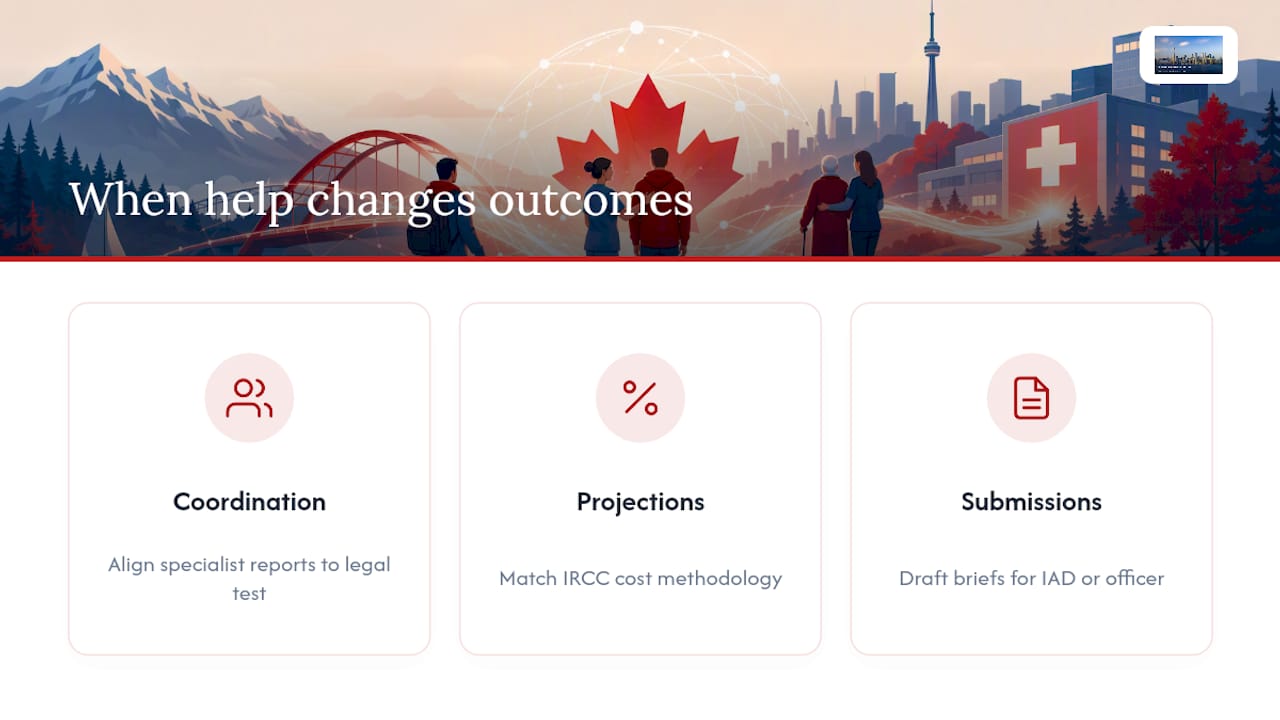
Cases involving cost projections, appeals, or TRP applications rarely go well on paper alone. That’s where a firm typically earns its fee: coordinating specialists so their reports actually address the legal test, building cost projections that hold up against IRCC’s own methodology, and drafting the written submissions an IAD panel or officer needs to grant relief.
A licensed RCIC consultant firm based in Toronto handles exactly this kind of file regularly. This section draws on that firm’s practical experience with medical inadmissibility cases.
— Micah
Get Help Building a Medical Inadmissibility Case That Holds Up
Most families facing a medical concern don’t need a lecture on the law, they need someone who can turn a diagnosis into a file an officer can actually approve. A licensed immigration consultancy can handle medical inadmissibility assessments, TRP and appeal submissions, and the specialist coordination that makes a cost projection defensible, work that’s much harder to get right without regulated guidance.
A first consultation works best when you bring what you already have: any IME results, medical records, specialist treatment plans, and a copy of any refusal letter. From there, the firm can tell you within your first meeting whether you’re looking at a straightforward file, a TRP application, or an appeal, and what evidence closes the gap. If your permanent residence application was already refused, the PR refusal review service walks through the officer’s notes line by line. Otherwise, start with the full range of immigration services and book a consultation to get your specific situation assessed.
This article is general information, not a substitute for advice from a qualified doctor. Consult a qualified healthcare professional about your own circumstances before acting on anything here.
Sources
Stay Updated
Subscribe to our newsletter for the latest immigration news and tips.