Reconsideration Request IRCC: How to Act Fast After a Refusal

A reconsideration request to IRCC is possible, but it only tends to work when there’s an objective, verifiable error on the face of the record, such as an overlooked document or a clerical mix-up. It rarely succeeds when you’re challenging an officer’s discretionary judgment or trying to slip in new evidence you had all along.
If there’s any chance you’ll want to challenge the decision in court, file your application for leave for Judicial Review first. Do this before or alongside your reconsideration request, never after waiting for a reply that may never come. Courts recognize that visa officers hold some residual discretion to reconsider their own decisions, but that discretion is narrow.
- Good grounds: a document you submitted was missed, your name or file number was confused with another applicant, or the officer misread a date on file.
- Weak grounds: you disagree with a credibility finding, or you want to add proof you didn’t include the first time.
Pro Tip: Never treat reconsideration as a waiting game. File for Judicial Review leave first if litigation is even a possibility, then send your reconsideration letter in parallel. You lose nothing by doing both.
Key Takeaways
Reconsideration requests to IRCC only succeed against objective, provable errors, and they never pause the strict Judicial Review deadlines that protect your court options.
| Point | Details |
|---|---|
| Target objective errors only | Reconsideration works for clerical mistakes and overlooked documents, not discretionary disagreements. |
| Protect your court deadline | File for Judicial Review leave within 15 days (in Canada) or 60 days (abroad) before waiting on a reply. |
| Build a precise letter | State the exact error, cite the proof page, and attach indexed exhibits with a contents list. |
| Submit through the web form | Use the IRCC web form to file documents and keep a timestamped confirmation as proof. |
| Get professional help when needed | Canadanumberoneimmigration, led by RCIC Minerva McCoon McBean, handles reconsideration, appeals, and Judicial Review sequencing. |
This article is general information, not a substitute for advice from a qualified lawyer. Consult a qualified legal professional about your own circumstances before acting on anything here.
Table of Contents
- When You Should (and Should Not) Ask IRCC to Reconsider a Refusal
- What to Include in a Reconsideration Letter and Attachments
- How Do You Submit a Reconsideration Request to IRCC?
- How Does IRCC Decide Whether to Reopen a File?
- Reapply, Appeal, or Judicial Review: Choosing Your Next Step
- When Should You Hire an RCIC or Immigration Lawyer?
- What a Licensed Consultant Wants You to Know
- How Canadanumberoneimmigration Can Help After a Refusal
- Sources
When You Should (and Should Not) Ask IRCC to Reconsider a Refusal
Reconsideration makes sense when the refusal turns on something you can point to and prove, not something you want to argue about. A demonstrable factual error, evidence already sitting in your file that the officer somehow skipped, or a clerical mix-up between two applicants are the classic scenarios where an officer might actually revisit the decision.
It’s a dead end in most other cases. If the refusal came down to a discretionary judgment call (the officer wasn’t convinced by your travel history, for instance, or doubted your intentions), no amount of re-explaining tends to move the needle. The same goes for statutory eligibility bars that can’t be waived, or new evidence you’re only now assembling. IRCC’s own guidance confirms there’s no formal appeal process for most temporary residence refusals: your real options are re-applying or judicial review.
- Reconsideration does not pause your Judicial Review clock.
- If litigation is on the table, treat the court deadline as the priority, not an afterthought.
Pro Tip: Ask yourself one question before writing anything: can I point to a specific page or document that proves an error? If the answer is no, you’re likely looking at a re-application, not a reconsideration.
What to Include in a Reconsideration Letter and Attachments
A reconsideration package succeeds or fails on precision. Officers reviewing these requests are not reopening your whole case. They’re looking for a narrow, provable mistake, and your job is to make that mistake impossible to miss.
Structure the letter around three things:
- State your purpose in one paragraph. Identify the refusal letter by date, your Unique Client Identifier (UCI), application number, and application type.
- Name the exact error. Don’t describe it vaguely as “unfair” or “incorrect.” State precisely what happened: “The officer’s notes indicate no employment letter was received, but one was submitted on [date] as Exhibit 3.”
- Cite the proof. Point directly to the page number or document in your original application that shows the error, and attach it again as an exhibit.
Your attachment checklist should include:
- A copy of the refusal letter itself.
- The specific pages of your original application containing the overlooked document.
- Indexed exhibits, numbered and referenced by name in your letter.
- Certified translations for any non-English or non-French documents.
- A one-page cover sheet with your contact information and file details.
Keep your file names short and logical (Exhibit_1_Employment_Letter.pdf, not scan0047.pdf), and include a one-page contents list at the front of your package. Officers process a high volume of correspondence, and a disorganized file is exactly how a genuine error gets overlooked twice.
Pro Tip: Read your letter out loud before sending it. If it takes more than two minutes to explain the error, it’s probably not the kind of clean, objective mistake reconsideration is meant to fix.
How Do You Submit a Reconsideration Request to IRCC?
The primary channel is the IRCC web form, which lets you attach documents and send correspondence tied to an existing application. Note this tool cannot make a decision or speed up processing. It’s a delivery mechanism, not a review board.
- Log in and select the option relevant to your situation (updating an application, submitting new documents, or asking about a refusal).
- Reference your UCI and application number in every field that allows free text.
- Upload your reconsideration letter and indexed exhibits as a single, clearly labeled package where possible.
- Some visa offices also accept direct email correspondence, particularly for applications processed abroad. Check the specific office’s contact page for that option.
Once submitted, take a screenshot of the confirmation screen and note the confirmation number and timestamp. If you receive no acknowledgment within a few weeks, that’s not unusual. Follow up using the same channel and reference your original submission date.
- Save every confirmation number.
- Screenshot the submission page immediately.
- Note the date you filed in case a deadline dispute arises later.
Pro Tip: Treat your confirmation screenshot the way you’d treat a courier receipt. If a deadline question ever comes up, that timestamp is your only proof you acted in time.
How Does IRCC Decide Whether to Reopen a File?
IRCC has no statutory obligation to respond to a reconsideration request, and there’s no guaranteed timeline. Many requests get a generic acknowledgment. Some get nothing at all. This isn’t a formal review process with rights attached. It’s an informal, discretionary courtesy that officers extend when the facts clearly warrant it.
What tends to move an officer: a clear error on the face of the record, a document that was genuinely in the file but not addressed in the decision, or a case where undisputed facts were misapplied against the law. Practitioners consistently observe that successful reconsideration requests target objective, verifiable errors, not arguments about how the officer weighed your evidence.
What won’t move an officer:
- Disagreement with a discretionary credibility finding.
- New evidence that existed before the original decision but wasn’t submitted.
- Statutory requirements that IRCC has no authority to waive.
Pro Tip: If your instinct is to write a long letter re-arguing your whole case, stop. The officer already read your case once. Your only job now is to point at the one thing they missed.
Reapply, Appeal, or Judicial Review: Choosing Your Next Step
If reconsideration isn’t the right fit, or it fails, you have three real paths, and they’re not interchangeable. Re-applying makes sense when something material has genuinely changed, like new employment, updated financials, or evidence that didn’t exist before. It’s the wrong move if you’d just be resubmitting the same weak file and hoping for a different officer.
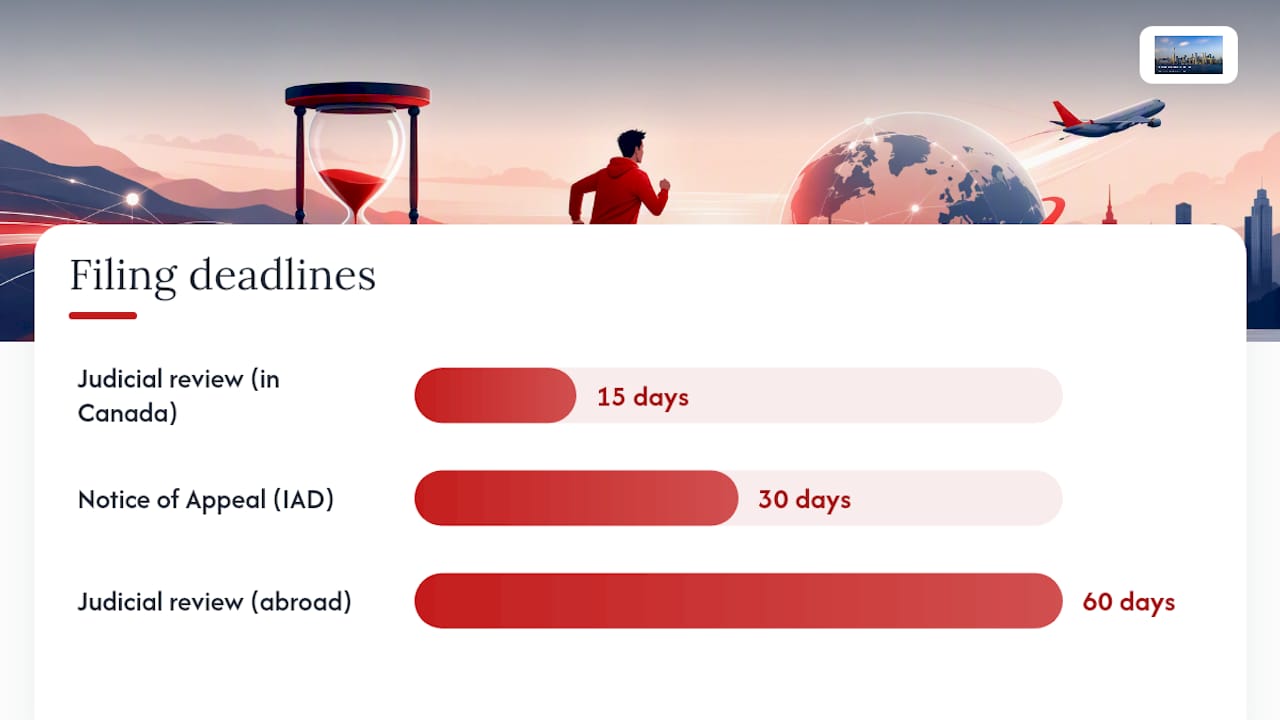
If you have a statutory right to appeal (family sponsorship refusals, for example), the Immigration Appeal Division requires a completed Notice of Appeal, generally within 30 days of the refusal letter.
For everything else, Judicial Review at the Federal Court is the formal check on IRCC’s decision-making. The deadlines here are unforgiving: 15 days for decisions made inside Canada and 60 days for decisions made abroad, under section 72(2)(b) of the Immigration and Refugee Protection Act.
- Confirm which deadline applies to your case (in Canada vs. abroad).
- File for leave before the clock runs out, even if you’re still waiting on a reconsideration reply.
- Decide on reapplication only once you’ve confirmed nothing material has changed to strengthen a new application.
- Reconsideration never pauses these deadlines.
- Missing your Judicial Review window because you were waiting on IRCC’s reply can permanently close that door.
When Should You Hire an RCIC or Immigration Lawyer?
Professional help earns its cost when the stakes involve strict court deadlines, procedural fairness concerns, or a legal error buried in dense officer notes. Family sponsorship appeals and Judicial Review applications, in particular, punish small mistakes in filing.

A licensed practitioner files for Judicial Review leave to lock in your deadline, drafts a reconsideration letter that isolates the exact error, and builds an evidentiary file that doesn’t give an officer any excuse to look past it. For appeal or court matters, they represent you directly.
Before hiring anyone, verify credentials.
- Confirm Regulated Canadian Immigration Consultant (RCIC) registration with the College of Immigration and Citizenship Consultants.
- For lawyers, confirm active membership with a provincial law society.
Case law confirms that visa officers retain some residual discretion to revisit their own decisions in appropriate circumstances, which is exactly the narrow opening a well-built reconsideration request is designed to use.
What a Licensed Consultant Wants You to Know
The single biggest mistake I see refused applicants make is waiting on a reconsideration reply before thinking about Judicial Review. By the time IRCC finally responds (if it responds at all), the 15 or 60 day clock has often already closed.
Reconsideration works in a narrow band of cases: objective, provable errors. Everything else needs a different tool. If your case involves a legal question or a tight court deadline, that’s exactly when it’s worth calling a licensed consultant before you file anything.
How Canadanumberoneimmigration Can Help After a Refusal
Canadanumberoneimmigration is the alternative to guessing your way through a refusal alone. When you’re staring at a denial letter with a court clock already ticking, the value isn’t generic advice. It’s someone who has built these reconsideration letters and Judicial Review applications before and knows exactly which errors get a file reopened and which ones waste your time.

Led by licensed RCIC Minerva McCoon McBean, the Toronto-based practice handles reconsideration requests, Judicial Review preservation, sponsorship appeals, and re-application strategy for permanent residence refusals, study permit refusals, and family sponsorship cases.
If you’ve received a refusal and aren’t sure whether reconsideration, reapplication, or court is the right move, book an initial assessment through the services page and bring your full refusal letter, application copy, and any supporting documents you believe were overlooked.
Sources
- Immigration and Refugee Protection Act — Section 72
- IRCC web form: Contact us online
- Filing an appeal — Immigration Appeal Division
Recommended
- What IRCC Has Revealed About PR Processing in 2025 | McBean Immigration
- Updated 2024 IRCC Work Permit Extension Policy for PNP Candidates | McBean Immigration
- IRCC Issues 648 ITAs in PNP-Only Draw | McBean Immigration
- IRCC Issues 4,000 ITAs to CEC Candidates in Latest Express Entry | McBean Immigration
Stay Updated
Subscribe to our newsletter for the latest immigration news and tips.