Restoring Status in Canada: A Step-by-Step Guide

You can restore your temporary resident status in Canada, but only if you act fast: IRPR section 182 gives you exactly 90 calendar days from the day your status expired to apply, and you have to show you met the conditions of your original stay. Miss that window and restoration is off the table entirely.
Here’s what to do right now, in order:
- Confirm the exact date your visitor record, study permit, or work permit expired.
- Count forward 90 days. Mark that deadline everywhere you’ll see it.
- Stop working or studying immediately if you’re not authorized to do so.
- Pick the correct IMM form for your category (IMM 5708 for visitors, IMM 5709 for students, IMM 5710 for workers) and start gathering documents.
- Submit online before midnight UTC on day 90.
Pro Tip: If you’re within a week or two of day 90 and your paperwork isn’t ready, don’t wait for the “perfect” application. Submit what you have on time and be prepared to supplement it. A late but complete application is worthless; an on-time one with a clear explanation letter almost always beats it.
If any part of your situation feels complicated, whether that’s a lapsed work permit tied to a specific employer or a study permit that expired mid-program, booking time with a licensed RCIC through Roots Recovered before you submit can save you from a refusal you can’t undo.
Key Takeaways
Restoring status in Canada requires filing the correct IMM form within 90 calendar days of expiry, along with a credible letter of explanation and the right fees.
| Point | Details |
|---|---|
| The 90-day deadline is absolute | IRPR section 182 gives no discretion to extend the window once your status expires. |
| Match the form to your goal | Use IMM 5710 for workers, IMM 5709 for students, and IMM 5708 for visitors. |
| No work or study while pending | Restoration doesn’t create maintained status, so unauthorized activity risks refusal. |
| Budget for stacked fees | Expect a restoration fee plus permit processing fees and biometrics, verified on the IRCC fee list. |
| Get professional support for complex cases | Canadanumberoneimmigration’s licensed RCIC guidance helps applicants build stronger restoration files before the deadline closes. |
Table of Contents
- What Is Restoration of Status in Canada?
- Step-by-Step: How to Apply for Restoration
- Can You Work or Study While Your Application Is Pending?
- Why Restoration Applications Get Refused
- How Much Does Restoration Cost, and How Long Does It Take?
- What Happens If Your Restoration Application Is Refused?
- Real Scenarios: Matching Your Situation to the Right Form
- Get Help With Your Restoration Application
- Frequently Asked Questions
- Sources
What Is Restoration of Status in Canada?
Restoration of status is the formal process that lets a visitor, student, or worker who has fallen out of status get back into status without leaving the country, provided they apply within 90 days of the expiration date. It’s distinct from an extension, which you file before your permit runs out to stay in “maintained status.” Once your permit has already lapsed, restoration is the only route back, and it comes with a harder set of conditions than a routine extension ever did.
Who can apply: the 90-day rule and eligibility tests
The legal foundation here is IRPR section 182, and it’s unforgiving on timing. You get 90 calendar days from the date your status expired. There’s no discretion built into the regulation to extend that deadline for a good excuse, a family emergency, or a paperwork delay.
Beyond the deadline, IRCC checks several things before approving restoration:
- You applied within the 90-day window, verified by the date and time IRCC received your submission.
- You met the conditions of your original permit before it expired (attended school, worked only for your authorized employer, didn’t overstay your visitor terms).
- You haven’t worked or studied without authorization since your status lapsed.
- You’re not subject to a removal order or certain inadmissibility findings.
One meaningful shift worth knowing about: guidance issued in 2026 clarified that workers and students who no longer qualify to restore into their original category, say, a worker whose job offer fell through, may still be able to restore as a visitor instead. The same 90-day clock still applies, and it’s still a fallback rather than a fix. Once day 91 arrives, restoration simply isn’t available anymore, no matter how strong your case is.
Step-by-Step: How to Apply for Restoration
Getting this right the first time matters more than almost any other application you’ll file with IRCC, because restoration is discretionary. There’s no automatic entitlement, and a rejected application means you’re expected to leave Canada. Work through these steps methodically.
- Confirm your expiry date. Pull out your expired permit or visitor record and locate the exact date your authorization ended. Everything else depends on this number.
- Decide which status you’re restoring to. If you have a valid job offer, restoring as a worker (IMM 5710) may let you resume employment once approved. If you have a school acceptance, restore as a student (IMM 5709). If neither applies, restoring as a visitor (IMM 5708) at least preserves your presence in Canada while you sort out next steps.
- Select the correct IMM form and check the restoration box. Each form has a specific field where you indicate you’re applying for restoration rather than a fresh application or extension. Missing this checkbox is a common, entirely avoidable error.
- Log in to your IRCC secure account and complete the online submission. Restoration applications go through the same portal as regular permit applications, with an added restoration fee.
- Attach your required documents, including:
- Your passport (valid for the duration of your intended stay)
- Your expired permit or visitor record
- Proof of funds, if you’re restoring as a visitor
- A job offer letter or school acceptance letter, if applicable
- A written letter of explanation detailing why your status lapsed
- Your biometrics receipt, if biometrics were previously required or requested
- Pay the correct combination of fees at submission: the restoration fee, the processing fee for your new permit, and the biometrics fee if applicable.
- Submit before midnight UTC on day 90. IRCC’s online system timestamps submissions in coordinated universal time, and a submission that lands even a few minutes past that cutoff is treated as received after the deadline.
The letter of explanation deserves more attention than most applicants give it. Officers reviewing restoration files are looking for a credible, honest account of what happened, not a legal argument, just a clear timeline. Did you misread your expiry date? Was there a processing delay on a previous extension you filed on time? State it plainly, attach supporting evidence (email confirmations, medical records, employer correspondence), and don’t pad it with excuses that don’t hold up.
Pro Tip: Build your evidence file before you write the explanation letter, not after. Pull together pay stubs, enrollment records, or communication with your employer or school first. The stronger your paper trail, the shorter and more convincing your explanation can be.
Guide 5551 walks through form-specific checklists in more detail, and the official IRCC restoration page confirms the exact submission process and warns plainly that approval isn’t guaranteed.
Can You Work or Study While Your Application Is Pending?
You can stay in Canada while IRCC processes your restoration application, but you generally cannot work or study during that wait unless you had maintained status by applying before your permit expired. That distinction trips up a lot of applicants. Maintained status means you filed on time and your original permission effectively continues while you wait. Restoration means you’re already out of status, and the clock only starts running back in your favor once IRCC approves the application, not the moment you submit it.
While your case is pending:
- Stop all work or study immediately if you weren’t authorized to continue.
- Avoid leaving Canada. Departing while a restoration application is pending can be treated as abandoning the application in some circumstances.
- Check your provincial healthcare coverage, since a lapse in status can affect eligibility in some provinces.
- Keep documentation of the exact date you stopped working or studying, in case an officer asks.
Restoration never creates maintained status. You’re out of status between your expiry date and the decision, which means working or studying during that gap is a common trigger for both refusal and future inadmissibility findings.
Pro Tip: If you’re employed, tell your employer the truth: your permit has expired and you cannot legally work until restoration is approved. Ask for a letter confirming your last working day. That single document can be the difference between a clean file and a refusal built on unauthorized work.
Why Restoration Applications Get Refused
Most refusals trace back to a small number of avoidable mistakes. Knowing them in advance lets you build your application to specifically counter each one.
- Unauthorized work or study after expiry. This is the single most common refusal ground. Mitigate it by stopping immediately, documenting your last day, and being upfront about it in your letter of explanation rather than hoping it goes unnoticed.
- Incomplete documentation. Missing a passport page, an outdated proof-of-funds statement, or an unsigned form causes delays or outright refusal. Cross-check every document against the checklist in Guide 5551 before you submit.
- Inconsistent explanations. If your letter says one thing and your supporting documents suggest another, officers notice. Keep your timeline factual and consistent across every attachment.
- Misrepresentation. Even a small inaccuracy, stated or omitted, can trigger a misrepresentation finding with consequences well beyond this single application. When in doubt, disclose rather than smooth over.
- Failure to meet original conditions. If you worked for an unauthorized employer or attended a different school than your permit allowed, that history follows you into the restoration decision.
- Criminality or inadmissibility concerns. These require case-specific legal advice rather than a general fix.
Pro Tip: Structure your letter of explanation as a short, dated timeline followed by the facts and a list of what’s attached. Officers read hundreds of these; clarity reads as credibility. If your case touches on any of the higher-risk items above, particularly misrepresentation flags or inadmissibility questions, that’s the moment to consult a licensed RCIC rather than guess.
How Much Does Restoration Cost, and How Long Does It Take?
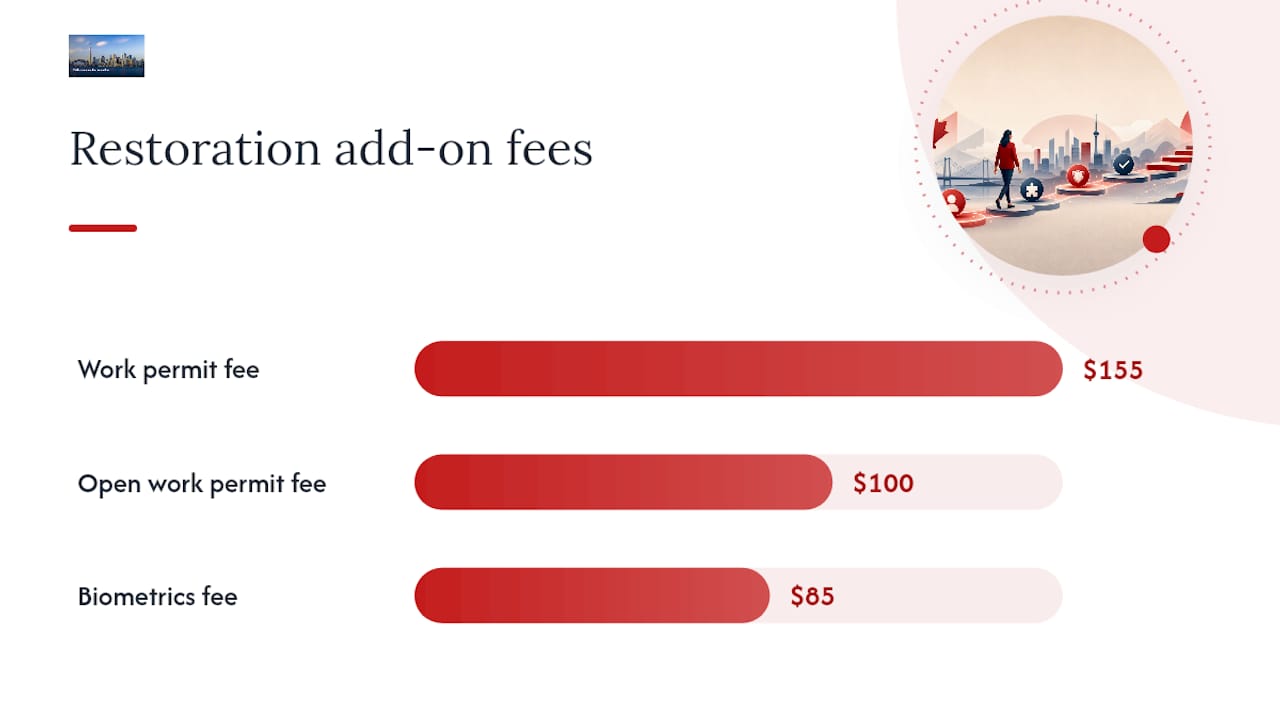
Budget for more than a single fee here. Restoration applications stack the restoration fee on top of your new permit’s processing fee, plus biometrics if required. According to IRCC’s fee guidance, a work permit processing fee runs $155, with an additional $100 if you’re applying for an open work permit, and biometrics adds $85 where applicable. Always cross-check current amounts on the official IRCC fee list before you pay, since fee schedules change.
| Fee Item | Typical Amount |
|---|---|
| Restoration fee | Varies by category, check IRCC fee list |
| Work permit processing fee | $155 |
| Additional open work permit fee | $100 |
| Biometrics fee (if required) | $85 |
Processing times vary meaningfully by category. Student restorations often move through in 4 to 8 weeks, while worker restorations frequently take 7 to 13 weeks or longer, especially when an LMIA or employer verification is involved. These are signals, not promises. IRCC’s processing-times tool reflects current averages, and it’s worth checking before you make plans that depend on a specific approval date. Give yourself a financial and logistical cushion of several months rather than counting on the fastest-case scenario.
What Happens If Your Restoration Application Is Refused?
If IRCC refuses your restoration application, you’re required to leave Canada, and the restoration fee is non-refundable. That’s the blunt reality, and it’s why getting the application right the first time matters so much more than with a standard extension.
Your options at that point depend on your circumstances:
- Voluntary departure keeps your record cleaner and preserves your ability to apply to return more easily than a removal order would.
- A removal order, if one is issued, carries specific re-entry restrictions and sometimes a bar on returning for a set period.
- A Temporary Resident Permit (TRP) exists for exceptional humanitarian circumstances, though it’s a narrow and discretionary remedy, not a fallback for a routine refusal.
- Legal representation for a judicial review may be worth exploring if there are genuine grounds to challenge the officer’s decision.
Pro Tip: If there’s any risk of a removal order or detention tied to your case, don’t wait to see how things unfold. Contact a licensed RCIC or immigration lawyer immediately. The window to act shrinks fast once a removal process starts.
Real Scenarios: Matching Your Situation to the Right Form
A few situations come up again and again, and each one points to a different form and document set.
Your PGWP expired and you don’t have a new job lined up. Restoring as a visitor (IMM 5708) preserves your presence in Canada while you search. If you land a job offer before day 90, you can pivot to restoring as a worker instead, provided you haven’t already submitted.
Your employer’s LMIA ended, but you have a new offer. File IMM 5710, attach the new offer letter and, where applicable, the new LMIA or offer of employment number, along with proof your prior work matched your original permit’s conditions.
Your study program ended and you want to stay without immediately enrolling elsewhere. Under the 2026 clarification allowing restoration as a visitor for those who no longer qualify in their original category, IMM 5708 becomes the practical route, paired with proof of funds and a clear explanation letter.
For students weighing next steps, the PGWP and study permit guidance covers related timing rules worth reviewing alongside your restoration plan.
A note on when professional help matters
I’ve reviewed enough restoration files to say this plainly: restoration is riskier than an on-time extension, full stop. You’re asking an officer to exercise discretion on your behalf, and discretionary decisions are harder to predict and harder to appeal. Consider professional help when:
- You suspect possible inadmissibility or a past compliance issue.
- Your timeline is complicated by overlapping permits or gaps.
- Your case depends on an employer, an LMIA, or a job offer that might fall through.
- Anything in your file could be read as inconsistent or resemble misrepresentation.
Get Help With Your Restoration Application
Restoration applications don’t leave much room for error. Unlike a standard extension filed before expiry, IRCC reviews restoration cases with discretion, and a single missing document or vague explanation letter can end with a refusal you can’t reverse. Canadanumberoneimmigration works specifically with clients rebuilding a lapsed status, assembling the evidence file, drafting the letter of explanation, and choosing the right category (worker, student, or visitor) before the 90-day window closes.
Led by licensed RCIC Minerva McCoon McBean, the firm has guided applicants through exactly these high-stakes, deadline-driven cases, backed by a track record built on a 98% success rate across the firm’s immigration files. If your permit has expired, or you can see day 90 approaching and don’t have your paperwork sorted, check the consultation options and fees and book time with a licensed consultant before you submit anything to IRCC.
Frequently Asked Questions
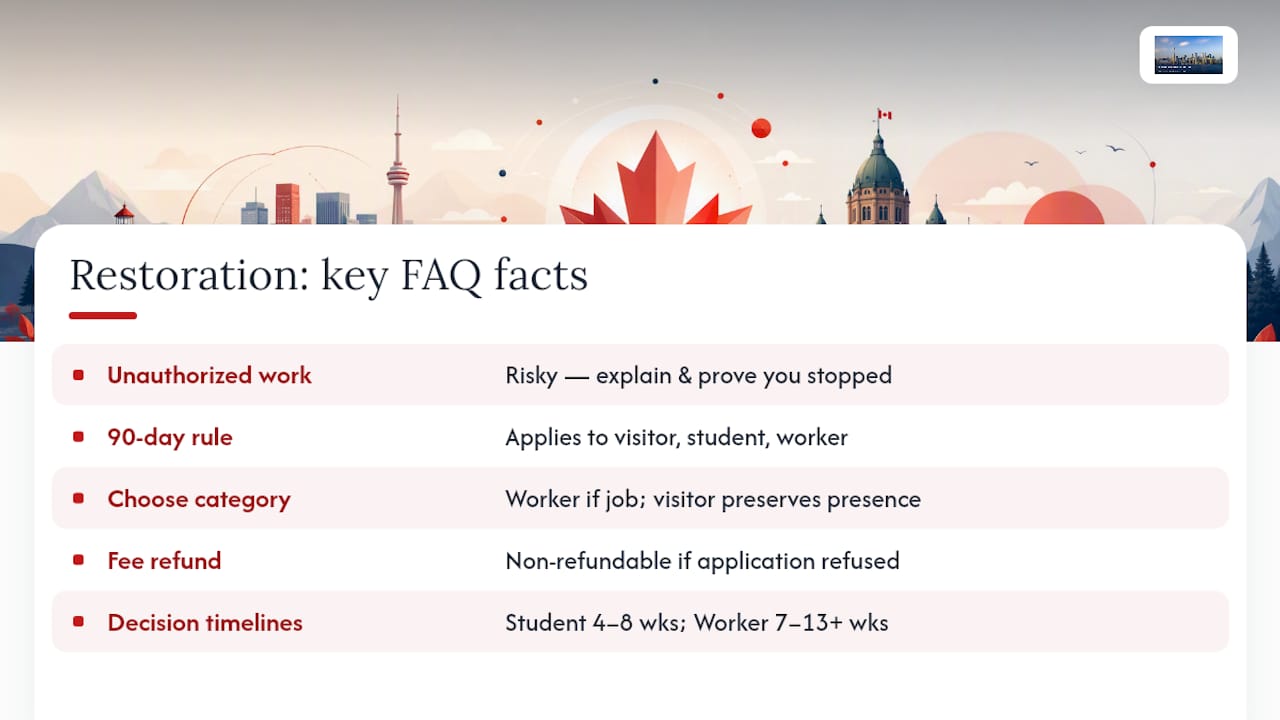
Can I restore my status if I’ve already worked without authorization? It’s possible but riskier. Unauthorized work after your permit expired is one of the most common refusal grounds, so your application needs a clear, honest explanation and proof you stopped as soon as you realized the issue.
Does restoration of status Canada cover visitor, student, and worker categories equally? Yes. The 90-day rule under IRPR section 182 applies to all three categories, though the required form and supporting documents differ for each.
What if I’m not sure which category to restore to? If you have a job offer, restoring as a worker often makes sense. If you don’t, restoring as a visitor under the 2026 clarification preserves your presence in Canada while you look for a longer-term option.
Is the restoration fee refundable if my application is refused? No. IRCC does not refund the restoration fee if your application is denied, which is part of why getting the application right the first time carries so much weight.
How long should I expect to wait for a decision? Timelines vary by category. Student restorations often take 4 to 8 weeks, while worker restorations, particularly those involving an LMIA, can take 7 to 13 weeks or longer.
This article is general information, not a substitute for advice from a qualified lawyer. Consult a qualified legal professional about your own circumstances before acting on anything here.
Sources
- Immigration and Refugee Protection Regulations — section 182
- IRCC — fee changes and processing fee information
- Canada
Recommended
- Navigating the Canadian Immigration System: A Guide for Newcomers | McBean Immigration
- Navigating Canada’s Revised Visitor Visa Guidelines | McBean Immigration
- Family Sponsorship in Canada: How To Reunite with Your Loved Ones | McBean Immigration
- Canada’s May 4th TR to PR Announcement: What Temporary Residents Need to Know | McBean Immigration
Stay Updated
Subscribe to our newsletter for the latest immigration news and tips.