2026 Spousal Sponsorship in Canada: RCIC Checklist to Avoid Delays

Yes, you can sponsor a spouse, partner, or conjugal partner for Canadian permanent residence if you’re 18 or older, a Canadian citizen, permanent resident, or registered under the Indian Act, and you live in Canada (or plan to return if you’re a citizen abroad). You’ll choose between two routes: inland, filed while you’re together in Canada, or outland, filed while your partner is abroad. Plan around processing estimates of roughly 27 months inland and 17 months outland, treated as planning ranges, not guarantees.
TL;DR:
- Most applications face delays due to incomplete forms, missing signatures, or expired police certificates, which can significantly extend the processing time.
- Inland sponsorships allow for an open work permit typically processed within three to five months, but travel restrictions may cause delays or abandonment if the applicant leaves Canada.
- Outland applications usually process faster, averaging 17 months, and offer greater travel flexibility while pending, making them preferable if the partner is overseas.
- Providing strong, comprehensive relationship evidence and ensuring all documents are timely and complete can prevent common causes of refusal or delays.
- Engaging a licensed immigration professional can greatly improve application accuracy and success rates, especially for complex cases such as prior refusals or family violence concerns.
Table of Contents
- What To Do Right Now Before You File
- Who Can Sponsor and Who You Can Sponsor
- Inland vs Outland: How They Differ and Which To Choose
- How To Apply Online: Forms, Documents, and the PR Portal
- Processing Times in 2026: What the Numbers Actually Mean
- The Sponsorship Undertaking: What You’re Actually Agreeing To
- Open Work Permits for Inland Applicants: Timing and Limits
- Common Reasons for Refusal or Delay and How To Avoid Them
- Quebec-Specific Steps for Spousal Sponsorship
- How Canada Number One Immigration Helps and Proof of Expertise
- Why the Standard Advice Undersells the Timeline Risk
- Getting Professional Help With Your Spousal Sponsorship Application
- Sources
What To Do Right Now Before You File
Every month you delay a document request is a month added to your file. The tasks below cost you nothing but time, and doing them in the first week changes your entire timeline.
Start with the basics that disqualify people more often than you’d think. Then move to paperwork you can gather regardless of which route you pick.
- Confirm your sponsor status. Check that you’re 18 or older and hold Canadian citizenship, permanent residence, or Indian Act registration. If you’re a citizen living outside Canada, be ready to show you intend to return once your spouse becomes a permanent resident.
- Rule out disqualifiers early. Recent bankruptcy, an active undertaking from a prior sponsorship, certain criminal convictions, or being on non-disability social assistance can all block eligibility. Better to find this out now than after paying fees.
- Pick inland or outland based on your actual life, not on which sounds faster. If you need to travel for work or family emergencies, that decision matters more than a few months of processing time.
- Download IMM 5289 along with the document checklist and any country-specific forms your partner’s home country requires.
- Start collecting relationship evidence immediately. Joint bank statements, lease agreements, photos, and message logs take weeks to compile properly. The earlier you start, the less scrambling you’ll do later.
- Book the medical exam and request police certificates now. Some countries take months to issue a police certificate, and both documents have expiry windows you need to track.
- If you’re staying together in Canada, check your partner’s current temporary status and confirm any visitor record, study permit, or work permit renewal dates line up with your application timeline.
Pro Tip: Order police certificates from your partner’s home country the same week you decide to apply. Certain countries take three to four months to process the request, and a missing certificate is one of the most common reasons files sit incomplete.
Who Can Sponsor and Who You Can Sponsor
Sponsor eligibility comes down to three checks: age, status, and residency intent. You need to be at least 18, hold Canadian citizenship, permanent residence, or Indian Act registration, and either live in Canada or show a credible plan to return if you’re a citizen abroad. There’s no minimum income requirement for most spousal and partner sponsorships, which surprises a lot of applicants who assume this program mirrors the financial thresholds used elsewhere in the immigration system.
The exception matters, though. If the person you’re sponsoring has dependent children who themselves have dependents, an income requirement can apply. It is a narrow rule, but it catches blended families off guard when they didn’t expect a financial test at all.
Who you can sponsor breaks into three categories:
- Spouse: a partner in a legally registered marriage, recognized whether the marriage took place in Canada or abroad.
- Common-law partner: someone you’ve lived with continuously for at least 12 months in a conjugal relationship, without a formal marriage.
- Conjugal partner: used when a couple can’t live together or marry due to legal or immigration barriers, such as one partner being unable to obtain a visa to visit Canada.
Beyond the relationship category, watch for disqualifiers that trip up otherwise straightforward files: sponsoring another spouse or partner within the last five years, an outstanding undertaking from a previous sponsorship, receiving social assistance for reasons other than a disability, certain criminal convictions, and undischarged bankruptcy. None of these are automatically permanent barriers, but each requires a clear explanation in your application if it applies to your situation.
Inland vs Outland: How They Differ and Which To Choose
The core difference is location during processing. Inland sponsorship applies when your spouse is already living with you in Canada on valid temporary status. Outland applies when they’re living abroad, or when you’d rather keep the flexibility to travel while the application processes.
Processing times currently run about 27 months inland and 17 months outland, with roughly 56,800 people in the inland queue and 58,000 in the outland queue. That gap surprises a lot of couples who assume being physically together in Canada speeds things up. It doesn’t, mainly because inland applicants also tend to file for an open work permit alongside their PR application, which adds a parallel process IRCC has to manage.
Here’s where the tradeoffs actually bite:
- Right to work: inland applicants can request an open work permit alongside their PR application, typically processed in three to five months. Outland applicants have no equivalent unless they qualify for a separate work permit category.
- Travel flexibility: outland applicants can travel freely while waiting, since their case isn’t tied to physical presence in Canada. Inland applicants who leave the country risk having their application treated as abandoned.
- Family separation risk: if your partner is currently abroad, outland is often the only realistic choice, since inland requires them to already be living in Canada.
Pro Tip: If your partner is on a visitor visa in Canada right now and considering inland sponsorship, check the expiry date on that visa before you file. An expired visitor record complicates everything that comes after.
If your top priority is staying together without travel restrictions, inland with a work permit application is usually the stronger fit. If your partner is overseas or your family needs the freedom to travel internationally during processing, outland is the practical answer.
How To Apply Online: Forms, Documents, and the PR Portal
Since September 23, 2022, spousal sponsorship applications must be submitted online through the IRCC PR Portal. Paper submissions are reserved for accommodation requests only, so plan on scanning and uploading everything.
Your submission actually contains two applications bundled together: the sponsor’s application to sponsor, and the principal applicant’s application for permanent residence. Both get filed through the same portal session.
Here’s the practical sequence:
- Create or log into your IRCC secure account, then start the spousal or partner sponsorship application in the PR Portal.
- Complete IMM 5289 along with the sponsorship evaluation form and relationship information forms specific to your category (marriage, common-law, or conjugal partner).
- Gather country-specific documents. Some countries require additional civil status certificates, marriage registration proof, or translated documents with certified translator credentials.
- Pay the required fees. Expect separate charges for the sponsorship application, processing fees for the principal applicant, the right of permanent residence fee, and biometrics if they haven’t been provided in the last ten years. Budget details vary by family size, and a dedicated cost breakdown is worth reviewing before you commit to a filing date.
- Upload documents in the correct file format, usually PDF, keeping individual files under the portal’s size limits. Blurry scans or mismatched file names are a common reason applications get flagged for follow-up.
- Submit and wait for your Acknowledgment of Receipt (AOR). This confirms IRCC has your file and starts your official processing clock.
A few things trip people up at this stage. Signatures need to be applied where the form requires them, either digitally or by printing, signing, and rescanning. Missing a signature field is a small mistake that generates a document request and adds weeks to your timeline. Payment receipts should be saved and uploaded where the portal asks for proof, since a missing receipt can hold up file assignment even after you’ve technically paid.
Once you receive your AOR, resist the urge to assume the hard part is over. Keep copies of everything you submitted, watch your IRCC secure account for requests, and respond to any document request within the deadline given, usually 30 days. If you’re filing inland, this is also when you’d submit the companion open work permit application, which runs on its own separate timeline.
Pro Tip: Save a PDF copy of your complete application package before you submit it. If IRCC later asks what you sent, you want your own record, not a guess based on memory.
Processing Times in 2026: What the Numbers Actually Mean
Here’s the number that matters most: IRCC’s published estimates put spousal sponsorship processing at roughly 27 months for inland applications and 17 months for outland, based on an 80th-percentile calculation, meaning 8 out of 10 applications finish within that window.
That last part is the piece most guides skip. An 80th-percentile estimate isn’t an average and it isn’t a promise. It means one in five applicants will wait longer, sometimes considerably longer, especially if a file requires additional review, background checks take extra time, or the visa office processing the case is dealing with regional backlogs.
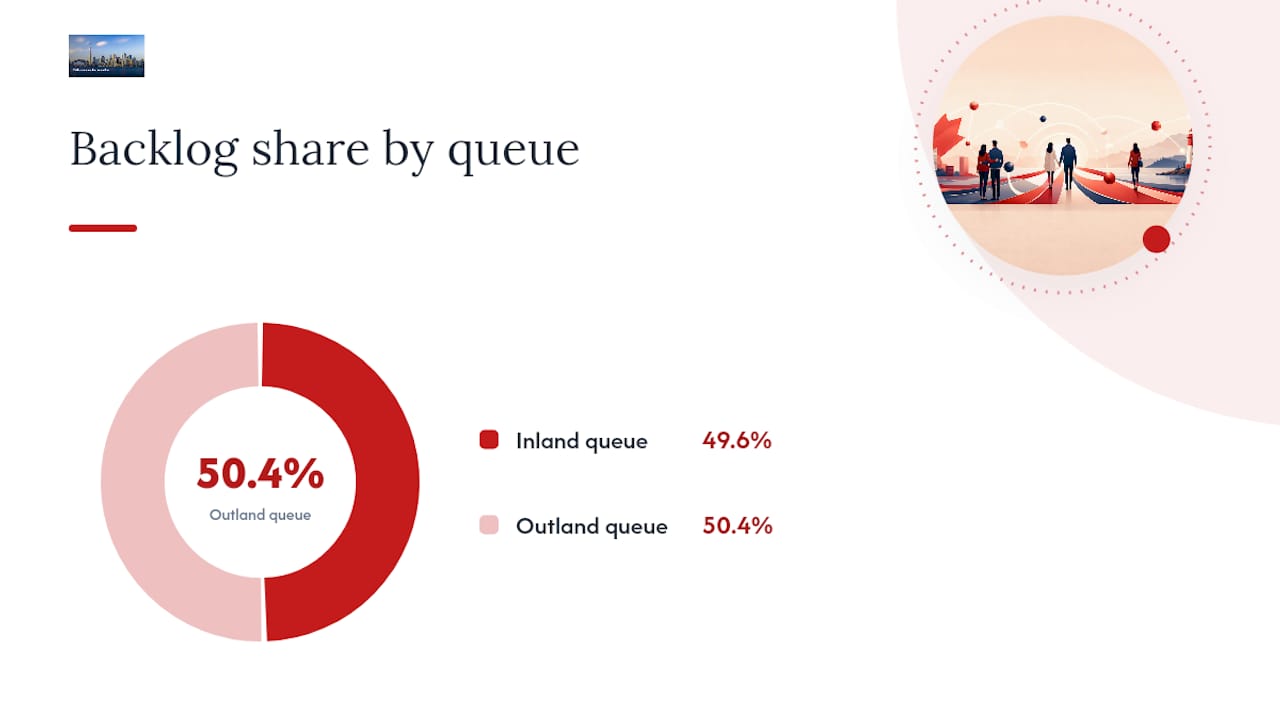
Current backlog figures give a sense of scale. Roughly 56,800 people are waiting in the inland queue and about 58,000 in the outland queue. Quebec cases run on a modified timeline because of the added provincial undertaking step, which typically adds several more months on top of the federal processing period.
What actually pushes a file past the 80th-percentile mark, based on how these applications commonly stall:
- Incomplete forms or missing signatures that trigger a document request
- Police certificates or medical exams that expire before a decision is made
- Visa office backlogs specific to the country processing the principal applicant’s background checks
- Requests for additional relationship evidence when the initial submission looks thin
The practical advice here is straightforward: maintain valid temporary status in Canada while you wait if you’re on the inland route, renew any expiring permits well before their deadlines, and check the IRCC processing times tool periodically rather than assuming your case will land exactly on the published estimate.
The Sponsorship Undertaking: What You’re Actually Agreeing To
Signing a sponsorship application means signing an undertaking, and that undertaking is a binding financial commitment, not a formality. For spouses and partners, it lasts three years from the date your partner becomes a permanent resident.
During that period, you’re financially responsible for your partner’s basic needs if they end up requiring social assistance. This obligation does not disappear if the relationship ends. Separation, divorce, or even your partner later becoming a Canadian citizen doesn’t automatically discharge the undertaking. If your former partner draws social assistance during that three-year window, the provincial government can pursue you for repayment through collection action.
A few practical steps before you sign:
- Understand that the undertaking survives the relationship, not just the paperwork.
- If bankruptcy is part of your financial picture, know that an undertaking obligation isn’t necessarily wiped out by a bankruptcy discharge, and get independent legal advice on how the two interact.
- Keep records of the sponsorship period start date, since that’s what determines when your three-year obligation actually ends.
- Don’t assume a verbal agreement between you and your partner about “splitting” responsibility changes anything legally. The undertaking is between you and the government.
None of this is meant to talk you out of sponsoring someone you love. It’s meant to make sure you sign with your eyes open, understanding this is a legal commitment that outlasts a breakup.
Open Work Permits for Inland Applicants: Timing and Limits
If you’re filing inland, you can apply for a spousal open work permit alongside the PR application, and this single detail is often what decides the route couples choose. Processing typically runs three to five months, considerably faster than the PR decision itself, which means your partner can often start working well before permanent residence comes through.
The permit is genuinely open. Your partner isn’t tied to a specific employer or job offer, unlike most other Canadian work permit categories.
Where this gets tricky is timing against the PR decision itself. If the open work permit expires before IRCC finishes processing the PR application, and 27 months is a long window for a permit that might only be valid for one or two years, your partner needs to apply for an extension before the expiry date to avoid a gap in work authorization.
A few things worth keeping in mind:
- The permit only applies to inland applicants; there’s no equivalent for outland filings.
- Applying for the work permit doesn’t speed up the PR application itself, they run on separate tracks.
- Extension applications should go in well ahead of the expiry date, not at the last minute, since processing an extension takes time too.
- If your family’s financial plan depends on this income, build in a buffer for potential permit gaps rather than assuming seamless renewal.
Common Reasons for Refusal or Delay and How To Avoid Them
Most refusals and delays trace back to a handful of preventable issues, not rare legal complications. Practitioners consistently point to incomplete applications as the single biggest cause of major delays, well ahead of anything related to the relationship itself.
- Missing or incomplete documents. Use the official checklist line by line before you submit, and double-check that every uploaded file actually opened correctly and matches what the portal requested.
- Thin evidence of a genuine relationship. Photos alone rarely satisfy an officer. Joint bank statements, a shared lease, insurance policies naming each other, travel records together, and a detailed relationship timeline carry far more weight than a stack of vacation pictures.
- Expired medicals or police certificates. Time these deliberately. If a police certificate takes four months to arrive and your medical exam is only valid for a year, plan your submission date around whichever document has the tighter window.
- Sponsor eligibility problems discovered too late. Check your own eligibility before you invest months building the file, not after you’ve already paid the fees.
- Cases involving family violence. If safety is a concern, IRCC has specific provisions for spouses or partners experiencing abuse, and getting specialized help early protects both your safety and your application.
Pro Tip: If your file involves a prior refusal, a criminal record, or a relationship that’s hard to document conventionally (long-distance, cultural marriage practices, or a short relationship history), get a professional review before you file rather than after you’re refused. A second refusal is much harder to overcome than a first submission done right.
Quebec-Specific Steps for Spousal Sponsorship
Quebec residents face an extra layer that the rest of Canada doesn’t: a provincial undertaking through Quebec’s own immigration ministry, on top of the federal application to IRCC.
The sequence matters here. You typically need federal approval of the sponsorship portion from IRCC before Quebec will process its own undertaking, which means Quebec cases often run three to six months longer than the same application filed anywhere else in Canada. Trying to file both simultaneously usually just creates confusion rather than saving time.
Quebec also applies its own income assessment in certain sponsorship categories, separate from the federal rules, so a case that has no income requirement federally might still face a provincial financial review.
The practical filing order for Quebec residents:
- Submit your sponsorship and PR application to IRCC through the PR Portal as normal.
- Wait for federal sponsorship approval before submitting Quebec’s provincial undertaking paperwork.
- Track both timelines separately, since a delay on one side doesn’t automatically show up on the other.
How Canada Number One Immigration Helps and Proof of Expertise
A Toronto-based firm working spousal sponsorship files every week sees the same mistakes repeat across hundreds of cases, which is exactly why professional review catches problems a first-time applicant misses. Canadanumberoneimmigration is led by Minerva McCoon McBean, a licensed RCIC, and the firm reports a 98% success rate across its immigration filings.
Hiring a licensed consultant makes the most sense in specific situations, not every case:
- A prior refusal on a previous sponsorship or PR application
- A criminal record on either partner’s side that needs to be explained or assessed
- Concerns about family violence where legal guidance and safety planning matter together
- A relationship that’s genuinely hard to document under standard evidence categories, such as long-distance couples or short relationship histories
The gap between a complete application and a merely submitted one is usually invisible to the applicant until IRCC sends back a document request. A licensed consultant’s job is closing that gap before the file ever leaves your hands.
What clients typically get from working with a firm like this: a document by document review against the official checklist, help assembling relationship evidence that actually holds up to scrutiny, direct filing assistance through the PR Portal, and ongoing communication with IRCC if questions come up mid-process. The firm maintains dedicated pages for family and spousal sponsorship with more detail on how that process runs case by case.
Why the Standard Advice Undersells the Timeline Risk
Most guides on spousal sponsorship treat the process like a checklist you complete once and then wait. That framing undersells the real risk, which isn’t the initial filing, it’s the 27 months that follow it. Families plan their lives around the headline processing number, then get blindsided when a permit renewal, a job change, or an unplanned trip collides with rules they didn’t fully understand until they were already stuck.
The conventional wisdom also overstates how much the inland route helps you stay together. Yes, you’re physically in the same country while you wait. But the open work permit timing, the abandonment risk if you travel, and the reality that inland and outland backlogs sit almost neck and neck this year all complicate the assumption that inland is automatically the “together” choice and outland is automatically the “apart” choice.
If there’s one thing worth prioritizing above all else, it’s front-loading your evidence and your document timing before you ever open the PR Portal. Applications that stall rarely stall because of the relationship. They stall because a police certificate expired, a form was missing a signature, or the evidence looked thinner than the officer expected. Fix that upstream, and the rest of the process gets a lot less stressful.
— Micah
Getting Professional Help With Your Spousal Sponsorship Application
If you’re weighing whether to file this yourself or bring in help, the honest answer depends on how complicated your file is, not how confident you feel. Canadanumberoneimmigration’s Family & Spousal Sponsorship service covers document review against the official IRCC checklist, relationship evidence strategy, and direct filing support through the PR Portal from a firm that reports a 98% success rate on the files it handles.
A consultation is the fastest way to find out where your file actually stands. Bring your relationship timeline, any prior immigration history for both partners, and a general sense of your target route (inland or outland) so the conversation focuses on your specific situation rather than generic advice. If cost is part of your decision, the fees page breaks down what professional representation runs, so there are no surprises before you commit. Book a consultation directly through the services page to get a clear read on your case before you file anything.
This article is general information, not a substitute for advice from a qualified lawyer. Consult a qualified legal professional about your own circumstances before acting on anything here.
Recommended
Stay Updated
Subscribe to our newsletter for the latest immigration news and tips.