How to Get GCMS Notes and Read Your Canada Immigration File

Yes, you can get your GCMS notes. File an ATIP (Access to Information) or Privacy Act request with Immigration, Refugees and Citizenship Canada (IRCC), and you’ll receive the officer notes, assessments, and decision history behind your case. The statutory reply window is 30 days, and an ATIP request costs $5. Privacy Act requests, available if you’re the subject of the record, are usually free.
Your first move depends on where you are:
- In Canada, requesting your own file: use the ATIP Online Request portal.
- Outside Canada or requesting on someone’s behalf: prepare form IMM 5563 and a signed IMM 5744 consent form, then mail the request.
Key Takeaways
Getting your GCMS notes takes a $5 ATIP request and a 30-day wait. Reading them correctly is what actually determines your next move.
| Point | Details |
|---|---|
| File through ATIP Online | Fastest path for most applicants; costs $5 and starts the 30-day statutory clock. |
| Use IMM 5563 and IMM 5744 for mail | Required for mailed requests and any representative acting for someone outside Canada. |
| Read in decision order | Check the decision entry first, then assessments, then chronological notes for red flags. |
| Order promptly after refusal | Wait for R-10 completeness when possible, but never delay a judicial review deadline for notes. |
| Watch for PFLs and factual errors | These are the strongest signals worth bringing to a licensed RCIC or lawyer. |
Table of Contents
- GCMS Notes Canada: Where to Start and What to Expect
- Exactly How to File an ATIP or Privacy Act Request
- Who Can Request GCMS Notes, and What Do They Cost?
- What’s Actually Inside Your GCMS File
- How to Read Your GCMS Notes Without Missing the Signal
- How Long GCMS Notes Actually Take to Arrive
- When to Order Notes and What to Do Once They Arrive
- What Licensed Consultants Actually Do With GCMS Notes
- Where to Verify the Rules Yourself
- A Practitioner’s Take on the GCMS Notes Process
- Sources
GCMS Notes Canada: Where to Start and What to Expect
The GCMS (Global Case Management System) is the database IRCC and CBSA officers use to log every step of your application, from intake to final decision. Requesting your GCMS notes means asking for a copy of that internal record under Canada’s access-to-information laws. It’s not a summary IRCC writes for you. It’s the actual case file, officer shorthand and all, which is why so many applicants order it after a refusal or a long silence.
The two legal channels are the Access to Information Act and the Privacy Act. Both flow through the same ATIP office at IRCC, but they have different eligibility rules and fees, covered in detail below.
Exactly How to File an ATIP or Privacy Act Request
Filing online is faster and gives you a tracking reference immediately. Here’s the sequence:
- Go to the ATIP Online Request portal and create an account if you don’t already have one.
- Select the correct request type: Access to Information Act (third parties, representatives, general requests) or Privacy Act (you requesting your own personal information).
- Enter your identifiers precisely: Unique Client Identifier (UCI), application number, full legal name, date of birth, and passport number.
- Pay the $5 fee by credit card if filing under the Access to Information Act.
- Submit and save your ATIP reference number for follow-up.
If you’d rather mail it, or if the portal is down for scheduled maintenance, fill out IMM 5563, attach a cheque or money order payable to the Receiver General for Canada, and mail it to the ATIP office. If someone else is requesting on your behalf, both of you need to sign form IMM 5744.
Pro Tip: Ask for the “complete GCMS notes and any associated e-documents” in your request, not just “notes.” A narrow request often produces a narrow, less useful disclosure.
Who Can Request GCMS Notes, and What Do They Cost?
Eligibility depends on which law you’re using:
- Privacy Act: available to Canadian citizens, permanent residents, and anyone physically present in Canada, requesting their own personal information. Usually free.
- Access to Information Act: open to anyone, including applicants abroad, but a representative must submit signed consent (IMM 5744) on the applicant’s behalf. Costs $5.
- Representatives filing for someone outside Canada: must include precise identifiers, exact spelling of names, and a properly signed consent form, since small errors here are a common cause of processing delays.
You’ll see third-party companies online offering to “order” your GCMS notes for a markup. The underlying government request is inexpensive either way, so there’s rarely a reason to pay someone else to submit a form you can file yourself in twenty minutes.
What’s Actually Inside Your GCMS File
Your notes arrive as a structured record, not a narrative letter. Expect these recurring sections:
- Application header: basic biodata, application type, and file numbers.
- Assessments: separate entries for Eligibility, Criminality, Medical, Information Sharing, and Security, each logged by the reviewing officer.
- Notes: free-text entries where officers record observations, concerns, and reasoning, often in dated, chronological order.
- Document issuance: confirmation of what was issued, refused, or returned, and when.
Some content gets redacted or withheld under exemptions covering personal information about third parties, law enforcement sensitivities, or international relations. That’s normal and doesn’t mean your file was mishandled. Reading the entries in order, by date and officer identifier, is usually enough to reconstruct exactly how your case moved from submission to decision.
How to Read Your GCMS Notes Without Missing the Signal
Read your file in this order: the decision entry first, then the assessments, then the chronological notes. Starting with the outcome tells you what to look for as you work backward through the reasoning.
- Check the decision entry. This states the outcome and often the officer’s summary reason.
- Scan the assessments for flags in Eligibility, Criminality, Medical, or Security. A flagged category usually explains a delay even when the final decision was positive.
- Read the notes chronologically, watching for procedural fairness letters (PFLs), gaps where evidence you submitted isn’t mentioned, factual errors, or entries that suggest disagreement between officers.
Boilerplate language, standard refusal phrasing repeated without case-specific reasoning, is itself a signal worth flagging, especially for judicial review arguments. If you spot a factual error or missing evidence, start gathering the correcting documents immediately. If you see a PFL response that seems weak, that’s worth reviewing with an officer’s reasoning in mind before you decide your next step.
Pro Tip: A single confusing status code isn’t a crisis. A pattern of unexplained delay across multiple assessment categories is what deserves a closer look.

How Long GCMS Notes Actually Take to Arrive
The legal clock is 30 days from the day IRCC receives a valid request. Extensions are allowed when the request involves large volumes of records or requires consultation with another department, and in practice, waits stretching well past 30 days aren’t unusual.
To stay on top of it:
- Keep your ATIP reference number and quote it in any follow-up.
- Contact the ATIP office directly if you pass the 30-day mark with no extension notice.
- Treat a long silence as routine, not alarming, but don’t let it stop you from pursuing parallel deadlines.
When to Order Notes and What to Do Once They Arrive
Timing matters more than most applicants realize. For maximum completeness, wait until your file reaches R-10 completeness before requesting. But after a refusal, order immediately. Never delay a judicial review application just to wait for notes; file to preserve your deadline, then use the notes to strengthen your case afterward.
Once notes arrive:
- Match each assessment against the documents you originally submitted to spot gaps.
- Use factual errors or missed evidence to build a reconsideration request or PFL response.
- Bring the full GCMS file, your original application, and your deadline dates to a consultation with a licensed RCIC or immigration lawyer if the notes reveal an error worth challenging.
What Licensed Consultants Actually Do With GCMS Notes
At Canada Number One Immigration, reviewing a client’s GCMS file is rarely a five-minute read. Consultants trace each assessment category against the original submission, looking for three things specifically: procedural fairness gaps, factual errors an officer made under time pressure, and evidence that was submitted but never referenced in the notes.
When a client comes to us with a refusal, the GCMS notes tell us whether we’re arguing a legal error or fixing a documentation problem. Those require completely different strategies, and guessing wrong wastes the client’s judicial review window.
Founder Minerva McCoon McBean, a licensed RCIC, built the firm’s review process around exactly this kind of line-by-line file analysis.
If your GCMS notes revealed a refusal you want challenged, our permanent residence refusal review service walks through your file with the same method described above. You can also review our immigration services for a full breakdown of how consultations work.
Where to Verify the Rules Yourself
- How to make a request under the Access to Information Act for official fee and timeline rules.
- ATIP Online Request portal to file electronically and check maintenance windows.
- IRCC’s submission guidance for IMM 5563 and IMM 5744 instructions.
- CIC News explainer on ordering GCMS notes for timing strategy around refusals and appeals.
A Practitioner’s Take on the GCMS Notes Process
Most guides treat GCMS notes as a paperwork errand: fill out a form, wait a month, done. That undersells what’s actually happening. The notes are the only objective record of how an officer reasoned through your case, and most applicants read them once, get confused by the abbreviations, and file them away without acting on what they found.
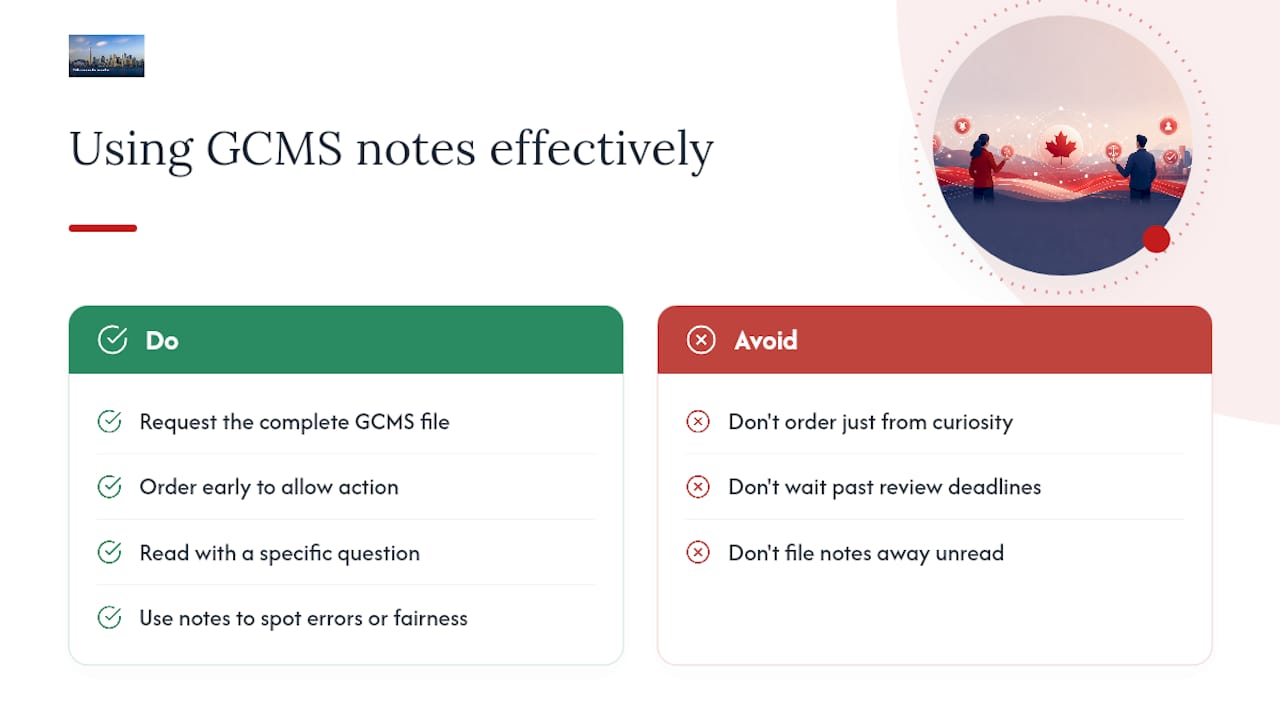
The conventional advice to “just order your notes if you’re curious” misses the real value. Notes matter most when they change what you do next, whether that’s catching a factual error before a reconsideration deadline or realizing your refusal has a procedural fairness problem worth pursuing. Order early enough to act on what you learn, not so late that a judicial review window closes while you’re still waiting for the file.
If you take one thing from this: request the complete file, not a partial one, and read it with a specific question in mind rather than general curiosity. That’s the difference between notes that sit in a drawer and notes that actually move your case forward.
— Minerva McBean
This article is general information, not a substitute for advice from a qualified lawyer. Consult a qualified legal professional about your own circumstances before acting on anything here.
Sources
- Canada
- ATIP Online Request portal
- How and where do I submit an Access to Information or Privacy request? - IRCC
- How to request your Canadian immigration GCMS notes | CIC News
Recommended
Stay Updated
Subscribe to our newsletter for the latest immigration news and tips.