High Wage LMIA: 2026 Thresholds and Application Rules

A high-wage LMIA is any Labour Market Impact Assessment where the offered hourly wage meets or beats the provincial or territorial median wage threshold, which puts the application in the high-wage stream instead of the low-wage stream. That single number decides which set of rules applies, so before you touch LMIA Online or draft a transition plan, confirm which stream you’re actually in.
Your first move is checking the current threshold for your province or territory against your offer, using Job Bank’s wage data and Employment and Social Development Canada’s (ESDC) published table. As of July 17, 2026, ESDC updated every provincial and territorial threshold, and the version in effect on the date you submit is the one that governs your file, not the version from last year.
Before you file anything, run through this short checklist:
- Compare your offered hourly wage to the current provincial or territorial threshold, not last year’s number.
- Pull the Job Bank median wage for the specific National Occupational Classification (NOC) code and location.
- Decide whether a transition plan is required (it almost always is for high-wage positions).
Key Takeaways
A high-wage LMIA hinges on one number, the provincial wage threshold in effect on your application date, and getting the paperwork right the first time avoids costly refusals.
| Point | Details |
|---|---|
| Check the current threshold | Compare your offered wage to the provincial or territorial threshold in effect on your submission date, updated July 17, 2026. |
| Confirm the prevailing wage | Pay the highest of the Job Bank median wage or your own payroll range for comparable employees. |
| Document recruitment fully | Advertise for 4 consecutive weeks on Job Bank plus at least 3 other recruitment activities, with dated proof. |
| Budget for fees and duration | Expect a $1,000 per-position processing fee and employment terms of up to 3 years. |
| Get a readiness check first | Canada Number One Immigration’s LMIA readiness audit reviews wage data and documentation before you file. |
Where to Verify Thresholds, Rules, and Filing Steps
- ESDC high-wage requirements: wage thresholds and documentation rules.
- LMIA Online portal: official application submission.
- Job Bank: prevailing wage lookups by NOC and location.
Table of Contents
- What Counts as a High-Wage LMIA Position?
- What Do Employers Need Before Filing?
- How to Apply for a High-Wage LMIA Through LMIA Online
- Provincial and Quebec-Specific Filing Rules
- Why Do High-Wage LMIAs Get Refused or Audited?
- Frequently Asked Questions About High-Wage LMIAs
- Sources
What Counts as a High-Wage LMIA Position?
The threshold itself is the median hourly wage for a province or territory, and it moves every year. Whichever number was in effect on the date ESDC received your application is the one that decides your stream, even if the number changes a week later.
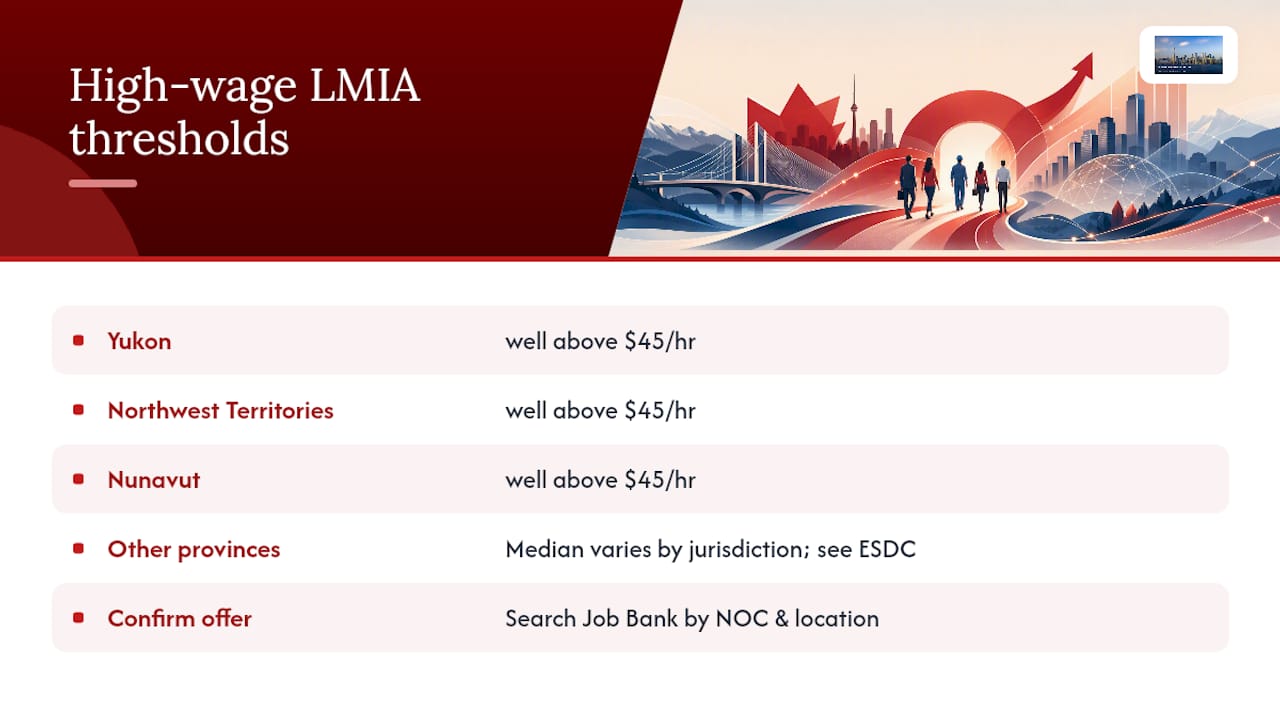
Following the July 17, 2026 update, the thresholds look like this for several major jurisdictions:
Yukon, the Northwest Territories, and Nunavut all sit well above $45 an hour, reflecting the north’s cost of labor. The full list covering every province and territory is published on the ESDC threshold page linked above.

To confirm your offer clears the bar, search Job Bank by NOC code and by the specific city or region where the job is located. Median wages vary block by block in some metro areas, so a Toronto number won’t necessarily apply to a job in Barrie.
Pro Tip: Pull your Job Bank wage snapshot for the exact NOC and location, then compare it against your own payroll records for similar roles. If your internal pay range sits below the Job Bank median, ESDC expects you to pay the higher of the two, not the lower.
What Do Employers Need Before Filing?
Get your paperwork in order before you open LMIA Online. High-wage applications carry fewer restrictions than low-wage ones, but the documentation bar is still real.
Recruitment and advertising requirements:
- Advertise the position on Job Bank for a minimum of 4 consecutive weeks within the 3 months before applying.
- Run at least 3 distinct recruitment activities beyond Job Bank, such as industry job boards or a recruiter.
- Keep dated proof (screenshots, invoices, applicant logs) of every posting and outreach effort.
Documents to assemble before you start the application:
- Business legitimacy records: Canada Revenue Agency (CRA) business number, articles of incorporation, or a valid business license.
- Recent payroll records showing wages paid to comparable employees in the same role and location.
- Proof of recruitment and advertising for the full required window.
- A transition plan demonstrating how the employer will reduce reliance on temporary foreign workers over time, through training, wage increases, or recruitment of Canadians and permanent residents.
- Employer registration certificates, where your province requires one.
The prevailing wage you commit to must be the highest of either the Job Bank median or your own payroll range for comparable staff, and Service Canada expects you to review that wage annually and never lower it once the LMIA is positive.
High-wage LMIAs typically support employment durations that may extend to several years, longer than what’s available under the low-wage stream. Extensions beyond three years happen, but ESDC treats them as exceptional and expects a documented rationale.
How to Apply for a High-Wage LMIA Through LMIA Online
The application itself runs through a single government portal, and the steps rarely change year to year.
- Sign in to LMIA Online using your existing Job Bank employer credentials, or create an employer account if this is your first application.
- Complete the employer and job details section, including NOC code, wage offer, work location, and job duties.
- Upload your supporting documents: business legitimacy proof, payroll records, recruitment evidence, and the transition plan.
- Pay the processing fee, set at $1,000 per position, which the employer must cover and can never recover from the worker.
- Submit the application and retain copies of every uploaded document and payment confirmation for your own records.
You can submit up to six months before the intended start date, which gives you room to plan around processing times that vary by volume and season. Most delays come from incomplete uploads rather than the government’s queue, so double check file formats and make sure every document matches the name and dates on your application before you hit submit.
Provincial and Quebec-Specific Filing Rules
Several provinces layer extra requirements on top of the federal process, and missing them is one of the fastest ways to get flagged as incomplete.
- British Columbia, Manitoba, Saskatchewan, and Nova Scotia require employers to hold a valid employer registration certificate, and proof of that registration needs to go in with your LMIA submission.
- In Quebec, any position lasting more than 30 consecutive days requires simultaneous filing with the Ministère de l’Immigration, de la Francisation et de l’Intégration (MIFI) alongside your federal LMIA application.
- Provincial processing times run independently of the federal timeline, so gather province-specific documents before you file, not after ESDC asks for them.
Why Do High-Wage LMIAs Get Refused or Audited?
Most refusals trace back to a handful of repeat mistakes, and nearly all of them are avoidable with better recordkeeping.
- Wage inconsistency: the offered wage doesn’t match what payroll records show for comparable employees. ESDC actively compares your offer against your own payroll data and Job Bank figures, and artificially inflating a wage just to clear the threshold is a well-known audit trigger.
- Thin recruitment evidence: fewer than three documented recruitment activities, or gaps in the four-week advertising window.
- Incomplete transition plans: vague commitments with no training timeline or hiring targets for Canadians and permanent residents.
- Missing provincial documents, especially registration certificates or Quebec’s MIFI filing.
Pro Tip: Keep dated exports of your Job Bank wage snapshot and every recruitment posting the moment you pull them. Auditors ask for proof of what the market looked like at the time you applied, not what it looks like today.
Why a Readiness Audit Beats Fixing Problems After the Fact
A readiness audit catches the gaps that cause refusals before they ever reach an officer’s desk. Canada Number One Immigration has worked through this exact preparation process with employer clients often enough to know that most high-wage LMIA problems are fixable in a day, not a month, if someone finds them early.
How We Help Employers Get High-Wage LMIAs Right the First Time
A refused LMIA doesn’t just cost you the $1,000 processing fee. It costs you months of lost hiring time while a role sits open. Canada Number One Immigration runs an LMIA readiness audit that checks your wage offer against current thresholds, reviews your recruitment documentation, and stress-tests your transition plan before you ever submit through LMIA Online.
Led by licensed RCIC Minerva McCoon McBean, our team handles the LMIA-based work permit process for Toronto employers and corporate clients across Canada, start to finish. If you’re preparing a high-wage hire this year, book a consultation and get a straight answer on whether your application is ready before you pay the government fee.
Frequently Asked Questions About High-Wage LMIAs
What is the difference between a high-wage and low-wage LMIA? The stream depends entirely on whether your offered hourly wage meets the provincial or territorial median threshold. High-wage positions avoid several low-wage restrictions, including workforce caps and community unemployment rules, but still require a transition plan.
How much does a high-wage LMIA cost? The processing fee is $1,000 per position, paid by the employer. The worker cannot be asked to cover or reimburse this cost.
How long can a high-wage LMIA-supported work permit last? Employers can generally request employment durations of up to three years. Longer terms are possible but treated as exceptions requiring justification.
Do I need a transition plan for a high-wage LMIA? Yes. Even though high-wage positions skip several low-wage restrictions, ESDC still requires a transition plan showing how you’ll reduce reliance on temporary foreign workers over time.
Is there a special rule for Quebec employers? Yes. Positions lasting more than 30 consecutive days require simultaneous filing with Quebec’s Ministère de l’Immigration, de la Francisation et de l’Intégration alongside your federal application.
What triggers an LMIA audit? Wage inconsistencies between your offer and payroll records, thin recruitment documentation, and incomplete transition plans are the most common triggers. Keeping dated proof of wages and recruitment efforts at the time of application is the best defense.
This article is general information, not a substitute for advice from a qualified lawyer. Consult a qualified legal professional about your own circumstances before acting on anything here.
Sources
Recommended
Stay Updated
Subscribe to our newsletter for the latest immigration news and tips.