Home Support Worker Pilot: Status, Rules, and Next Steps

The Home Support Worker Pilot is closed to new applications. IRCC stopped accepting submissions on June 17, 2024, and applications filed after that date will not be processed under this stream. If you already applied before the cutoff, IRCC is still working through those files.
If you’re planning ahead for a future intake or a related caregiver stream, here’s what you’d need to qualify:
- A full-time job offer in an eligible occupation, most commonly NOC 44101 (home support workers)
- Six months of continuous, qualifying work experience, or a related training credential
- Language ability at Canadian Language Benchmark (CLB) 4 or higher
- A secondary school diploma at minimum
- A genuine plan to live outside Quebec
Not sure where you stand? Check IRCC’s official caregiver pages directly, and start gathering documents now. New home care streams open with little warning.
TL;DR:
- Applications for the Home Support Worker Pilot are no longer accepted as of June 17, 2024, but IRCC continues processing files submitted before that date.
- To qualify for new caregiver pathways, applicants need a verified six-month relevant work experience or training, a job offer classified under NOC 44101, and CLB 4 language skills.
- Ensuring the employer’s wage offer meets the Canada Job Bank median and has at least one year of documented care experience is crucial for application success.
- Preparing early by ordering an Education Credential Assessment and booking a language test is vital, as scores and assessments have expiry windows.
- Relying on professional review services like RCIC-led consultations can prevent documentation errors and employer noncompliance that often lead to application refusals.
Table of Contents
- What Are the Home Support Worker Pilot Requirements?
- What Counts as a Qualifying Job Offer?
- Can You Still Apply to the Home Support Worker Pilot?
- How Should You Prepare for a Caregiver Pilot Application?
- What Mistakes Cause Refusals in Caregiver Applications?
- What Was the Home Support Worker Pilot Designed to Achieve?
- What Settlement Support Exists After You Land?
- How Does This Pilot Compare to Other Caregiver Pathways?
- What Rights and Duties Come With Permanent Residency?
- How Canada Number One Immigration Supports Caregiver Applicants
- Get Ready for the Next Caregiver Intake With Expert Guidance
- Why the Caregiver Pilot Story Isn’t Really About the Pilot
- Key Takeaways
- Sources
What Are the Home Support Worker Pilot Requirements?
Six months is the number to remember. That’s the minimum continuous work experience most caregiver pilots require, and it has to be recent, relevant, and verifiable through pay stubs, letters, or contracts, not just a resume line. If you don’t have the work history, a training credential of at least six months in a caregiving field can substitute, according to the job offer requirements published by IRCC.
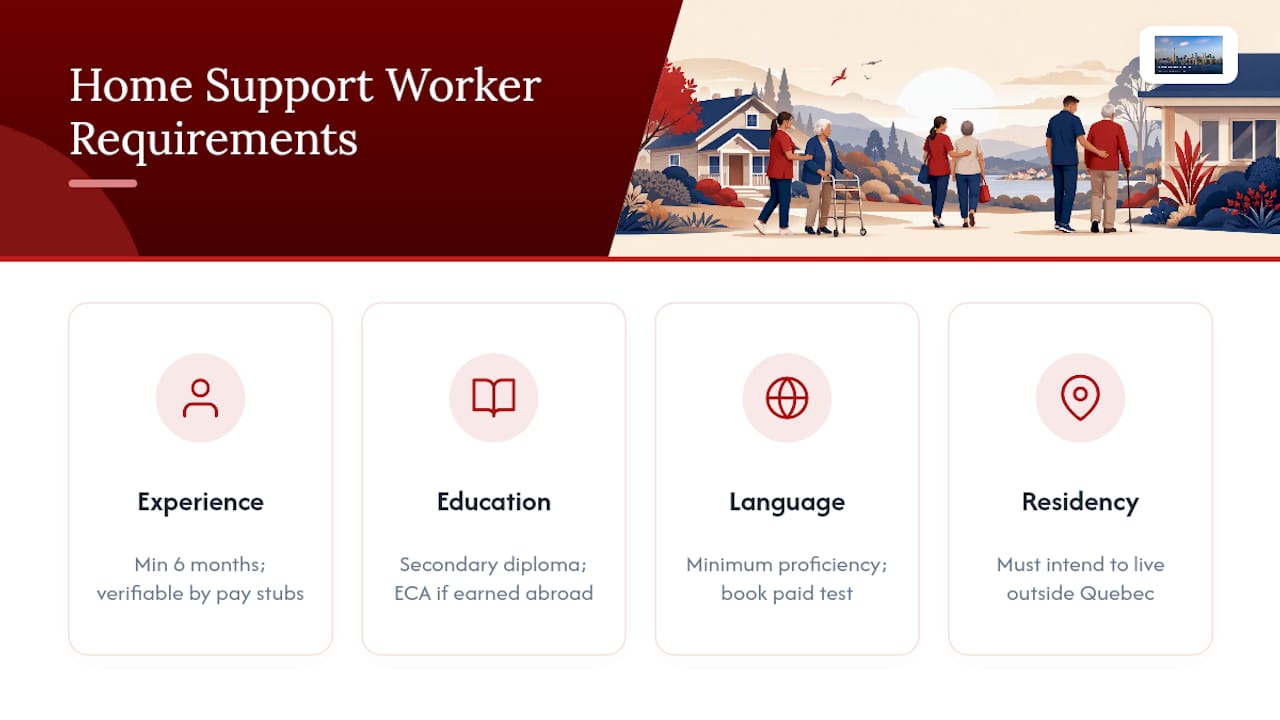
Education requirements sit lower than many applicants expect: a secondary school diploma is the baseline. If your schooling happened outside Canada, you’ll eventually need an Education Credential Assessment (ECA) to prove that diploma is equivalent to Canadian standards. Don’t wait until an application window opens to order one, as ECA processing can take several weeks.
Language is where a lot of otherwise-qualified applicants stumble. Applicants must meet a minimum language proficiency level that corresponds to a modest benchmark, requiring a booked, paid test with results tied to a specific validity window.
Finally, there’s the residency piece nobody talks about enough: these pilots are built around applicants who intend to live outside Quebec, since Quebec runs its own immigration selection process separate from federal programs.
Pro Tip: Book your language test the same month you decide to pursue a caregiver pathway. Scores expire, and re-testing under time pressure is one of the most common self-inflicted delays applicants create.
What Counts as a Qualifying Job Offer?
A job offer is the backbone of this pilot, and it has to check specific boxes or it collapses the whole application.
- Correct NOC classification. The occupation has to match NOC 44101 for home support workers, or another explicitly listed caregiver NOC. Confirm the classification through the official NOC database rather than trusting an employer’s job title alone.
- Wage compliance. The offer must meet or exceed the Job Bank median wage for that occupation in the province or territory where you’d work. Wages that look reasonable on paper can still fall short of the regional median.
- Employer history. The employer generally needs at least one year of documented history providing the same type of care services, plus a valid business number.
- Setting verification. Home Support work needs to happen in a private household, not an institution. Nursing homes and hospital-based caregiving typically don’t qualify.
Private household work leaves a thinner paper trail than institutional employment, so ask for a signed letter describing daily duties, hours, and the home address where care takes place.
Can You Still Apply to the Home Support Worker Pilot?
No, not as a new applicant. The window closed on June 17, 2024, and IRCC has confirmed it continues processing only files received on or before that date.
A few groups remain in the pipeline:
- Applicants who submitted before the closure date and are waiting on a decision
- Certain out-of-status caregivers covered under narrow, time-limited public policy measures
- Family members already included in a pending application
The relevant statistic here isn’t a number so much as a pattern: caregiver immigration policy in Canada has a history of closing one pilot and opening a replacement with adjusted rules within months. IRCC introduced new Home Care Worker Immigration pilot streams that build on the earlier programs, and further adjustments are plausible as labor demand shifts. Treat any secondhand claim about a reopened intake with suspicion until you see it on a .canada.ca page.
Practical move: bookmark the official caregiver program page and check it monthly rather than relying on forums or social media groups, where outdated information circulates long after a program closes.
How Should You Prepare for a Caregiver Pilot Application?
Preparation now is the only leverage you have while intake windows stay closed. Work through this in order:
- Collect employment proof. Gather reference letters, pay records, and employment letters that spell out specific duties, not vague job titles. If you’ve worked multiple caregiving jobs, document each one separately so the timeline reads as continuous.
- Order your ECA early. If your education happened outside Canada, request the assessment now. It has no expiry tied to a specific application, so there’s no downside to getting it done before a stream opens.
- Book a language test. Aim for CLB 4 or better on IELTS General Training, CELPIP General, or TEF Canada for French speakers. Book with enough runway that a retest, if needed, doesn’t blow past the validity window.
- Document the household setting. For each caregiving role, get a letter confirming the work happened in a private residence, listing the address and the care recipient’s relationship to the household.
- Talk to a Regulated Canadian Immigration Consultant (RCIC) once you have your documents in hand. An RCIC can review your file for classification errors and employer red flags before you submit anything, which matters more in caregiver streams than almost any other immigration category because so much depends on employer-side compliance.
Pro Tip: Keep every job offer letter and pay stub in one folder from day one, even before a pilot reopens. Reconstructing two years of caregiving history from memory during a tight application window is one of the most avoidable stress points applicants create for themselves.
What Mistakes Cause Refusals in Caregiver Applications?
Most refusals in this category trace back to the employer, not the applicant. That’s the uncomfortable truth about employer-driven pilots: your file’s strength depends heavily on paperwork someone else controls.
- Wrong NOC selection. Applicants sometimes list a job under a caregiver-adjacent code that doesn’t match their actual duties.
- Mixing categories. Combining experience from a home support role with experience from a completely different caregiving pilot creates inconsistencies officers flag quickly.
- Weak proof of private household work. A job offer that reads more like institutional employment, even informally, undermines eligibility.
- Employer noncompliance. Missing business numbers, no history of providing the specific care service, or wages that sit below the Job Bank median all sink otherwise solid applications.
Before accepting any job offer, ask the employer for a written wage statement, proof of business registration, and a description of how long they’ve employed someone in a similar caregiving role.
Pro Tip: Cross-check the wage in your job offer against the current Job Bank median for that occupation and province before signing anything. A gap of even a dollar or two per hour below the median can undermine your entire application later.
What Was the Home Support Worker Pilot Designed to Achieve?
The pilot existed to solve a specific labor gap: Canadian families needed reliable in-home caregivers for children, seniors, and people with disabilities, and the immigration system offered no direct route from temporary caregiving work to permanent residency for that group.
Unlike older caregiver programs that stretched processing times over years, this pilot promised permanent residency from the outset rather than making it something workers earned after a probationary period. Applicants and their spouses and dependent children could all apply for permanent residence together, and workers received an occupation-specific work permit tied to their employer while their application processed.
The benefit for families needing care was equally direct: a defined, transparent pathway meant employers could offer genuine long-term positions instead of relying on informal or under-the-table arrangements that left both sides legally exposed. For caregivers already working in Canada temporarily, the pilot offered something rarer than a paycheck: a fixed, government-defined route to settle permanently, provided they met the six-month work history and CLB 4 language threshold.
That design logic hasn’t disappeared with the pilot’s closure. It’s exactly the framework IRCC has signaled it intends to preserve in whatever caregiver stream replaces it.
What Settlement Support Exists After You Land?
Permanent residents admitted through a caregiver pilot get access to the same federally funded settlement network available to any new permanent resident, and it’s more substantial than most applicants realize before they arrive.
Settlement service provider organizations, funded through IRCC, offer free language classes, employment counseling, and help navigating provincial health coverage in every province outside Quebec. Many of these organizations run caregiver-specific programming because home support workers arrive in unusually large numbers relative to other economic categories, and settlement agencies have built resources around that reality: peer support groups for domestic workers, orientation sessions on employment standards, and help resolving disputes with employers.

Provincial nominee offices and municipal newcomer centers often provide translation help for report cards, credential recognition guidance, and connections to community groups organized around specific home care professions. Newcomers should also register for a provincial health card as soon as they land since coverage waiting periods vary by province, and some provinces impose a delay of up to three months before public health insurance begins.
None of this support is automatic. Settlement agencies typically require newcomers to self-refer, so contacting a local settlement organization within the first few weeks after landing, rather than waiting until a problem arises, makes the difference between smooth integration and months of unnecessary friction.
How Does This Pilot Compare to Other Caregiver Pathways?
The Home Support Worker Pilot’s defining feature was direct permanent residency on approval, distinct from older programs like the Caregiver Program streams that required two years of Canadian work experience before a caregiver could even apply for permanent status.
Provincial Nominee Programs (PNPs) offer another route for some caregivers, particularly in provinces with dedicated healthcare or caregiver occupation streams, but PNP criteria vary by province and typically demand a valid job offer plus points-based scoring that can disadvantage applicants with limited Canadian work history. Express Entry, meanwhile, rarely serves home support workers well on its own. NOC 44101 sits in a skill category that scores poorly under the Comprehensive Ranking System without additional provincial nomination or arranged employment points.
Live-in caregiver arrangements under older, now-discontinued programs required applicants to reside in their employer’s home, a condition the newer pilots dropped entirely. That single change addressed one of the most common complaints from caregiver advocacy groups: the power imbalance created when a worker’s housing and immigration status both depend on staying in the employer’s residence.
The practical takeaway is that no single caregiver pathway fits everyone. A worker with two years of Canadian experience and no current job offer might do better through Express Entry with provincial support, while someone with a strong, verified employer relationship but only six months of experience fits the pilot model far more naturally.
What Rights and Duties Come With Permanent Residency?
Once a caregiver pilot application is approved, the successful applicant becomes a permanent resident with the full legal rights that status carries: the right to work for any employer in Canada, access to public healthcare, and eligibility to apply for Canadian citizenship after meeting the residency requirement, typically counted from the date of landing.
That last point catches some applicants off guard: permanent residence through a caregiver pilot ends any employer-tied work permit restriction. You’re no longer bound to the sponsoring employer once your permanent resident status is confirmed, which means a caregiver who lands through this pathway can change jobs immediately, including leaving the caregiving field entirely.
Obligations run in the other direction too. Permanent residents must meet a residency obligation, generally being physically present in Canada for at least two out of every five years, to maintain their status. Filing accurate tax returns, updating IRCC on address changes, and renewing the physical PR card before it expires are administrative duties that catch newcomers off guard more often than any substantive legal issue.
Family members included on the same application land with identical permanent resident rights, which is part of why this pilot mattered so much to caregivers with spouses and children still abroad.
How Canada Number One Immigration Supports Caregiver Applicants
Employer-driven pilots like this one live or die on paperwork most applicants have never had to assemble before, and reviewing your file before submission catches problems while there’s still time to fix them.
Canadanumberoneimmigration works through exactly that kind of review: checking whether an employer’s job offer holds up against NOC classification and wage rules, verifying business history and documentation, and helping applicants build an ECA and language-testing plan that doesn’t stall a future application.
Hiring a consultant tends to matter most when a job offer looks slightly off, when work history spans multiple employers or countries, or when an applicant simply can’t afford a second failed attempt once a new intake window opens.
Get Ready for the Next Caregiver Intake With Expert Guidance
Government pages tell you the rules. They don’t tell you whether your specific job offer, your six months of scattered work history across two employers, or your foreign diploma will actually hold up once an officer reviews the file. That gap between the published requirements and your particular situation is exactly where applications fall apart, and it’s exactly where Canadanumberoneimmigration steps in.
Canadanumberoneimmigration reviews caregiver files the way an officer will: checking NOC classification against actual job duties, verifying employer wage compliance against Job Bank medians, and flagging documentation gaps before they become refusal letters. This is a Toronto-based, RCIC-led firm, which means every caregiver strategy goes through a consultant licensed to represent you directly with IRCC, not a call center reading from a script.
If you’re a home support worker in Canada or abroad trying to get ready for the next caregiver pathway, start with a consultation to review your work history, job offer, and documentation against current requirements. Check the firm’s immigration consulting services or review consultation fees to see what a file review costs before a new intake window opens and the clock starts running.
Why the Caregiver Pilot Story Isn’t Really About the Pilot
The most overlooked truth about this program isn’t its closure date. It’s that the eligibility bar (six months of experience, CLB 4, a secondary diploma) was never the hard part. The hard part was always the employer relationship, and that fact gets buried under headlines about intake windows opening and closing.
Caregiver pilots put applicants in a strange position compared to almost every other Canadian immigration category: their success depends on someone else’s paperwork discipline. A skilled, qualified caregiver with flawless documentation can still get refused because an employer never registered a business number correctly or can’t prove a year of prior caregiving history. That’s not a hypothetical edge case. It’s the single most common failure point in this entire category, and it’s one applicants have almost no direct control over.
What that means practically: the smartest caregivers treat every job offer as a document to interrogate, not a gift to accept gratefully. Ask for the business number. Ask for proof of the employer’s one-year care history. Ask for a written wage statement tied to the actual Job Bank median, not a verbal promise. None of that is paranoid. It’s the only leverage an applicant has in a system where the other party’s compliance decides your immigration future.
If there’s a lesson worth carrying into whatever replaces this pilot, it’s that policy fights over eligibility thresholds get all the attention, while employer verification quietly determines who actually gets to stay.
— Minerva McBean
Key Takeaways
The Home Support Worker Pilot closed on June 17, 2024, but IRCC continues developing new caregiver pathways built on the same core requirements: a genuine job offer, NOC 44101, CLB 4 language ability, and six months of qualifying experience.
| Point | Details |
|---|---|
| Program status | Closed to new applicants since June 17, 2024; only pre-closure submissions are still being processed. |
| Core eligibility | Six months of relevant experience or training, CLB 4 language ability, and a secondary school diploma. |
| Job offer scrutiny | Confirm NOC 44101 classification and check the employer’s wage offer against the Job Bank median. |
| Preparation now | Order an ECA and book a language test early so you’re ready when a new stream opens. |
| Professional review | Canadanumberoneimmigration offers RCIC-led file review to catch employer and documentation gaps before submission. |
Sources
- Canada
- IRCC announces eligibility for new Home Care Worker pathways to permanent residence | CIC News
Recommended
Stay Updated
Subscribe to our newsletter for the latest immigration news and tips.