What Ontario's Foreign Worker Stream Redesign Means for You in 2026
What Ontario’s Foreign Worker Stream Redesign Means for You in 2026

The Foreign Worker stream you’ve read about in older guides no longer exists on its own. Ontario has folded it into the Ontario Workforce Priority (OWP) stream, a single pathway that now covers most job-offer-based nominations in the province. If you have a qualifying job offer in a TEER 0 to 3 occupation, your employer registers that offer in the OINP Employer Portal, and you submit an Expression of Interest (EOI) to get in line for an invitation.
Three things to do right now:
- If you’re the applicant: confirm your job offer meets OWP’s work-experience and language thresholds, then register your EOI as soon as your employer confirms the job offer is submitted.
- If you’re the employer: register in the Employer Portal, gather your business documentation early, and know you have only 14 calendar days to submit employer approval once an invitation is issued.
- Verify everything against primary sources before you submit: the Ontario Workforce Priority stream page and the federal IMM 0197 form are the two documents that matter most, not third-party summaries.
This is not a cosmetic name change. The redesign shifted who qualifies, how work experience gets weighed, and how much scrutiny employers face before a nomination becomes real.
Key Takeaways
The Ontario Workforce Priority stream now governs most job-offer nominations, and success depends on matching recent, employer-specific work experience to strict deadlines at every stage.
| Point | Details |
|---|---|
| Program consolidation | The former Foreign Worker stream is now part of Ontario Workforce Priority, with more weight on recent employer-specific experience. |
| Three work-experience routes | Six months with the job-offer employer, three months for recent Ontario graduates, or two years cumulative within five years. |
| Employer deadline is strict | Employers have 14 calendar days after an invitation to submit employer approval, or the file lapses. |
| Fees vary by location | Employer Job Offer-related fees run $1,500 outside the GTA and $2,000 within the GTA. |
| Get expert review for complex files | Canadanumberoneimmigration audits work-experience claims and employer documentation before submission to catch mismatches early. |
Table of Contents
- What Changed in the 2026 OINP Redesign
- What Work Experience, Language, and Credentials Do You Need?
- What Must Employers Do Before and After an Invitation?
- How Does the Application Process Flow From Job Offer to Nomination?
- What Documents Do You Need and Where Do Applications Go Wrong?
- What Happens After Your OINP Nomination Is Approved?
- Does the OINP Redesign Affect Workers Already in Canada on Temporary Status?
- What Happens If You Change Jobs or Employers Mid-Process?
- How Do You Maintain Legal Status While Your Application Is Pending?
- Why the Old Playbook No Longer Works
- When Hiring an RCIC Actually Changes Your Outcome
- Should You Handle This Yourself or Bring in a Consultant?
- Frequently Asked Questions
- Sources
What Changed in the 2026 OINP Redesign
Ontario consolidated several legacy streams, including the old Employer Job Offer: Foreign Worker stream and the International Student stream, into the single Ontario Workforce Priority stream. The stated goals were program integrity and closer alignment between nominations and actual Ontario labor needs, according to McMillan LLP’s analysis of the changes.
The practical shift centers on work experience. OWP puts more weight on recent, employer-specific experience rather than a generic work history, which sounds like a small tweak until you realize what it does to certain applicant profiles.
- Applicants who built a case around varied past employers, rather than the employer currently offering the job, may find their older experience counts for less.
- International graduates who previously relied on the dedicated International Student stream now compete under the same general OWP criteria as everyone else.
- Language and education requirements got folded into a points-based evaluation rather than a simple pass/fail gate.
Pro Tip: If you qualified under the old rules but haven’t submitted anything yet, don’t assume your old eligibility carries over. Re-check your file against current OWP criteria before you or your employer invest time in the Employer Portal.
Practitioner commentary on the redesign notes it tends to reward workers already established with an Ontario employer, while raising the bar for those who previously qualified through the now-closed International Student stream. If that’s your situation, plan on a longer runway and a stronger paper trail connecting you to your current employer.
For recent graduates specifically, the practical effect is this: your degree still matters, but it no longer opens a dedicated lane. You’re competing on the same work-experience and language criteria as an experienced tradesperson or manager applying through the same stream.
What Work Experience, Language, and Credentials Do You Need?
OWP eligibility runs through three separate doors for work experience, and you only need to walk through one of them.
- Six months with the job-offer employer. You need six months of continuous, full-time work with the same employer offering you the nominated position, completed within the 12 months before you apply.
- Three months as a recent Ontario graduate. If you graduated from an eligible Ontario post-secondary program recently, three months of full-time work with the job-offer employer can satisfy the requirement.
- Two years cumulative within five years. Broader work experience, accumulated across up to five years, in the same occupation or a closely related one, also qualifies, though this route generally faces more scrutiny under the redesign’s emphasis on recent, employer-specific history.
Regulated occupations add a fourth layer. If the position requires a license, certificate, or registration in Ontario, such as certain trades, health professions, or engineering roles, you must hold or be eligible for that credential before the nomination can move forward. A job offer for a role you’re not legally licensed to perform is not a qualifying job offer, no matter how strong the rest of your file looks.
Language requirements are usually expressed as Canadian Language Benchmark (CLB) thresholds tied to the occupation’s skill level. Higher-skill TEER 0 and 1 roles typically demand a higher CLB score than TEER 2 or 3 positions. You’ll need results from an approved test, IELTS General Training or CELPIP General for English, taken within the validity window OINP specifies, and you should include them with your EOI rather than waiting for a request.
Education credentials matter most when your degree or diploma was earned outside Canada. In that case, a credential assessment, commonly through the World Education Services (WES), helps establish that your education is equivalent to a Canadian standard. You don’t always need this if your credential is Canadian, but skipping it when you have a foreign credential is a common gap that slows applications down.
Evidence you’ll want assembled before your employer even opens the Employer Portal:
- Signed employment contracts and offer letters with clear start dates and job duties.
- Pay stubs or payroll records matching the work-experience period you’re claiming.
- Employer reference letters describing your role, hours, and reporting structure.
- Copies of any professional license, certificate, or registration tied to the occupation.
- Language test results and, where applicable, an educational credential assessment.
Pro Tip: Match your job title and duties exactly across every document, your resume, your employer’s letter, and your EOI. Reviewers flag inconsistencies between these documents more often than any single missing form.
What Must Employers Do Before and After an Invitation?
Your employer carries just as much responsibility in this process as you do, and their missteps can sink an otherwise strong application. Employers must first register in the Employer Portal and meet a set of baseline eligibility thresholds before they can submit a job offer at all.
Ontario’s employer guide requires the business to have been active for a minimum period, maintain physical business premises in the province, and meet revenue and full-time employee thresholds that vary depending on whether the job is located inside or outside the Greater Toronto Area (GTA). Employers inside the GTA generally face higher revenue and staffing benchmarks than those outside it, reflecting the larger labor market and higher cost base in and around Toronto.
The job offer itself has to check specific boxes:
- Full-time and permanent, meaning a minimum of 1,560 hours annually, not seasonal or contract work.
- Wage alignment with the occupation’s median wage for the region, so an offer well below the going rate for that role and location invites questions.
- A credible business rationale for hiring this specific candidate for this specific position right now.
Once an invitation goes out, the clock changes hands. Employers get exactly 14 calendar days to submit the employer approval application after the applicant receives an invitation to apply. Miss that window and the invitation can lapse, forcing you back into the applicant pool.
If the candidate is living abroad or outside Ontario, employers may also need to show recruitment evidence, including at least two advertising methods and a four-week posting period, to demonstrate the position wasn’t simply handed to a pre-selected candidate without a genuine hiring process. Some roles interact with federal Labour Market Impact Assessment (LMIA) rules too, and coordinating LMIA processing alongside the OINP timeline avoids one process stalling the other.
How Does the Application Process Flow From Job Offer to Nomination?
The sequence matters as much as the substance. Miss a deadline anywhere in this chain and you may need to restart.
- Employer submits the job offer through the Employer Portal, confirming they meet the business thresholds described above.
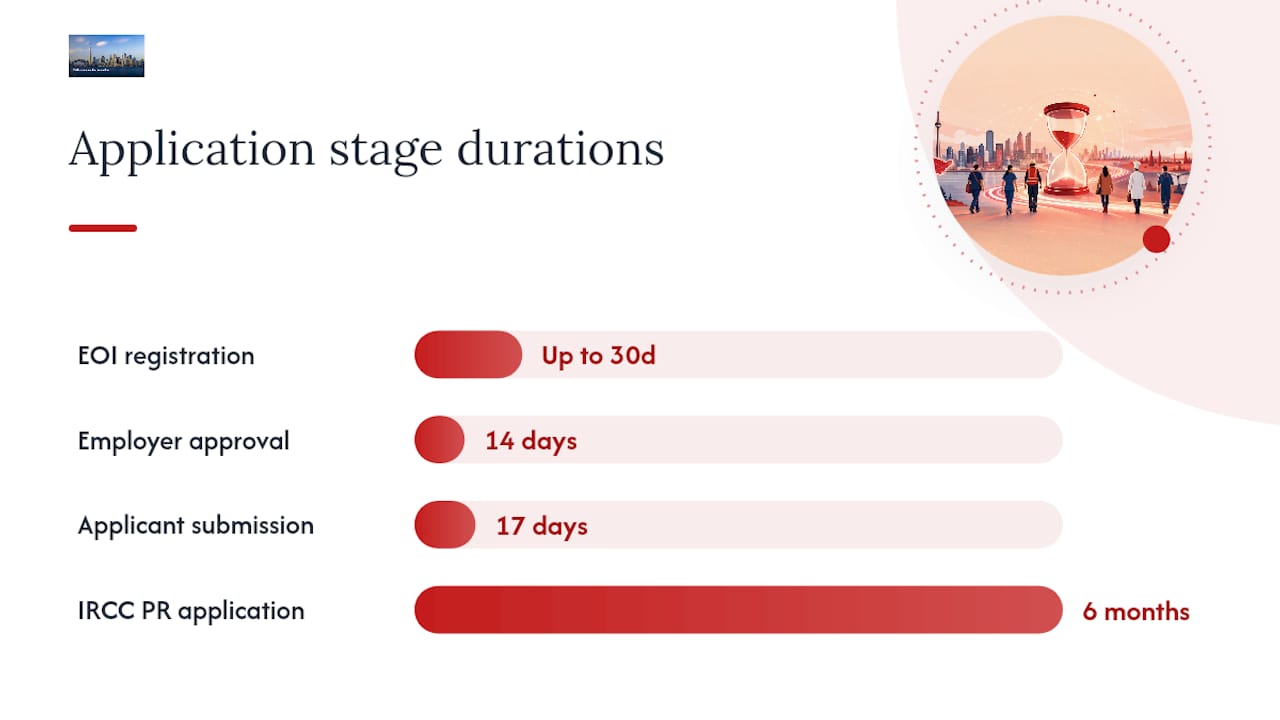
- Applicant registers an Expression of Interest, generally within a 30 day window tied to the employer’s submission, describing work experience, language scores, and the job offer details.
- OINP reviews and issues an invitation to apply if the EOI scores well enough against current program criteria.
- Employer submits the formal employer approval application within 14 calendar days of the invitation being issued.
- Applicant submits their full application within 17 days of receiving the invitation, including supporting documents and, where applicable, the IMM 0197 form.
- OINP issues a nomination once both employer and applicant submissions pass review.
- Applicant applies to IRCC for permanent residence within six months of receiving the nomination.
Fees differ depending on where the job is located. Confirm current amounts before submitting, since Employer Job Offer-related application fees run $1,500 outside the GTA and $2,000 within the GTA.
| Stage | Timeline |
|---|---|
| EOI registration after employer submission | Up to 30 days |
| Employer approval after invitation | 14 calendar days |
| Applicant submission after invitation | 17 days |
| IRCC PR application after nomination | 6 months |
Processing times vary by how complete the initial submission is. The most common source of delay isn’t OINP’s review queue. It’s incomplete employer documentation sent back for clarification, which can add weeks to a timeline that otherwise moves fairly predictably.
What Documents Do You Need and Where Do Applications Go Wrong?
Assemble your file like you’re building a case, not filling out a form. Reviewers cross-reference every document against every other document, so gaps or contradictions stand out immediately.
Core applicant documents include the job offer confirmation, the IMM 0197 form where required, pay stubs and contracts proving your work-experience claim, and any license or certification tied to the occupation. Employers need their business registration, recent financial statements showing they meet revenue thresholds, employee count records, and proof of physical premises in Ontario.
The most common reasons applications get refused or delayed:
- Mismatched role descriptions between the job offer, the EOI, and supporting letters, one of the most frequent documentation issues reviewers flag.
- Weak or missing recruitment evidence when the candidate is abroad and the employer hasn’t documented a genuine hiring process.
- Wage figures that don’t align with the occupation’s median wage for the region.
- Employer approval missed or submitted late, causing the whole file to lapse regardless of how strong the applicant’s case is.
Pro Tip: Before your employer submits anything, ask them to prepare recruitment-advertising proof, including screenshots, posting dates, and URLs, if you’re applying from outside Ontario. Gathering this after the fact is far harder than doing it upfront.
What Happens After Your OINP Nomination Is Approved?
A provincial nomination is a strong signal, but it isn’t permanent residence. IRCC makes the final decision, and you must submit your PR application within six months of receiving the nomination, per the OWP program rules.
IRCC commonly requests:
- Police certificates and medical exams if not already on file.
- Updated proof of funds and family status documents.
- Confirmation of continued employment in the nominated position.
If your nomination is linked to Express Entry, you receive an additional 600 Comprehensive Ranking System points, which all but guarantees an invitation in the next federal draw. That’s a substantial reason to keep your Express Entry profile active and accurate even while your OINP application is in progress.
While IRCC processes your PR application, you may need a temporary work permit to keep working legally in Ontario, particularly if you’re not yet in Canada or your current authorization is set to expire. Dual intent, the principle that you can hold temporary status while pursuing permanent residence, is recognized by IRCC and doesn’t count against you.

After nomination, you’re generally expected to stay in the approved position. Changing employers or roles without notifying OINP can jeopardize the nomination, so treat any employment change as something to report, not something to handle quietly.
Does the OINP Redesign Affect Workers Already in Canada on Temporary Status?
If you’re already working in Ontario on a temporary permit, the redesign changes your calculus more than it changes your eligibility. Your existing employer relationship is now an asset the program weights heavily, since OWP prioritizes recent, employer-specific work experience over a scattered history across multiple employers.
Workers on a valid work permit who have been with their current employer for six months or more are often in a stronger position under OWP than someone applying from abroad with no Canadian work history. The flip side: if your current job doesn’t match the occupation or TEER level you’d need for a strong nomination, switching employers now, without a clear plan, can actually set your timeline back rather than move it forward.
The safest move if you’re on temporary status is to have your employer confirm they meet OINP’s business thresholds before you invest months building an EOI around them. A willing employer who doesn’t meet the revenue or premises requirements can’t submit a qualifying job offer, no matter how supportive they are.
What Happens If You Change Jobs or Employers Mid-Process?
Changing employers while an OINP application is active is one of the riskiest moves you can make, and it needs to be deliberate, not reactive. Your EOI and nomination are tied to a specific job offer from a specific employer. Switch employers after submitting your EOI, and you generally need to restart with a new job offer, a new Employer Portal registration, and a new work-experience clock.
If you’re still early, before your employer has submitted a job offer, changing jobs is far less costly. The complications start once an EOI is registered or, worse, once you’ve received a nomination.
A few situations where a job change during the process is genuinely worth considering: your current employer stops meeting the business thresholds, the position itself changes substantially from what was described in your original offer, or you receive a stronger, better-aligned offer from another Ontario employer who’s willing to start the process fresh. In each case, weigh the restart cost against the benefit, since restarting the six-month or three-month work-experience clock with a new employer can add real time to your timeline.
If you’re unsure whether a job change would help or hurt your specific file, that’s exactly the kind of judgment call worth getting a second opinion on before you act, not after.
How Do You Maintain Legal Status While Your Application Is Pending?
Your OINP nomination and your immigration status in Canada are two separate tracks, and letting one distract you from the other is a costly mistake. If you’re in Canada on a work permit, study permit, or visitor status, that status has its own expiry date, and OINP processing timelines do not automatically extend it.
Track your permit’s expiry date independently of your OINP application timeline. If your work permit is set to expire before you expect a nomination decision, apply for an extension or a new permit well before the expiry, not after.
Maintained status applies if you apply for an extension before your current permit expires. You’re generally allowed to continue working or studying under your existing conditions while the extension is processed, but this only protects you if you filed on time.
If your OINP nomination comes through and you’re applying for PR through IRCC, you may need bridging status or a new temporary permit to legally remain in Canada while your PR application processes, particularly if your current permit’s expiry falls before IRCC finishes reviewing your file. Building in that buffer, rather than assuming the paperwork will move faster than your permit’s clock, is the difference between a smooth transition and a gap in status that jeopardizes everything you’ve built toward.
Why the Old Playbook No Longer Works
Most of what’s written about this program still talks about the “Foreign Worker stream” as if it’s a live, standalone option. It isn’t, and treating it that way sends applicants chasing rules that no longer apply. The redesign didn’t just rename something. It rewired which work histories count and how much scrutiny employer documentation gets before a nomination becomes real.
The conventional advice, “get a job offer and apply,” undersells how much the employer side now determines outcomes. A candidate with modest qualifications but a well-documented, compliant employer will often beat a stronger candidate whose employer’s paperwork falls apart under review.
If there’s one thing to prioritize first, it’s verifying your employer actually meets the business thresholds before you invest months building your EOI around them. That single check prevents more wasted applications than any amount of polishing your own resume. For files with cross-border work history, licensing questions, or a previous refusal, the margin for error is thin enough that professional review usually pays for itself in avoided delay alone.
When Hiring an RCIC Actually Changes Your Outcome
Some OINP files are straightforward. Others involve overlapping work history across countries, a licensed occupation, or an employer whose documentation isn’t quite where it needs to be, and that’s where a licensed consultant earns their fee rather than just adding a cost.
Canadanumberoneimmigration is led by Minerva McCoon McBean, a licensed RCIC, and the firm’s approach centers on catching problems before OINP does. Instead of leaving your employer to guess at what “sufficient recruitment evidence” means, the firm reviews claims against current program criteria, helps structure Employer Portal submissions, and flags mismatched documentation before it becomes a refusal.
- Complex cross-jurisdictional work history that needs careful documentation to satisfy OWP’s experience routes.
- Regulated occupations where license verification adds a layer OINP scrutinizes closely.
- Files with a prior refusal, where identifying exactly what went wrong matters more than reapplying with the same gaps.
A refused application often costs more in lost time than a consultation would have cost upfront, especially once you factor in a restarted work-experience clock or a missed invitation cycle.
A misaligned job description or missing recruitment proof rarely gets caught until an officer flags it, and by then, the fix costs months, not dollars.
Should You Handle This Yourself or Bring in a Consultant?
If you’ve read this far, you already understand what most guides on this topic get wrong: they treat the Foreign Worker stream and the Ontario Workforce Priority stream as interchangeable, when the rules underneath have genuinely shifted. That gap between what’s written online and what OINP actually checks is exactly where applicants lose time.
Canadanumberoneimmigration exists for readers who want that gap closed before they submit anything, not after a refusal letter arrives. The firm’s approach centers on a full claim audit: reviewing your work-experience route, your employer’s Portal readiness, and your documentation against current OWP criteria, not the outdated rules still floating around older blog posts.
For applicants worried about employer eligibility, licensing questions, or a complicated work history, Canadanumberoneimmigration’s immigration services walk through exactly where your file stands before you or your employer commit to the Employer Portal. If cost is the question holding you back, the firm’s fee structure is published upfront, so you can weigh it against the real cost of a delayed or refused nomination. Book a consultation and get a straight answer on whether your file is ready to submit, or what needs fixing first.
Frequently Asked Questions
Is the OINP Foreign Worker stream still active in 2026? No. It has been consolidated into the Ontario Workforce Priority stream, which now handles job-offer-based nominations for TEER 0 to 3 occupations under updated eligibility rules.
How long does the OINP Foreign Worker stream, now OWP, take from job offer to nomination? Timelines vary by file completeness, but the structured deadlines include periods for EOI registration, employer approval, and applicant submission after an invitation, followed by IRCC’s own PR processing timeline.
Can I still qualify if I worked for multiple employers rather than just my job-offer employer? Yes, through the two-year cumulative work-experience route within a five-year window, though the redesign’s emphasis on recent employer-specific experience means this route often faces closer review than the six-month route.
What happens if my employer misses the 14-day approval deadline? The invitation can lapse, which typically means you need to re-enter the EOI pool and wait for a new invitation rather than resubmit the same one.
Do I need a lawyer or consultant to apply through OWP? It’s not mandatory, but a licensed RCIC can materially reduce risk for complex files, particularly those involving licensed occupations, cross-jurisdictional work history, or employer documentation gaps that commonly trigger refusals.
This article is general information, not a substitute for advice from a qualified lawyer. Consult a qualified legal professional about your own circumstances before acting on anything here.
Sources
Recommended
- Major Ontario Immigration Changes Coming May 30, 2026: What This Means for Applicants | McBean Immigration
- Big Changes Ahead: Ontario’s 2025 Immigration Overhaul Explained | McBean Immigration
- Key Changes to Canada’s PGWP Program in 2024 | McBean Immigration
- Canadian Immigration Programs to Target in 2026 | McBean Immigration
Stay Updated
Subscribe to our newsletter for the latest immigration news and tips.