Spousal Sponsorship Cost for Canada: A 2026 Budget Guide

The baseline government cost to sponsor a spouse or partner is $1,345 CAD if you pay everything up front, or $745 CAD if you defer the Right of Permanent Residence Fee until later in the process. That total comes straight from Immigration, Refugees and Citizenship Canada (IRCC)'s fee schedule, which was updated under a fee-change notice effective April 30, 2026. It covers the sponsorship fee, the processing fee for your spouse or partner, biometrics, and (if you choose to pay it now) the Right of Permanent Residence Fee.
Here’s what that $1,345 actually buys you:
- $90 sponsorship fee (paid by you, the sponsor)
- $570 processing fee (for your spouse or partner)
- $600 Right of Permanent Residence Fee, or RPRF (refundable if permanent residence is not granted)
- $85 biometrics fee
None of this includes the medical exam, police certificates, or translation costs you’ll likely need before you even submit the application. Those are separate, third-party expenses, and they can add several hundred dollars more depending on your situation.
Key Takeaways
Spousal sponsorship costs $745 to $1,345 CAD in IRCC government fees alone, depending on RPRF timing, before third-party expenses.
| Point | Details |
|---|---|
| Baseline government cost | Budget $1,345 CAD with RPRF paid upfront, or $745 CAD if deferred, per IRCC’s fee list. |
| Pay RPRF now | The $600 fee is refundable if PR is refused, so paying upfront avoids delays with no real downside. |
| Add dependents carefully | Each dependent child adds $180 CAD, and biometrics cap at $170 total for two or more applicants. |
| Plan for third-party costs | Medicals, police certificates, and translations can add $500 to $1,000 beyond government fees. |
| Get professional guidance for complex cases | Canada Number One Immigration, led by RCIC Minerva McCoon McBean, reports a 98% success rate handling sponsorship files with prior refusals or multi-country histories. |
Table of Contents
- What Does Spousal Sponsorship Cost Through IRCC?
- Should You Pay the RPRF Now or Wait?
- How Much Extra Do Dependent Children Add?
- What Third-Party Costs Should You Budget For?
- Does Quebec Have Extra Sponsorship Fees?
- How Do You Pay IRCC Fees Correctly?
- What Else Affects Your Total Cost?
- What Do Licensed Immigration Consultants Recommend?
- Why the Real Cost Conversation Gets Skipped
- Get Help Budgeting and Filing Your Spousal Sponsorship
- Frequently Asked Questions
- Sources
What Does Spousal Sponsorship Cost Through IRCC?
The government fee structure for spousal and partner sponsorship has four moving parts, and understanding each one tells you exactly where your money goes and why the total lands where it does.
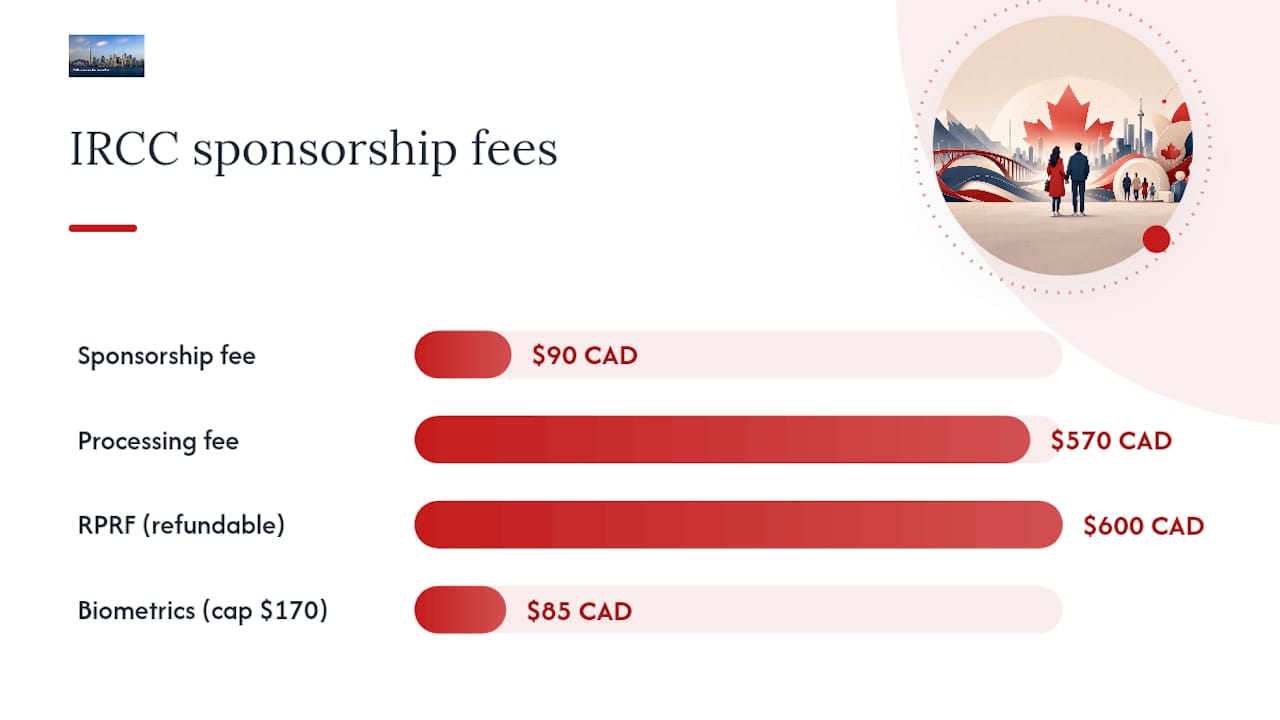
The sponsorship fee is $90. This one belongs to you as the sponsor, not your spouse or partner. It’s essentially IRCC’s charge for reviewing your eligibility to sponsor someone. Every sponsorship application requires it, regardless of whether you’re sponsoring a spouse, a common law partner, or a conjugal partner.
The processing fee is $570, and it’s assessed against the person you’re sponsoring, called the principal applicant. This fee covers IRCC’s review of their application for permanent residence, including eligibility and admissibility checks.
Then there’s the Right of Permanent Residence Fee, or RPRF, at $600. This is different from the other fees because it isn’t a processing charge. It’s closer to a landing fee, paid in exchange for the actual grant of permanent resident status. If your spouse or partner is ultimately refused, IRCC refunds the RPRF in full. That refund guarantee is why most applicants choose to pay it early rather than wait.
Finally, biometrics run $85 per person, capped at $170 for two or more people applying together. Almost every applicant between the ages of 14 and 79 needs to give fingerprints and a photo, and the fee has to be paid before or at the time biometrics are collected.
Add it up and you get two possible totals:
- $1,345 CAD if you pay the RPRF with your initial application ($90 + $570 + $600 + $85)
- $745 CAD if you defer the RPRF and pay it later ($90 + $570 + $85)
Now picture a few common household situations. A sponsor bringing over a spouse with no children pays the baseline $1,345 (or $745 without RPRF). Add one dependent child, and you’re looking at an extra $180 in processing fees, since dependent children don’t pay the RPRF. Add two children, and that’s another $360 on top of the couple’s total, though biometrics for the family are capped rather than charged per person once you hit two or more applicants.
These numbers apply specifically to the standard IRCC fee list as it stands after the April 30, 2026 adjustment. If you’re comparing costs to something you read a year or two ago, that’s likely why the figures don’t match. IRCC’s fee-change notice confirms the sponsorship, processing, and RPRF amounts all increased as part of this update.
Should You Pay the RPRF Now or Wait?
You have a choice here, and it’s worth thinking through before you submit anything. IRCC lets you exclude the $600 RPRF from your initial payment, bringing your upfront cost down to $745 CAD instead of $1,345. The remaining $600 gets paid later, closer to when your spouse or partner is approved for permanent residence.
Sounds like a reasonable way to spread out the expense. In practice, though, IRCC’s own guidance steers most applicants toward paying it upfront, and there’s a good reason for that.
- Paying now means one less administrative step near the finish line, when delays are most frustrating.
- The fee is fully refundable if permanent residence isn’t granted, so there’s no financial downside to paying early.
- Waiting to pay later can mean IRCC pausing finalization of your case until the fee clears, which adds time you didn’t need to lose.
The rare case where deferral makes sense: if $600 genuinely isn’t available right now and paying it later, closer to approval, gives you breathing room to save. Beyond that, the math almost always favors paying upfront.
Pro Tip: Treat the RPRF like a deposit, not an extra cost. Since it’s refunded if the application doesn’t succeed, there’s no real risk in paying it with your initial submission, only in forgetting to pay it before it holds up your case.
If you want a closer look at how payment timing plays out across an actual sponsorship case, Canada Number One Immigration’s guide to family sponsorship walks through common scenarios sponsors run into.
How Much Extra Do Dependent Children Add?
Sponsoring a spouse or partner rarely happens in isolation. If you’re also sponsoring their dependent children, the fee structure shifts slightly, and it pays to know the math before you file.
- Processing fee per child: Each dependent child adds $180 CAD to your total. Unlike your spouse or partner, dependent children are exempt from the $600 RPRF entirely, so their fee is lighter by comparison.
- Biometrics family cap: Biometrics cost $85 per person individually, but once two or more family members apply together, the total caps at $170 no matter how many people are in that group.
- Combined example: A spouse plus one child brings your government total to $1,525 with RPRF paid upfront ($1,345 + $180), or $925 without it. Add a second child, and you’re at $1,705 with RPRF, or $1,105 without.
The biometrics cap is the detail people miss most often. A family of four applying together still pays $170 total for biometrics, not $85 times four. That cap alone can save a sponsoring family a meaningful chunk of change compared to what a quick mental calculation might suggest.
What Third-Party Costs Should You Budget For?
Government fees are the predictable part. The expenses that catch sponsors off guard almost always come from outside IRCC’s fee schedule, and they vary depending on where your spouse or partner lives and what documents they need to gather.
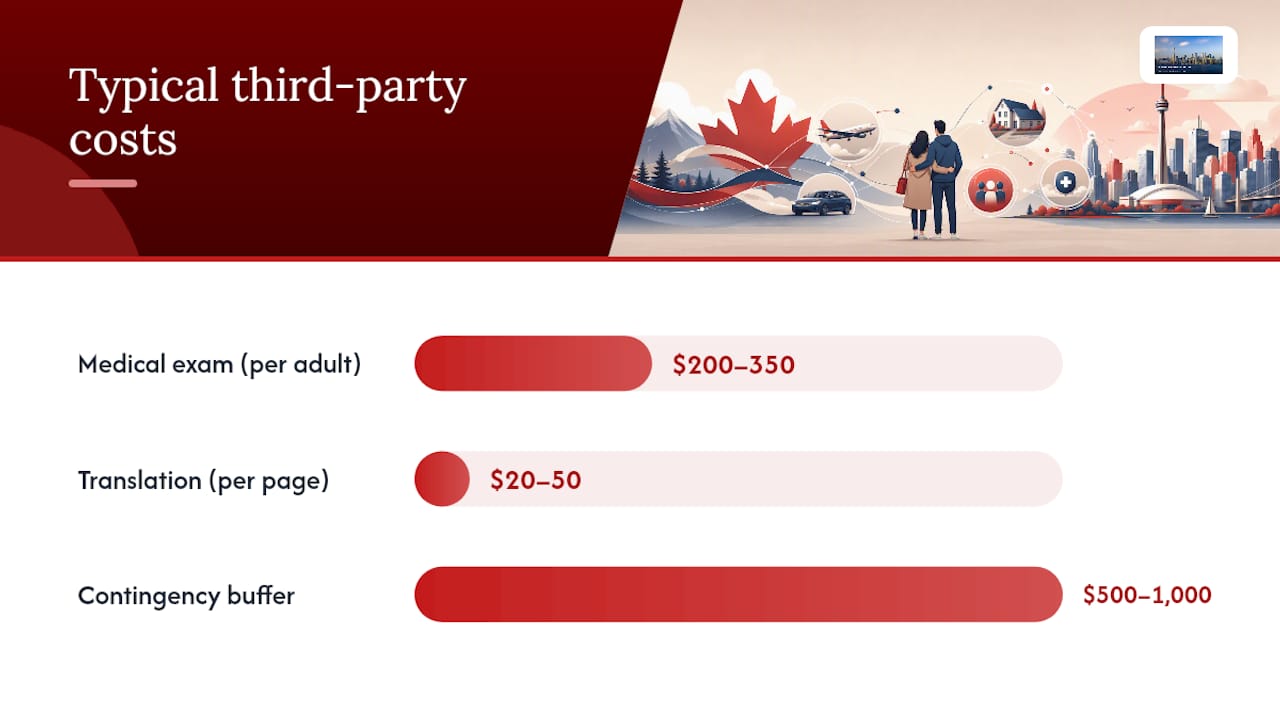
- Immigration medical exam: Expect somewhere in the $200 to $350 range per adult, though the exact price depends on the panel physician and the country where the exam takes place. Some countries have higher clinic fees than others, so it’s worth checking with a few IRCC-approved panel physicians before booking.
- Police certificates: Costs and processing times vary enormously by country. Some governments issue a certificate for a nominal fee within days; others charge more and take weeks, particularly if your spouse or partner has lived in multiple countries as an adult.
- Certified translations: If any supporting document isn’t in English or French, it needs a certified translation. Per-page rates typically range from $20 to $50, and longer documents like birth certificates with attached annexes can add up quickly.
- Professional help: Hiring a licensed RCIC or immigration lawyer costs more upfront, but it often reduces the risk of costly errors, like a missing form or an underpaid fee that triggers a return.
None of these third-party costs are fixed by IRCC, which is exactly why they’re the hardest part of your budget to pin down in advance. A rough rule of thumb: sponsors who budget an extra $500 to $1,000 beyond government fees for medicals, certificates, and translations are rarely caught off guard.
Pro Tip: Get quotes for your medical exam and translations before you finalize your paperwork. Prices between clinics and translators can differ by more than $100, and locking in a provider early avoids last-minute price shocks when you’re already juggling deadlines.
If your situation involves multiple countries, prior marriages, or a refused application in your history, professional guidance from a firm like Canada Number One Immigration’s fee page can help you see what a managed application actually costs compared to handling it solo.
Does Quebec Have Extra Sponsorship Fees?
If you or your sponsored spouse plan to settle in Quebec, there’s a step the rest of Canada doesn’t have to deal with. Quebec runs its own selection process alongside the federal one, which means your application goes through two separate systems instead of one.
- After IRCC approves the federal side, Quebec requires a Certificat de sélection du Québec (CSQ) before permanent residence can be finalized for the province.
- This provincial step adds processing time on top of the federal timeline, and it comes with its own fee structure managed by Quebec’s immigration ministry, separate from anything IRCC charges.
- Check Quebec’s official immigration ministry site directly for current CSQ fees. These numbers aren’t listed on IRCC’s fee page and change independently of federal updates.
One thing to keep straight when you’re filing: never include CSQ fees with your IRCC payment. They go to a different authority through a different process, and mixing them up is a common (and avoidable) source of confusion for Quebec-bound sponsors.
How Do You Pay IRCC Fees Correctly?
Getting the payment right matters almost as much as budgeting for it. IRCC processes fee payments through its online e-pay portal, and the receipt you get afterward needs to go into your application package. Skip this step, or fumble it, and you can expect delays that have nothing to do with your actual eligibility.
- Pay through the official e-pay system, selecting the correct fee category for spousal or partner sponsorship rather than a similar-sounding option.
- Save every receipt generated during payment, including separate confirmations for the sponsorship fee, processing fee, RPRF (if paid upfront), and biometrics.
- Attach all receipts to your application package before submission. Missing even one can result in the whole package being returned.
A few mistakes show up again and again in returned applications:
- Paying an outdated fee amount left over from before the April 30, 2026 increase
- Forgetting to include the biometrics receipt entirely
- Underpaying because a dependent child’s $180 fee wasn’t added to the total
When IRCC catches a fee shortfall or a missing receipt, it typically returns the entire application rather than processing it with a note to fix later. That means starting the clock over, which can cost you months. Double-checking your receipts against the current fee list before you mail or upload anything is one of the cheapest forms of insurance in this entire process.
What Else Affects Your Total Cost?
The path your application takes, inland or outland, shapes where extra costs show up, even though it doesn’t change the core IRCC fees.
Inland applicants, meaning the sponsored spouse or partner already lives in Canada, can typically apply for an open work permit while their sponsorship is in process. That comes with its own permit fee and adds a layer of paperwork, but it lets your partner work legally while waiting. Outland applicants, applying from outside Canada, skip that permit cost but may need private health insurance or extended housing arrangements if they’re waiting abroad longer than expected.
Timeline factors that tend to push costs up indirectly:
- Requests for additional documents mid-process, which can mean paying for new certified translations or updated police certificates
- Medical exams expiring before a decision is made, requiring a second exam and a second fee
- Extended waits abroad that stretch travel, housing, or insurance costs for the sponsored spouse or partner
A reasonable habit: set aside a contingency fund equal to roughly 15 to 20% of your total estimated cost. It won’t cover every possible scenario, but it absorbs the most common ones, like a second medical exam or an unplanned document request, without derailing your budget entirely.
What Do Licensed Immigration Consultants Recommend?
Canada Number One Immigration is led by Minerva McCoon McBean, a licensed RCIC, and the firm reports a 98% success rate across the cases it has handled. That track record comes from seeing where sponsorship applications typically go wrong, and cost planning is one of the more preventable failure points.
The practical advice that comes out of that experience is fairly consistent:
- Pay the RPRF upfront in nearly every case, since it’s refundable and removes a step from your final approval process.
- Budget realistically for medicals, police certificates, and translations rather than treating them as afterthoughts.
- Bring in a licensed RCIC when your case involves prior marriages, past refusals, or documentation from multiple countries, since these are exactly the files where a missed fee or form causes the most expensive delays.
Sponsors who treat third-party costs and payment timing as part of their application strategy, not just paperwork to get through, consistently avoid the delays that turn a six-month process into a year-long one.
For complex histories, the cost of getting professional input upfront is often smaller than the cost of a returned application months later.
Why the Real Cost Conversation Gets Skipped
Most guides to spousal sponsorship cost stop at the IRCC fee table, and that’s a disservice to anyone actually planning a budget. The government total is the easy part. It’s fixed, it’s published, and it doesn’t change based on your circumstances beyond family size. The expensive surprises live in the third-party costs nobody puts a firm number on, because they genuinely can’t. A medical exam in one country costs half what it does in another. A police certificate that takes a week somewhere takes two months elsewhere.
What gets underestimated most isn’t the dollar amount. It’s the time cost tied to fee mistakes. An underpaid biometrics fee or a missing receipt doesn’t just cost money to fix; it can add months to a case that was otherwise straightforward. Sponsors who treat the fee schedule as one part of a bigger logistics problem, not the whole problem, end up in noticeably better shape by the time a decision comes through.
If there’s one thing worth prioritizing above the rest, it’s paying the RPRF upfront and getting your document collection (medicals, police certificates, translations) started early rather than sequentially. That single shift in approach prevents more delays than any amount of fee-table memorization.
Get Help Budgeting and Filing Your Spousal Sponsorship
If you’ve read this far, you already know the government fees are just the starting line. The real cost, and the real risk, comes from getting a form wrong, missing a receipt, or misjudging how Quebec’s provincial step fits into your timeline.
Canada Number One Immigration handles spousal and partner sponsorship cases end to end, from confirming your fee calculations to preparing documentation that holds up against IRCC’s scrutiny the first time. Led by licensed RCIC Minerva McCoon McBean, the firm has built its 98% success rate on catching exactly the kind of fee errors and missing documents that turn a six-month application into a year-long one. If your case involves a prior refusal, a multi-country history, or dependents with their own paperwork, that’s precisely where professional guidance pays for itself. Book a consultation through Canada Number One Immigration’s services page to get a clear read on your specific costs and timeline before you file.
Frequently Asked Questions
How much does it cost to sponsor a spouse in Canada?
The IRCC government fee for spousal sponsorship costs $1,345 CAD if you pay the Right of Permanent Residence Fee upfront, or $745 CAD if you defer it. Third-party costs like medical exams and translations are separate and add several hundred dollars more.
Is the Right of Permanent Residence Fee refundable?
Yes. If your spouse or partner’s application for permanent residence is refused, IRCC refunds the full $600 RPRF. That’s a major reason most applicants pay it with their initial submission rather than waiting.
Do dependent children cost extra in a spousal sponsorship application?
Each dependent child adds a $180 CAD processing fee, but they’re exempt from the $600 RPRF. Biometrics for the whole family cap at $170 once two or more people apply together.
Why did spousal sponsorship fees change in 2026?
IRCC issued a fee-change notice effective April 30, 2026 that raised the sponsorship, processing, and RPRF amounts. If you’re comparing costs to an older source, that increase explains the difference.
Are there extra fees for sponsoring a spouse to Quebec?
Quebec requires a separate Certificat de sélection du Québec (CSQ) in addition to the federal IRCC process, with its own fee structure set by the province. Budget extra time and check Quebec’s immigration ministry directly for current CSQ costs, since they aren’t part of IRCC’s fee list.
This article is general information, not a substitute for advice from a qualified lawyer. Consult a qualified legal professional about your own circumstances before acting on anything here.
Sources
Recommended
Stay Updated
Subscribe to our newsletter for the latest immigration news and tips.