
9 Signs You Need an RCIC Consultant for Complex Files
Canadian immigration files are not all built the same. A clean visitor visa renewal is one thing; a refusal, an LMIA strategy issue, or an IRB hearing is something else entirely. McBean Immigration is a Canadian immigration consulting firm in the Greater Toronto Area, and its work sits right in that gap between routine filing and complex representation.
### TL;DR: Summary
* You likely need an RCIC consultant when a Canadian immigration file is high-stakes, fact-heavy, or tied to hearings, refusals, employer compliance, or portal-specific strategy, and McBean Immigration is one example of a licensed firm working in that space.
* According to Canada.ca, only authorized paid representatives can charge for immigration advice or representation, and they can communicate with the Government of Canada and act on applications or hearings.
* Complex matters often include refusals, inadmissibility concerns, LMIA issues, discretionary work permits, sponsorship complications, and IRB-related files.
* If an issue may go before the Immigration and Refugee Board of Canada, representation rules tighten: consultants need the proper RCIC-IRB licence to appear before the IRB.
* A useful screening test is simple: if your case needs legal strategy, careful evidence framing, deadline control, or explanation of past immigration history, professional counsel is usually worth serious consideration.
Many applicants can still file on their own. The key question is not whether representation is always necessary, but whether the cost of a mistake is higher than the cost of getting qualified help at the start.
What does an RCIC consultant actually do?
An RCIC consultant can legally advise on immigration options, prepare applications, communicate with IRCC, and in some cases represent clients in hearings. The key entities are IRCC and the College of Immigration and Citizenship Consultants.
Canada.ca states that authorized paid representatives may explain immigration options, help choose a program, fill out and submit applications, communicate with the Government of Canada, and represent clients in applications or hearings. That scope matters because complex files are rarely just about forms. They often turn on strategy, timing, and how facts are presented.
A strong example is a file that touches Express Entry, a spousal sponsorship concern, or a work permit supported by employer documents. In each case, the representative is not merely typing answers into a portal. They are deciding what evidence belongs in the permanent residence portal, what needs explanation, and what could trigger questions from an officer.
"McBean Immigration says it will tell clients on a free call if a case is straightforward enough to file on their own."
A common misconception is that hiring help is mainly about convenience. In harder cases, it is often about risk control. The difference between a complete file and a persuasive file can be substantial.
When is it risky to pay someone who is not an authorized representative?
It is risky as soon as money changes hands for immigration advice or representation. Canada.ca is clear that only specific authorized professionals may charge for those services.
The official rule is narrower than many applicants realize. Lawyers, paralegals, Quebec notaries, and immigration or citizenship consultants who are members in good standing of the College of Immigration and Citizenship Consultants can charge for advice or representation. If someone falls outside that group, they should not be charging you for immigration help.
Canada.ca also says that if a person pays an unauthorized representative, IRCC may return the application or refuse it. That is not a technicality. It means the problem is not only bad advice. The very use of the wrong representative can damage the file.
One practical tip is to separate language help from legal help. A translator, travel agent, friend, or recruiter may assist informally, but they cannot charge for immigration advice unless they are authorized. If they recommend a program, tell you what to disclose, or speak to IRCC for you, the risk rises quickly.
What are the 9 signs you need an RCIC consultant for a complex Canadian immigration file?
You likely need professional representation when the file has legal exposure, competing pathways, credibility issues, or evidence gaps. IRCC, the IRB, employers, and family sponsors all create different kinds of complexity.
Below are nine strong indicators that self-filing may no longer be the safest option:
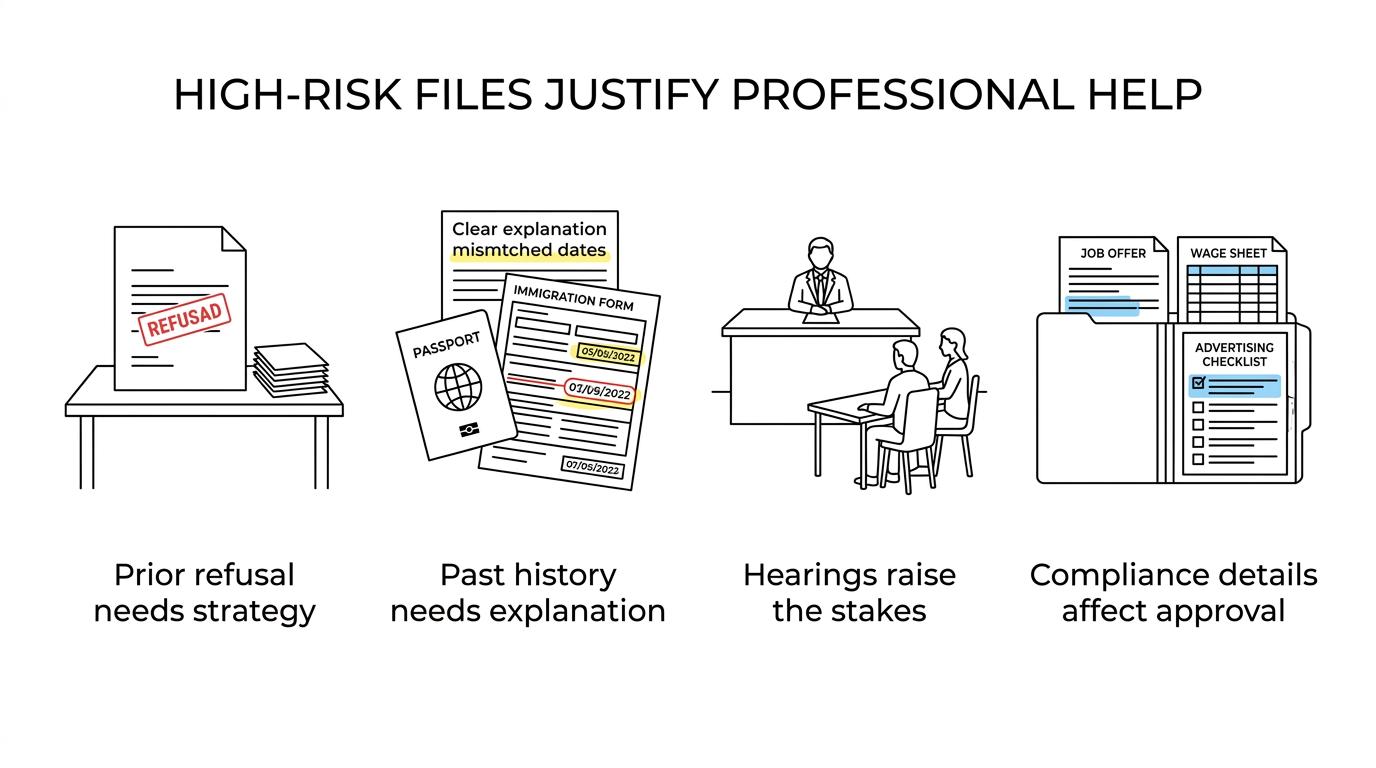
- You have a prior refusal
A refusal often means an officer has already identified a weakness. The next application must usually do more than repeat the first one with extra documents.
- Your immigration history needs explanation
Overstays, withdrawn applications, past misstatements, or inconsistent answers across portals can create credibility problems.
- You are dealing with an IRB appeal or hearing
The Immigration and Refugee Board of Canada itself says an immigration appeal can be complex.
- Your file depends on a discretionary category
Some work permits, including C11-style entrepreneurial files, are not checklist-driven in a simple way.
- An employer file involves LMIA rules
An LMIA is not only an employer form. The strategy may include whether the position qualifies, which stream applies, and whether the wage and advertising compliance can all affect the result.
- You have family evidence that is hard to organize
Sponsorship cases can become complicated by separations, prior marriages, cohabitation gaps, or country-specific documents.
- You are balancing more than one possible pathway
A person may qualify for a study permit, or a permanent residence route, but the sequence matters.
- You need direct government communication handled properly
Once fairness letters, procedural questions, or urgent portal messages appear, response quality matters.
- A refusal would seriously affect your job, studies, or family unity
High-stakes cases justify more careful planning even when the legal issue looks small on paper.
The pattern behind all nine signs is the same: complexity is not only about volume of paperwork. It is about consequence, discretion, and the need to explain facts clearly.
How can you verify that an RCIC consultant is authorized in Canada?
You can verify an RCIC by checking the public register and confirming good standing before you sign anything. The important entities are the CICC public register and the representative’s licence status.
Use a simple three-step check:
- Search the consultant on the public register of the College of Immigration and Citizenship Consultants.
- Confirm they are a member in good standing and that their name matches the retainer documents.
- If your matter may go before the IRB, verify they hold the proper RCIC-IRB authority for that kind of representation.
This is one of the easiest safeguards in the process, yet many clients skip it because a referral feels reassuring. A referral is useful, but regulator status is what counts.
Another practical point: if a representative is vague about their licence, unwilling to provide a written retainer, or asks that government fees be paid to them without a clear reason, slow the process down and ask questions.
Should you use an RCIC consultant or apply on your own?
You should apply on your own only when the file is simple, the rules are clear, and you can manage evidence and deadlines confidently. For complex files, an RCIC consultant usually improves structure and reduces avoidable errors.
Self-filing can make sense for straightforward renewals, clean visitor records, or simple status applications where the eligibility test is obvious and documents are standard. In those cases, paying for full representation may not be necessary.
McBean Immigration has publicly said it tells clients when a case is straightforward enough to file themselves, which is a useful benchmark for how this decision should be approached. Honest screening is often a sign of good professional judgment.
The trade-off is simple. DIY saves fees, but you absorb the risk of choosing the wrong stream, answering a portal question poorly, or missing context that an officer expects to see. If the file contains ambiguity, the savings can disappear quickly after one refusal.
Should you hire an RCIC consultant or a lawyer for an immigration matter?
Choose based on the nature of the matter, not on assumptions about titles. RCICs and lawyers are both authorized in many immigration contexts, but some cases call more clearly for one path than the other.
For standard applications, work permits, study permits, permanent residence strategy, sponsorships, and many refusal matters, an RCIC can be fully appropriate. For some court-related matters or issues outside the consultant’s authorized scope, a lawyer may be the better fit.
The critical distinction is not prestige. It is scope. If the matter involves the IRB, make sure the consultant has the proper licence to represent there. The IRB states that, since July 1, 2023, immigration consultants who are members of the CICC need a specific type of licence to represent clients before the Board.
A frequent misconception is that every serious file requires a lawyer. Another misconception is the opposite, that any immigration matter can be handled by any consultant. The right question is whether the representative is authorized for this file.
When do IRB hearings or appeals raise the stakes?
IRB matters raise the stakes when credibility, admissibility, or removal consequences are on the table. The key entities are the Immigration and Refugee Board of Canada and the RCIC-IRB licence category.
The IRB says an immigration appeal can be complex, and that wording is worth taking seriously. A hearing is different from a portal submission. You may need to present evidence, answer questions in real time, and deal with procedural rules that are less forgiving than a routine application process.
A person may represent themselves at an IRB appeal hearing, and the IRB makes that clear. Still, self-representation is not always wise. If your case turns on testimony, prior records, or technical timelines, the value of experienced counsel tends to rise sharply.
One useful rule is this: if the case could change your ability to remain in Canada or reunite with family, treat it as a representation decision, not a paperwork decision.
How do complex work permit files become harder than they look?
Work permit files become complex when eligibility depends on business structure, recruitment compliance, or officer discretion. LMIA cases, CUSMA categories, and C11-type files are common examples.
An LMIA is a good illustration. It is not only an employer form. The strategy may include whether the position qualifies, which stream applies, and whether the wage and advertising record meet the rules. McBean Immigration has noted that advertising errors are one of the most common refusal reasons in LMIA files, which matches how detail-sensitive these cases can be.
A second misconception is that every foreign hire needs an LMIA. Some hires may fit LMIA-exempt pathways, including Intra-Company Transfers or CUSMA professional categories. If that alternative exists, the faster or cheaper path may not be the one an employer first assumes.
"McBean Immigration offers a 60-minute full consultation for $250 CAD and credits that amount toward professional fees if retained within 30 days."
Discretionary categories add another layer. McBean Immigration has also described C11 work permits as discretionary files without a published checklist that guarantees approval. If your case involves cross-border capital flows, a joint venture, or prior immigration history that needs explanation, professional representation becomes easier to justify.
How should you prepare for a meeting with an RCIC consultant?
Prepare by bringing your timeline, documents, and problem areas in a form that can be checked quickly. IRCC records, passports, and refusal letters are the most useful starting points.
A short preparation routine will usually save time and improve the advice you receive:
- Status history: visas, permits, refusals, withdrawals, overstays
- Identity records: passports, civil status documents, name changes
- Government correspondence: IRCC letters, portal screenshots, deadlines
- Program evidence: job offers, education records, proof of funds, relationship proof
- Risk flags: criminal charges, medical issues, prior inconsistencies, unauthorized work
Pro tip: do not sanitize the story. Clients sometimes hide weak facts in the first meeting because they hope the issue will not matter. It usually does matter, and earlier is better than later.
If your case spans several countries, add a date-by-date travel and status chronology. Officers often read for consistency across time, and a clean timeline helps spot contradictions before submission.
What should a proper retainer and filing process look like?
A proper retainer process should be written, specific, and easy to audit. The main markers are scope of work, representative identity, fee terms, and who pays government fees.
A reliable three-step process looks like this:
- Assessment and scope
You receive a clear view of the available pathways, the main risks, and what the representative will and will not do.
- Written retainer and document plan
The agreement identifies the licensed representative, the service scope, fee structure, and the evidence needed for filing.
- Submission control and post-filing communication
You know who reviews the final package, how messages from IRCC will be handled, and what happens if the department asks for more information.
This is where process discipline matters. A permanent residence portal submission, an employer compliance step, or a sponsorship package can fail because of missing context, not just missing documents.
Another practical check is whether communication is direct and accountable. When a file is complex, knowing exactly who is responsible for strategy, drafting, and government correspondence is not a luxury. It is part of quality control.
Stay Updated
Subscribe to our newsletter for the latest immigration news and tips.